Strength of Acids and Bases (VCE SSCE Chemistry): Revision Notes
📚Revision Notes
Strength of Acids and Bases
Introduction to acid and base strength
When equal concentrations of different acids react with zinc metal, they don't all react at the same rate. Some acids produce bubbles more vigorously than others, indicating that they are stronger acids. This observation tells us that acids vary in their strength, even when they are present in the same concentration.
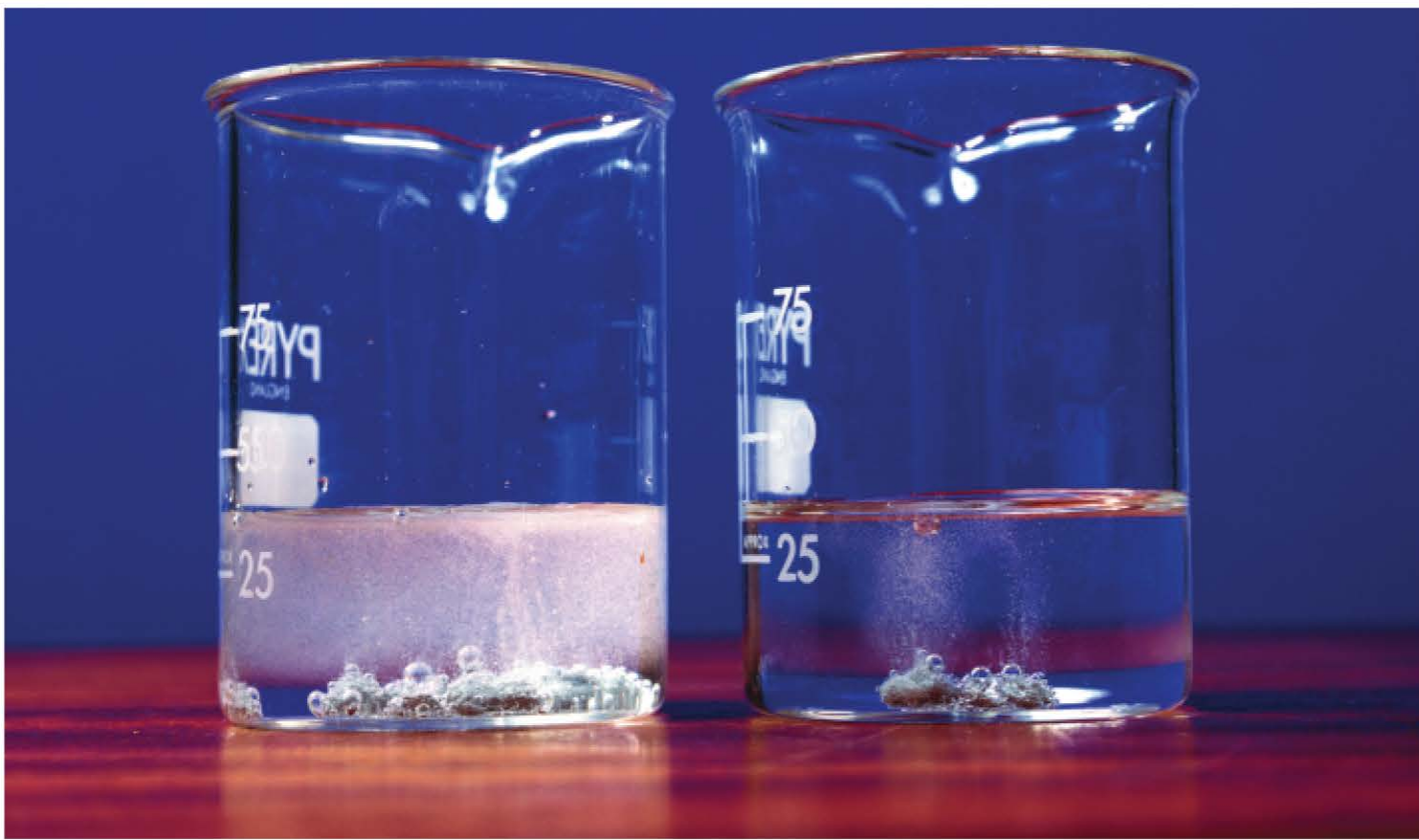
According to the Brønsted-Lowry theory, acids are substances that donate protons (H⁺ ions) and bases are substances that accept protons. The strength of an acid refers to how easily it can donate a proton to a base. Similarly, the strength of a base measures how readily it can accept a proton from an acid. When we compare acids and bases in aqueous solutions, we look at how they interact with water molecules to determine their strength.
Different acids with the same concentration don't all produce the same concentration of hydronium ions (H₃O⁺) in solution. This means they will have different pH values, even though the original acid concentration was identical. The key difference lies in the extent to which each acid donates its protons.
Note
The strength of an acid is determined by how readily it can donate a proton. Strong acids donate protons easily, while weak acids donate protons less readily. This is fundamentally different from concentration, which tells us how much acid is dissolved in solution.
Strong acids
Strong acids are excellent proton donors. When a strong acid dissolves in water, it breaks apart completely into ions - virtually no intact acid molecules remain in the solution. This complete breakdown is called complete ionisation.
The three most common strong acids you need to know are:
- Hydrochloric acid (HCl)
- Nitric acid (HNO₃)
- Sulfuric acid (H₂SO₄)
When hydrogen chloride gas bubbles through water, every HCl molecule donates its proton to a water molecule. Similarly, pure nitric acid and sulfuric acid are covalent molecular compounds that completely ionise when they dissolve in water. We can represent these ionisation reactions with chemical equations:
Important
Notice that each equation uses a single arrow (→) pointing to the right. This single arrow indicates that the reaction goes to completion - all the acid molecules convert into ions. In a solution of a strong acid, you will find hydronium ions and the conjugate base ions, but essentially no unreacted acid molecules.
Weak acids
Unlike strong acids, weak acids only partially break apart in water. Most of the acid molecules remain intact, and only a small proportion donate their protons to water molecules at any given time. This incomplete breakdown is called partial ionisation.
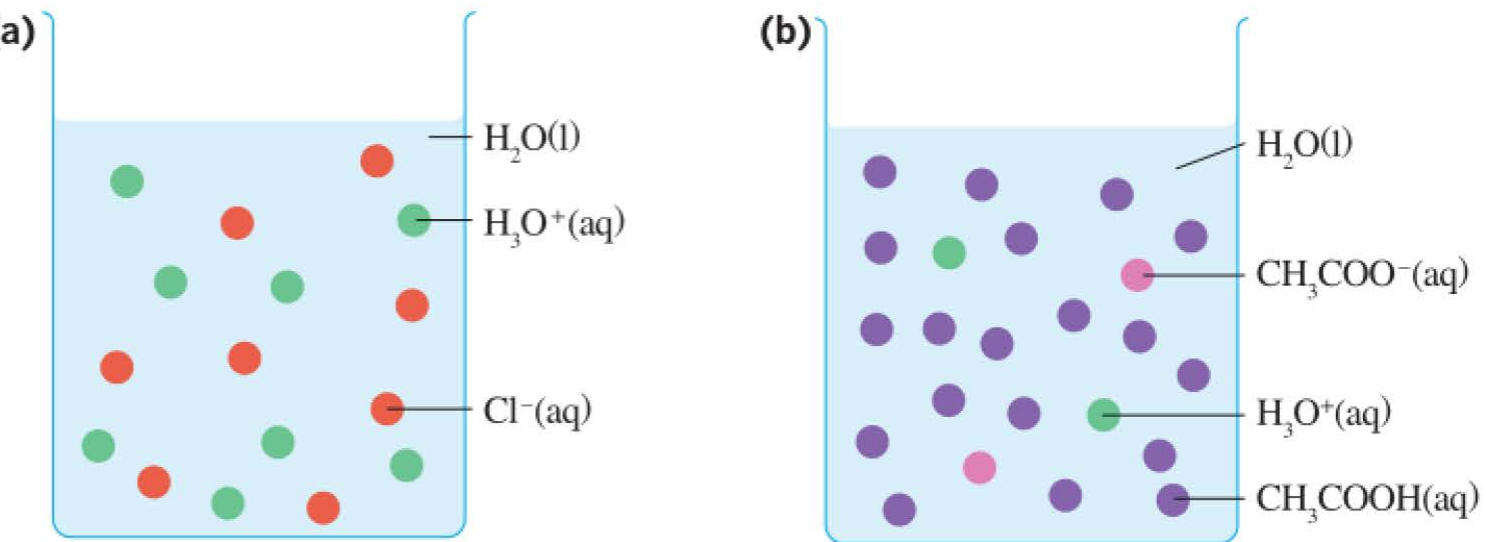
Ethanoic acid (CH₃COOH), found in vinegar, is a common weak acid. When pure ethanoic acid dissolves in water, it exists mostly as CH₃COOH molecules. Even in a concentrated 1.0 M solution of ethanoic acid, only about 0.004 M of the acid molecules have donated their protons to form hydronium ions (H₃O⁺) and ethanoate ions (CH₃COO⁻). This means that at 25°C, less than 1% of the ethanoic acid molecules are ionised.
The partial ionisation of ethanoic acid is represented using a double arrow (⇌):
The double arrow indicates that this is a reversible reaction. As ethanoic acid molecules donate protons to form products, some of the products are simultaneously recombining to reform ethanoic acid molecules. An equilibrium is established where both forward and reverse reactions occur, but most molecules remain in the un-ionised form.
Note
This diagram clearly shows the difference at the molecular level. In a strong acid solution (hydrochloric acid), virtually all acid molecules have broken apart into ions. In a weak acid solution (ethanoic acid) of the same concentration, most molecules remain intact with only a few ions present.
Strong bases
Strong bases are excellent proton acceptors - they readily take protons from acids. The oxide ion (O²⁻) is an example of a strong base. When sodium oxide (Na₂O), an ionic compound, dissolves in water, it releases oxide ions that react completely with water molecules:
In this reaction, the oxide ion acts as a base by accepting a proton from water (which acts as an acid). The reaction goes to completion, as shown by the single arrow. Each oxide ion produces two hydroxide ions.
Note
Sodium hydroxide (NaOH) is often called a strong base. More precisely, according to the Brønsted-Lowry definition, sodium hydroxide is a soluble ionic compound that provides the strong base OH⁻ when it dissolves in water. The hydroxide ion itself is the species that can accept protons from acids.
Weak bases
Weak bases only partially accept protons from acids. At any given moment, only a small proportion of weak base molecules have accepted a proton.
Ammonia (NH₃) is the most common weak base. When ammonia dissolves in water, it accepts a proton from water molecules to form ammonium ions and hydroxide ions:
In this reaction, ammonia acts as a base (it gains a proton), while water acts as an acid (it donates a proton). The double arrow shows that this is a reversible reaction. Even in a concentrated 1.0 M ammonia solution, most of the dissolved substance exists as NH₃ molecules. Only a small number of ammonium ions (NH₄⁺) and hydroxide ions (OH⁻) are present because the ionisation is incomplete.
Relative strength of conjugate acid-base pairs
Conjugate acids and bases are pairs of species that differ by exactly one proton (H⁺). When an acid donates a proton, what remains is its conjugate base. When a base accepts a proton, it becomes its conjugate acid.
There is an important inverse relationship between the strength of an acid and its conjugate base: the stronger an acid is, the weaker its conjugate base will be. Similarly, the stronger a base is, the weaker its conjugate acid will be.
Example
Worked Example: Identifying Conjugate Acid-Base Pairs
In the reaction:
HF is the conjugate acid of F⁻, and OH⁻ is the conjugate base of H₂O. These form two conjugate acid-base pairs: HF/F⁻ and H₂O/OH⁻.
We can arrange common acids and bases in order of their relative strength. At the top of the list are the strongest acids, which have the weakest conjugate bases. At the bottom are the weakest acids (strongest bases). Here are some key points from the strength comparison:
- Strong acids (HCl, H₂SO₄, HNO₃) have very weak conjugate bases
- H₃O⁺ is in the middle - moderately strong acid
- Weak acids (HF, CH₃COOH, H₂CO₃) have moderately strong conjugate bases
- Very weak acids (H₂O, OH⁻) have very strong conjugate bases
This relationship helps predict the direction of acid-base reactions. Reactions tend to proceed from the stronger acid and base towards the weaker acid and base.
Strength versus concentration
It is crucial not to confuse the terms 'strong' and 'weak' with 'concentrated' and 'dilute'. These terms describe different properties of acid and base solutions.
Important
Strength refers to the extent of ionisation:
- Strong acids ionise completely in water
- Weak acids ionise only partially in water
- Strength is an inherent property of the acid or base molecule
Concentration refers to the amount of substance dissolved in a given volume of solution:
- Concentrated solutions contain a large amount of solute
- Dilute solutions contain a small amount of solute
- Concentration can be changed by adding more solute or more solvent
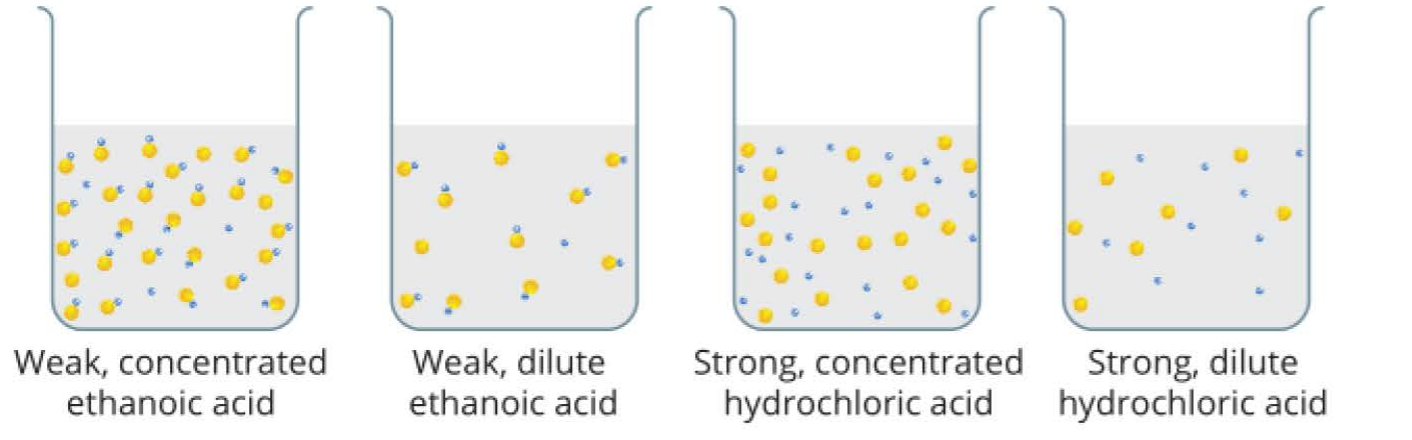
This means you can have four different types of acid solutions:
- Strong and concentrated: A large amount of strong acid dissolved in water, all of it ionised (e.g., concentrated HCl)
- Strong and dilute: A small amount of strong acid dissolved in water, all of it ionised (e.g., dilute HCl)
- Weak and concentrated: A large amount of weak acid dissolved in water, only partially ionised (e.g., concentrated CH₃COOH)
- Weak and dilute: A small amount of weak acid dissolved in water, only partially ionised (e.g., dilute CH₃COOH)
Example
Worked Example: Understanding Strength vs Concentration
Hydrochloric acid is always a strong acid because it completely ionises in water, regardless of concentration. You can make a concentrated solution by bubbling a large amount of hydrogen chloride gas into water, or a dilute solution by using only a small amount. In both cases, every HCl molecule will donate its proton - it remains a strong acid.
Similarly, ethanoic acid can be prepared as either a concentrated or dilute solution, but it will always be a weak acid because only a small proportion of its molecules donate protons, regardless of how much ethanoic acid is dissolved.
To give solutions a precise, quantitative description, we state their concentration in units such as mol L⁻¹ or g L⁻¹, rather than using qualitative terms like 'strong', 'weak', 'concentrated', or 'dilute'.
Super acids
Fluorosulfuric acid (HSO₃F) is one of the strongest acids known to chemistry. Its molecular structure is similar to sulfuric acid, but with one key difference - a highly electronegative fluorine atom replaces one of the hydroxyl groups.
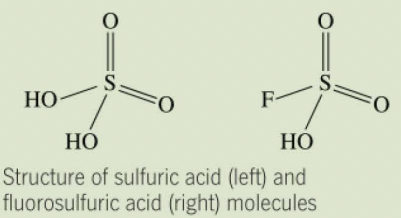
This fluorine atom makes the oxygen-hydrogen bond much more polarised than in sulfuric acid. As a result, the acidic proton transfers to a base far more easily, making fluorosulfuric acid an extremely strong acid.
Note
Super acids are defined as acids that are stronger than pure sulfuric acid. Fluorosulfuric acid and triflic acid (CF₃SO₃H) are approximately 1000 times stronger than sulfuric acid. Carborane acid (H(CHB₁₁Cl₁₁)) is about one million times stronger. The strongest known super acid, fluoroantimonic acid (H₂SbF₆), is an incredible times stronger than 100% sulfuric acid. These acids are so reactive that they must be handled with extreme care under very controlled conditions.
Common strong and weak acids and bases
Here is a summary table of common acids and bases you should know:
| Strong acids | Weak acids | Strong bases | Weak bases |
|---|---|---|---|
| Hydrochloric acid, HCl | Ethanoic acid, CH₃COOH | Sodium hydroxide, NaOH | Ammonia, NH₃ |
| Sulfuric acid, H₂SO₄ | Carbonic acid, H₂CO₃ | Potassium hydroxide, KOH | |
| Nitric acid, HNO₃ | Phosphoric acid, H₃PO₄ | Calcium hydroxide, Ca(OH)₂ |
Summary
Key Points to Remember:
-
Strong acids ionise completely in water and readily donate protons. The three common strong acids are HCl, HNO₃, and H₂SO₄. In equations, complete ionisation is shown with a single arrow (→).
-
Weak acids ionise only partially in water. Only a small proportion of molecules donate protons at any time. Ethanoic acid (CH₃COOH) is a common weak acid. Partial ionisation is shown with a double arrow (⇌).
-
Strong bases readily accept protons from acids. The oxide ion (O²⁻) and hydroxide ion (OH⁻) are strong bases. Weak bases only partially accept protons, with ammonia (NH₃) being the most common example.
-
The stronger an acid, the weaker its conjugate base, and vice versa. This inverse relationship helps predict the direction of acid-base reactions.
-
Don't confuse strength with concentration. Strength refers to how completely a substance ionises, while concentration refers to how much is dissolved. You can have strong dilute acids, strong concentrated acids, weak dilute acids, and weak concentrated acids.