Calculating Heat Energy Released (VCE SSCE Chemistry): Revision Notes
📚Revision Notes
Calculating Heat Energy Released
Understanding the energy released by different fuels helps us compare their suitability for specific purposes. For example, aircraft fuel differs from car or bus fuel because they have different energy requirements and operating conditions.
When fuels undergo combustion, they release heat energy. This energy release is described in thermochemical equations using the enthalpy change () value, which is based on the stoichiometric ratios in the equation. By measuring how much the temperature of water increases when heated by a burning fuel, we can experimentally determine the heat energy released.
Specific heat capacity of water
What is specific heat capacity?
Specific heat capacity tells us how much energy is required to increase the temperature of a substance. It measures the amount of energy (in joules) needed to raise the temperature of a specific quantity of that substance (usually gram) by .
Symbol:
Units: joules per gram per degree Celsius () or joules per gram per kelvin ()
Note
An increase of is the same as an increase of , so both units are interchangeable for temperature changes.
Specific heat capacities of common liquids
Different substances have different specific heat capacities. Here are values for some common liquids:
| Substance | Specific heat capacity () |
|---|---|
| Water | |
| Glycerine | |
| Ethanol | |
| Hexane | |
| Olive oil | |
| Paraffin oil |
Water has a relatively high specific heat capacity compared to other common substances. This means water requires more energy to increase its temperature by compared to most other liquids.
Why does water have a high specific heat capacity?
The specific heat capacity of a substance depends on the types of bonds holding the molecules, ions, or atoms together. Water has a specific heat capacity of 4.18 J g⁻¹ °C⁻¹, which means joules of heat energy are needed to increase the temperature of gram of water by .
Important
This relatively high value is due to the hydrogen bonds between water molecules. These bonds must absorb significant energy before the temperature increases. The higher the specific heat capacity, the more effectively a material can store heat energy.
Comparing water and glycerine
When substances are heated, their temperature rises at different rates depending on their specific heat capacity. The graph below shows how water and glycerine respond differently when the same amount of heat energy is supplied:
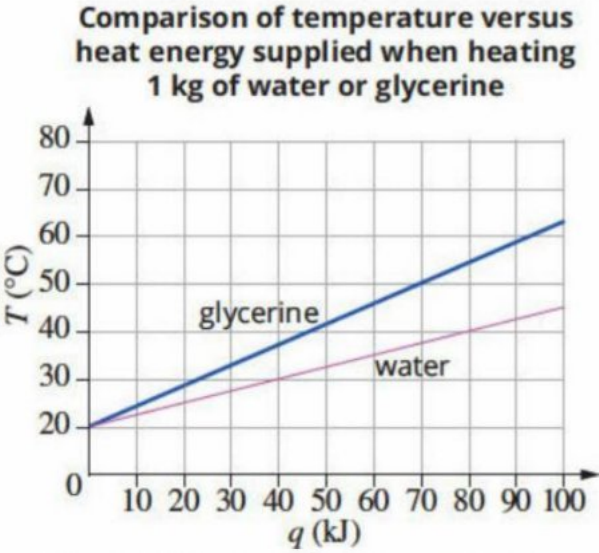
The graph demonstrates that:
- gram of water increases by when supplied with of heat energy
- gram of glycerine increases by when supplied with of heat energy
- When equal amounts of heat energy are supplied, glycerine's temperature rises more rapidly than water's temperature
Real-world application: Hot beach, cool bay
The different heat capacities of water and sand are evident at the beach on a hot summer's day. Sand that is not in contact with water can heat very quickly to the point where it can burn your feet. In contrast, the water, even in rock pools, remains cool and refreshing.

Note
The specific heat capacity of water is , while that of sand is . This means water can absorb nearly 10 times as much energy as sand for the same temperature increase. Each gram of water absorbs before it increases by , while each gram of sand absorbs only before it increases by .
Calculating heat energy transferred to water
The specific heat capacity of water allows us to calculate the heat energy (in joules) needed to increase the temperature of a given mass of water by a specific amount.
The heat energy formula
The heat energy transferred to water can be calculated using measurements of:
- Initial temperature of the water
- Highest (final) temperature of the water
- Mass of water
The relationship used to calculate the energy transferred is:
Using symbols, the equation is written as:
or simply:
Important
where:
- is the amount of heat energy (in )
- is the mass (in )
- is the specific heat capacity of water ()
- is the temperature change (in or )
The temperature change is calculated as:
Converting volume to mass for water
Remember that the density of water is 1.0 g mL⁻¹, so of water has a mass of .
Note
Sometimes the density of water is quoted as ; however, this value (to significant figures) is only accurate at . For most calculations, using is appropriate.
Example
Worked Example: Calculating energy to heat water
Question: Calculate the heat energy, in , needed to increase the temperature of of water by .
Solution:
Step 1: Convert volume to mass
- of water has a mass of (using density )
Step 2: Find the specific heat capacity
- The specific heat capacity of water is
Step 3: Calculate heat energy using
Step 4: Convert to kilojoules
- To convert from to , multiply by
Experimental determination of heat of combustion
When an exothermic chemical reaction, such as the combustion of a pure substance, is carried out underneath a container of water, some of the heat released by the combustion reaction is transferred to the water. By measuring the temperature change of the water, we can determine the approximate amount of energy released by the substance.
Apparatus setup
The diagram below shows an experimental arrangement for estimating the heat of combustion of an organic liquid, such as ethanol:
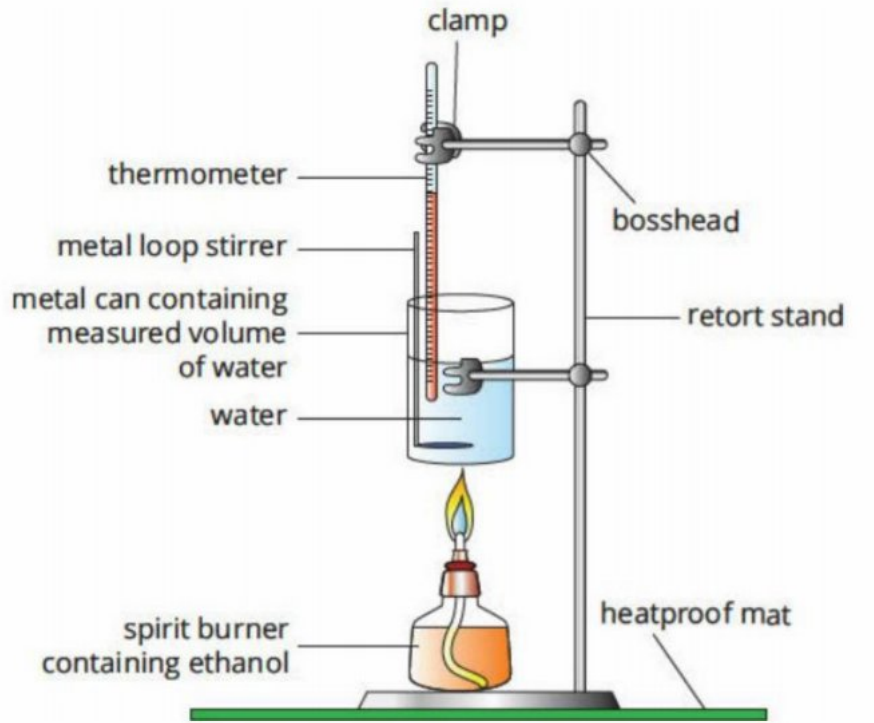
This experimental method is suitable for many organic liquids, including:
- Alcohols (e.g., methanol, ethanol)
- Some alkanes
- Some alkenes
Because these liquids release significant energy when burnt, some of them can be used as fuels.
Experimental procedure
The flowchart below summarises the steps followed in this experiment:

Note
The procedure involves:
- Measuring a volume of water (e.g., ) and placing it in the metal can
- Measuring the initial temperature of the water
- Measuring the mass of the spirit burner and fuel
- Lighting the burner and heating the water while stirring continuously
- After some time, extinguishing the burner and recording the highest temperature reached by the water
- Measuring the mass of the burner and remaining fuel
- Calculating the mass of fuel consumed
Key measurements
Three key pieces of information collected from this procedure are:
- Mass of water
- Change in temperature of the water ()
- Mass of organic liquid fuel consumed (from which the amount in moles can be calculated)
Calculating heat of combustion
The heat of combustion of a fuel is the heat energy released when a specified amount of the substance burns completely. It is reported as a positive value. In contrast, the enthalpy of combustion () reflects the exothermic nature with a negative sign and appears in thermochemical equations.
The heat of combustion can be calculated using:
where:
- is the energy absorbed by the water (calculated using )
- is the amount of fuel (in moles) that has been burnt
To find the amount in moles:
where is the mass of fuel burnt and is the molar mass.
Important limitation
Important
This calculation assumes that all the energy is transferred from the burning fuel to the water. In reality, substantial heat losses occur, so the calculated values for heat of combustion will be less than the actual values. This experiment can only provide an estimate of the heat of combustion or can be used to compare the energy released by different substances.
Example
Worked Example: Heat of combustion of methanol
Question: of methanol () undergoes complete combustion in a spirit burner. The heat energy released is used to heat of water. The temperature of the water rose from to . Calculate the heat of combustion of methanol in and write the thermochemical equation for the reaction.
Solution:
Step 1: Calculate the temperature change
Step 2: Calculate energy absorbed by water using
Step 3: Convert to kilojoules
Step 4: Calculate amount of methanol in moles
Molar mass of
Step 5: Calculate heat of combustion
Step 6: Write thermochemical equation
The thermochemical equation includes a negative sign for because combustion is exothermic:
;
or (multiplied by 2 to avoid fractions):
;
Estimating energy content of fuels and foods
Energy content vs heat of combustion
Foods and some fuels (like diesel) are mixtures rather than pure substances. For these materials, the heat energy released during combustion of a known mass is best described as energy content, measured in (kilojoules per gram).
Note
This differs from heat of combustion (measured in ), which applies to pure substances where we can calculate the number of moles.
Calculating energy content
If we measure the mass of fuel or food burned to produce energy, the energy content can be calculated as:
The mass of fuel or food burned is determined by:
It is not necessary to burn all the fuel or food sample, as long as the mass that is burned is determined.
Limitation of this method
Important
Heat loss is a consistent problem in this type of experiment, so the calculated values for energy content are estimates only and will be less than the actual values.
Example
Worked Example: Energy content of food
Question: A sample of cheese biscuit was burned under a steel can containing of water. After the flame went out, the mass of the cheese biscuit was and the temperature of the water had risen by . Calculate the energy content of the biscuit in .
Solution:
Step 1: Calculate heat energy absorbed by water
Step 2: Convert to kilojoules
Step 3: Calculate mass of food burned
Step 4: Calculate energy content
(to significant figures)
Heat loss in calorimetry experiments
Sources of heat loss
When energy is transferred from burning a sample of fuel or food across an open space, heat is lost to the surroundings (such as the air around the burning fuel). Similarly, if there is no lid on a container of water, heat will be lost from the surface of the water.
When some heat energy from the burning fuel or food is transferred to the surrounding air, the temperature of the water does not increase as much as it would if all the energy was used to heat the water. A lower temperature change () of the water results in a lower calculated energy value ().
Methods to reduce heat loss
There are several ways to reduce heat loss during calorimetry experiments:
- Put a lid on the container holding the water
- Insulate the beaker of water (with flameproof material)
- Place insulation around the burning fuel (although sufficient oxygen must reach the fuel for combustion to be complete)
Impact on experimental results
Important
This loss of heat energy represents a significant systematic error in the calculation of heat of combustion by simple experimental methods. The calculated values will always be lower than the actual values because not all the heat energy reaches the water.
More accurate determinations of energy content require more sophisticated equipment, such as a bomb calorimeter.
Bomb calorimetry
What is a bomb calorimeter?
A bomb calorimeter is specialized equipment used for measuring the energy released by combustion reactions that involve gaseous reactants or products. It provides much more accurate measurements than simple calorimetry methods.
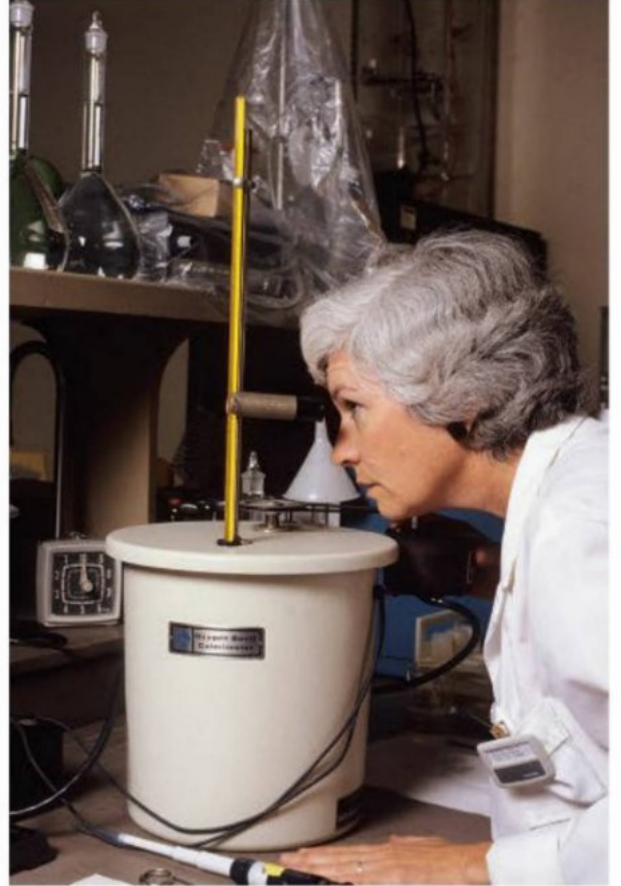
Components and operation
The diagram below shows the main components of a bomb calorimeter:
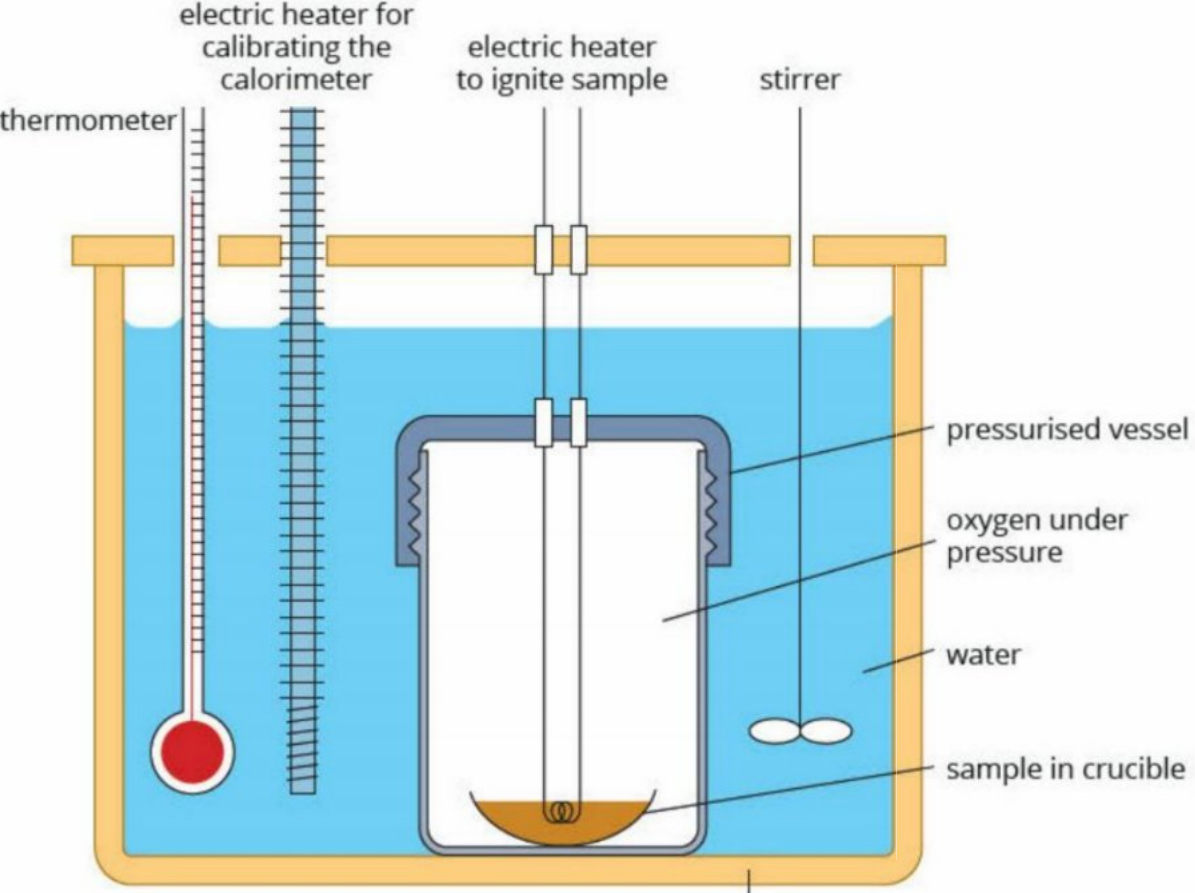
Key features include:
Pressurised vessel: The reaction vessel is designed to withstand the high pressures that may build up during reactions. This is why it's called a "bomb" calorimeter.
Oxygen supply: Sufficient oxygen under pressure is provided to completely combust the fuel, ensuring all available energy is released.
Insulated container: Insulation around the calorimeter prevents heat escaping to the surroundings, making measurements more accurate.
Thermometer: Measures the change in temperature of the water surrounding the reaction vessel.
Stirrer: Ensures the temperature of the water is uniform throughout.
Electric heater: Used both to ignite the sample and to calibrate the calorimeter.
Sample in crucible: The fuel or food sample is placed in a small crucible at the bottom of the pressurised vessel.
Advantages over simple calorimetry
Note
The bomb calorimeter provides more accurate results because:
- Heat loss is minimized through insulation
- Complete combustion is ensured through excess oxygen
- Pressure containment allows for reactions involving gases
- Temperature measurements are more precise
Case study: The energy of candlelight
Candles have been used for over years of human civilization. Candle wax is made of large molecules composed of carbon and hydrogen atoms, such as eicosane (), and has an approximate energy content of .
Candles were used by the ancient Romans as early as BCE. However, Romans primarily used oil lamps burning olive oil as their main light source. The burning of whale oil was common practice in lamps from the 16th to the 19th centuries. Whale oil is a mixture containing large quantities of oleic acid, which has an energy content of .
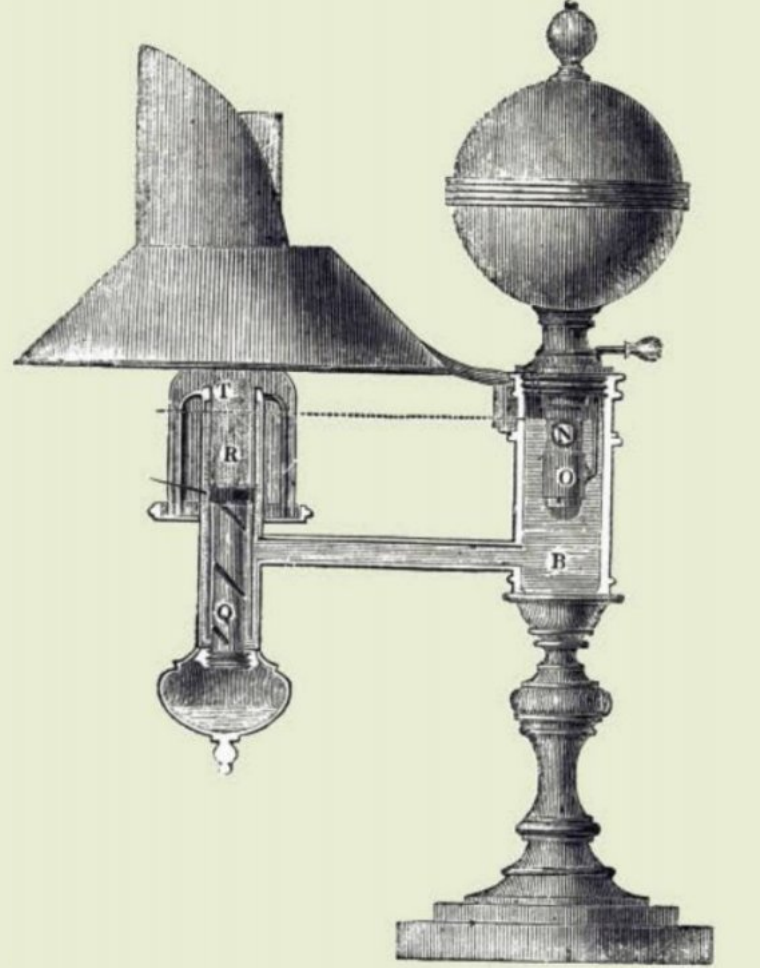
One such lamp was developed in by François-Pierre-Amédée (also known as Ami) Argand, a student of Antoine Lavoisier. These lamps were considered to have about the same light output as to candles.
Note
In fact, a "candela" or candle power is a measure of the intensity of light, now known as lumens. A modern Watt LED globe has an output of over lumens. Argand further developed his lamp into a burner that was used until the development of the Bunsen burner.
Cheaper alternatives to whale oil were available at that time, but they did not burn as cleanly, producing large quantities of carbon soot. Demand for whale oil vastly increased in the 17th century, and whale hunting reached its peak in the 1820s. After that time, there was a rapid decline in use of whale oil as cheaper and cleaner-smelling combustible materials became more common.
Camphine (also known as "oil of turpentine"), a mixture of turpentine and alcohol, was used until kerosene rapidly dominated the market from the 1860s, making the use of camphine insignificant by 1866.
Now, in the 21st century, whale hunting is banned across most of the globe, and we use electricity to power our lights. Just as humans have moved away from the use of whale oil for lighting, we have the potential to explore more renewable fuel sources for our energy needs, so that we can preserve our environment.
Summary
Key Points to Remember:
-
Specific heat capacity () measures the energy needed to raise the temperature of of a substance by . Water has a high value () due to hydrogen bonding.
-
Heat energy transferred to water is calculated using , where is heat energy (J), is mass (g), is specific heat capacity, and is temperature change (°C).
-
Heat of combustion (in ) is calculated by dividing the energy released by the number of moles of fuel burned:
-
Energy content (in ) is used for mixtures like foods and some fuels, calculated as:
-
Heat loss is a major source of error in simple calorimetry experiments, causing calculated values to be lower than actual values. This can be reduced by using lids, insulation, and more sophisticated equipment like bomb calorimeters.