Energy from Fuels and Food (VCE SSCE Chemistry): Revision Notes
📚Revision Notes
Energy from Fuels and Food
Introduction
Both fuels and food serve as energy sources, but in different ways. Fuels like petrol and coal provide energy for heating, lighting, and transport. Food provides the energy needed for the millions of chemical reactions happening in your body right now. Just as some fuels release more energy per gram than others, different foods also provide varying amounts of energy. When we transform the chemical energy in fuels and food into forms we can use, a significant amount of energy is lost in the process.
Note
Understanding how efficiently energy transforms from one form to another is crucial for both improving technology and making informed decisions about the food we eat.
Energy transformations
What is an energy transformation?
An energy transformation occurs when energy converts from one form to a different form. Think of a cyclist eating an energy bar before a race. The chemical energy stored in the food transforms inside the cyclist's body into mechanical and kinetic energy that propels them forward. Similarly, when you burn logs on a campfire to boil water, the chemical energy in the wood transforms into thermal energy that heats the kettle.

The first law of thermodynamics
Important
The first law of thermodynamics states that energy cannot be created or destroyed - it can only change form. This means the total amount of energy before and after a transformation remains the same.
However, here's the catch: not all of the original energy converts into the specific form we want. In the campfire example, very little of the logs' chemical energy actually ends up heating the water. Most of it escapes into the surrounding air.
Energy converters and efficiency
Many devices we use daily are essentially energy converters. They transform energy from various sources (renewable or non-renewable) into the form we need, such as electrical or mechanical energy. Scientists and engineers are keenly interested in how efficient these conversions are.
Energy transformation efficiency measures the percentage of energy from a source that successfully converts to useful energy. The maximum theoretical efficiency is 100%, but in real-world situations, this is never achieved because some energy always escapes as waste heat or other unwanted forms.
The formula for calculating energy transformation efficiency is:
Example: the petrol engine
Let's examine how a petrol engine works to understand energy efficiency better. The main component of petrol is octane, which combusts according to this equation:
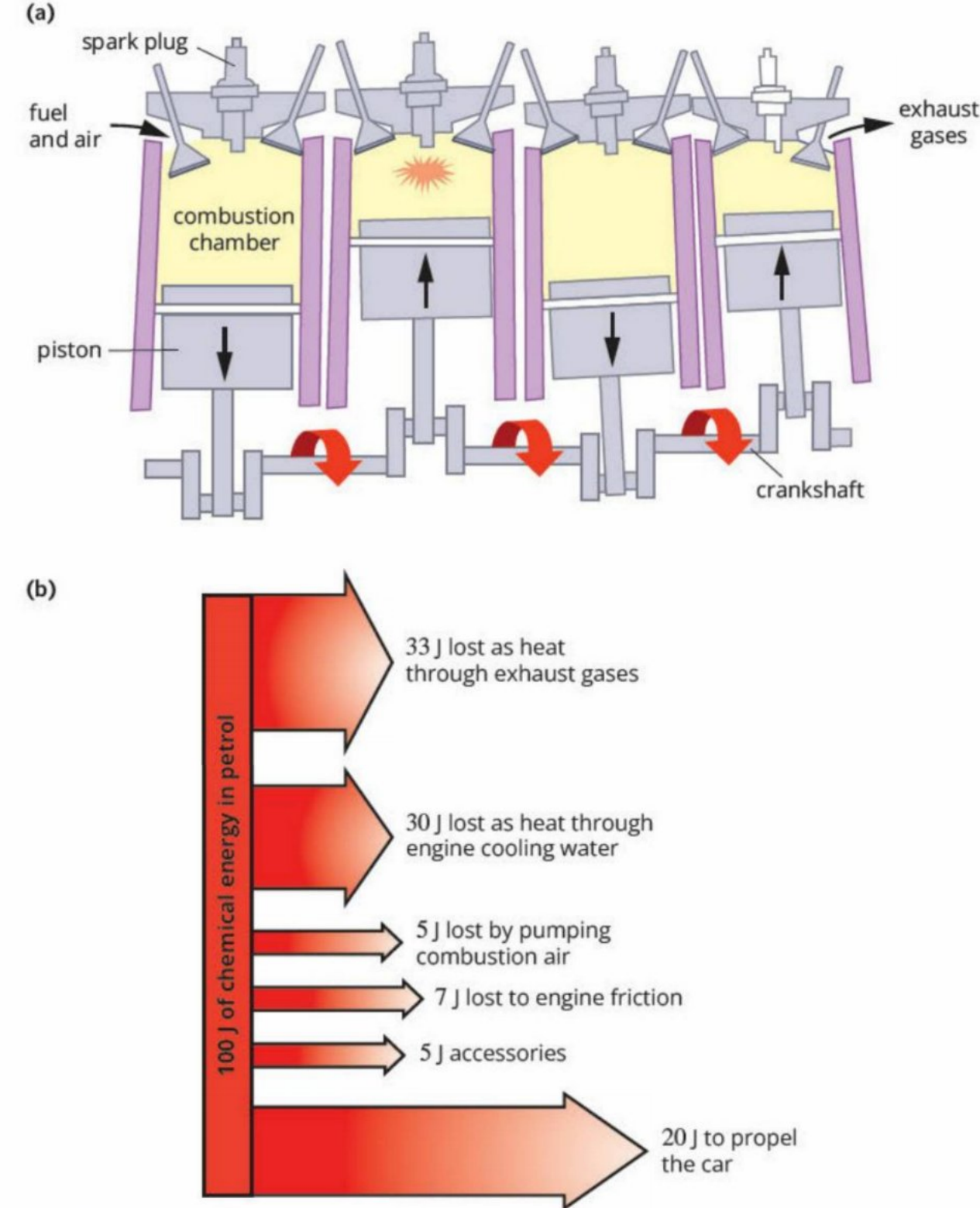
When octane burns in the engine's combustion chamber, the heat released expands the gases inside. These expanding gases push the pistons along the cylinders, which causes the crankshaft to rotate and ultimately drives the wheels of the car.
The diagram shows how energy is distributed in a petrol engine. Out of every 100 J of chemical energy from the petrol:
- Only 20 J actually propels the car (useful energy)
- 33 J is lost as heat through exhaust gases
- 30 J is lost as heat through the engine cooling water
- 7 J is lost to engine friction
- 5 J is used by accessories
- 5 J is lost by pumping combustion air
This means the petrol engine is only 20% efficient - quite wasteful!
Comparing energy converters
Different devices have very different energy transformation efficiencies:
| Device | Energy transformation | Typical efficiency |
|---|---|---|
| Coal-fired power station | Chemical to electrical | 30% |
| Lead-acid battery | Chemical to electrical | 70% |
| Electric motor (in electric car) | Electrical to mechanical | 77% |
| Petrol engine | Chemical to mechanical | 20% |
Note
Notice that the electric motor in an electric car is nearly four times more efficient than a petrol engine. This is one reason why electric vehicles are considered more energy-efficient for transport.
For comparison, the human body has an energy transformation efficiency of around 25% when converting food energy into mechanical work.
Calculating energy transformation efficiency
You'll encounter three main types of efficiency calculations in chemistry. Let's work through each type with detailed examples.
Type 1: Calculating efficiency from experimental results
When conducting combustion experiments in the laboratory, results rarely match the theoretical values from data books. This happens because heat escapes to the surroundings. You can calculate the energy efficiency of such an experiment by comparing your experimental result (useful energy) with the theoretical value (energy input).
Example
Worked Example: Calculating Experimental Efficiency
A pair of students measured the enthalpy of combustion of methanol by burning it in a spirit burner under a can of water. They measured the temperature change of the water and the mass change of the burner. From their results, they calculated the enthalpy of combustion of methanol to be .
The theoretical enthalpy of combustion of methanol from the data book is . Calculate the percentage efficiency of the energy transformation.
Solution:
The 'useful energy' is the energy that heated the water, which enabled calculation of the experimental value:
The energy input is the theoretical enthalpy of combustion:
Using the formula:
The experiment was 51.7% efficient at transferring chemical energy to thermal energy in the water.
Type 2: Calculating useful energy when efficiency is known
Sometimes you know the percentage efficiency of a process and need to determine how much useful energy is produced. This requires rearranging the efficiency formula.
Example
Worked Example: Finding Useful Energy from Known Efficiency
A propane burner heats a saucepan containing water with 35.0% efficiency. Calculate the energy transferred to the water from the complete combustion of of propane. The heat of combustion is .
Solution:
Step 1: Calculate the total energy released (energy input) by the combustion:
Step 2: Rearrange the efficiency formula to find useful energy:
Therefore, 249 kJ of energy is transferred to the water.
Type 3: Calculating heat of combustion using efficiency
In this most complex type, you know the efficiency and the useful energy, and you need to work backwards to find the theoretical heat of combustion of the fuel.
Example
Worked Example: Finding Heat of Combustion from Efficiency Data
A student burnt of propan-2-ol in a spirit burner to heat of water. The process was 65.0% efficient. During the experiment, the water temperature increased by . Calculate the heat of combustion of propan-2-ol. (The specific heat capacity of water is .)
Solution:
Step 1: Calculate the useful energy (energy that heated the water) using :
Step 2: Convert the percentage efficiency to a decimal:
Step 3: Rearrange the efficiency formula to find energy input:
Step 4: Use the relationship between energy released and enthalpy to find :
The heat of combustion of propan-2-ol is 2.01 × 10³ kJ mol⁻¹.
Energy available to the body
Nutrients and biomolecules
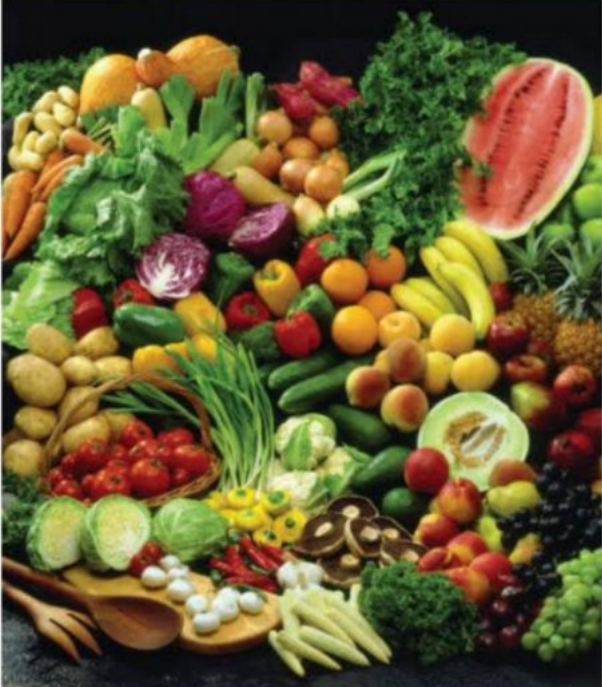
Food supplies your body with nutrients - large biomolecules that keep you alive. These nutrients provide energy, regulate growth, and maintain and repair body tissue. The three main nutrient classes are:
- Carbohydrates
- Proteins
- Fats
Each provides a different amount of energy per gram when digested.
Why isn't all food energy available?
When you burn food in a calorimeter, it releases a certain amount of energy. However, when your body digests that same food, less energy becomes available for your cells to use.
Note
Why Food Energy Is Not Fully Available
This happens for three main reasons:
- Incomplete absorption - Not all nutrients are fully absorbed by the body after digestion
- Incomplete oxidation - Some nutrients, such as proteins and insoluble fibre, are not completely broken down
- Heat loss - Some energy released during digestion is lost as waste heat rather than being used by cells
Variation within nutrient classes
Even within a single nutrient class like carbohydrates, the amount of energy your body can extract varies significantly.
Important
Starch vs Cellulose: A Critical Difference
Starch is readily digested by humans. Enzymes in your digestive system break down starch into glucose, which provides energy for your cells. Most of the chemical energy in starch becomes available to your body.
Cellulose, on the other hand, cannot be digested by humans because we lack the enzyme cellulase needed to break it down. Cellulose in foods like vegetables is called dietary fibre. While it provides no energy, it plays an important role in digestive health by providing "bulk" that helps food move through your digestive system. A high-fibre diet helps prevent constipation and reduces the risk of bowel cancer.
Energy content of macronutrients
The energy available to your body from each macronutrient type is:
- Carbohydrates: 16 kJ g⁻¹
- Fats: 37 kJ g⁻¹
- Proteins: 17 kJ g⁻¹
Notice that fats provide more than twice as much energy per gram as carbohydrates or proteins. This is why high-fat foods are energy-dense.
Calculating energy value of foods
Understanding food composition
Different foods contain vastly different proportions of carbohydrates, fats, and proteins. This is why some foods are much more energy-dense than others.
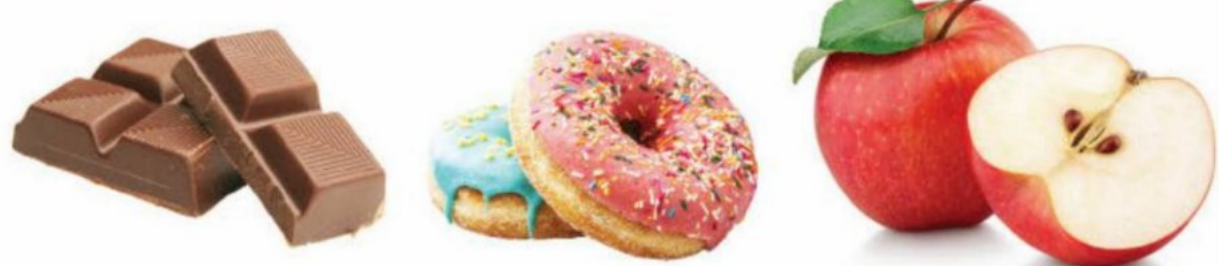
Compare these three foods:
| Food | Carbohydrate (g/100g) | Fat (g/100g) | Protein (g/100g) | Energy content (kJ/100g) |
|---|---|---|---|---|
| Milk chocolate | 52 | 30 | 8 | 2130 |
| Doughnut | 51 | 23 | 5 | 1803 |
| Apple | 14 | 0.2 | 0.3 | 247 |
Note
Notice how milk chocolate and doughnuts have high percentages of both carbohydrates and fats, resulting in very high energy content. Apples, being mostly water with some carbohydrates and minimal fat, have much lower energy content.
How to calculate energy value
When you know the percentage composition of a food, you can calculate its energy value using the energy content of each nutrient type.
Here are some examples of food compositions and their energy values:
| Food | Carbohydrate (%) | Protein (%) | Fats and oils (%) | Energy value (kJ g⁻¹) |
|---|---|---|---|---|
| White rice | 79 | 7 | negligible | 15.2 |
| Wholemeal bread | 39 | 11 | 4 | 9.7 |
| Avocados | 6 | 2 | 17 | 7.2 |
| Roasted peanuts | 18 | 26 | 50 | 24.3 |
| Pizza (with cheese) | 31 | 11 | 8 | 10.0 |
| Apples | 53 | 4 | 8 | 11.7 |
| Almonds | 19 | 19 | 54 | 25.4 |
Example
Worked Example: Calculating Energy Value from Food Composition
The labelling on unsalted cashews indicates they contain 29.0% carbohydrates, 18.0% protein, and 46.0% fat. The remaining 7.0% is water, which does not supply energy. Calculate the energy value in kJ g⁻¹.
Solution:
Step 1: Identify the available energy for each nutrient type:
- Carbohydrates:
- Proteins:
- Fats:
Step 2: Assuming 100 g of cashews, multiply each nutrient percentage by its energy value:
- Carbohydrates:
- Proteins:
- Fats:
Step 3: Sum the energies and divide by 100 to find energy per gram:
The energy value of cashews is 24.7 kJ g⁻¹.
Remember!
Summary
Key Points to Remember:
-
Energy transformations occur when energy changes from one form to another, such as chemical energy to kinetic energy. While total energy is conserved (first law of thermodynamics), not all of it becomes useful.
-
Energy transformation efficiency is calculated using: Real-world devices never reach 100% efficiency.
-
Petrol engines are only 20% efficient - out of every 100 J of chemical energy in petrol, only 20 J propels the car. The rest is lost as heat through exhaust, cooling systems, and friction.
-
The three macronutrients provide different amounts of energy:
- Carbohydrates: 16 kJ g⁻¹
- Proteins: 17 kJ g⁻¹
- Fats: 37 kJ g⁻¹ Fats provide more than twice the energy of the other two.
-
Not all food energy is available to your body because of incomplete absorption, incomplete oxidation, and heat loss during digestion. Cellulose (dietary fibre) cannot be digested by humans but is important for digestive health.