Solution Calorimetry (VCE SSCE Chemistry): Revision Notes
📚Revision Notes
Solution Calorimetry
What is calorimetry?
Calorimetry is an experimental technique used to measure the amount of heat energy released or absorbed during a chemical reaction or physical process. This method is essential in chemistry for understanding energy changes in reactions, such as when fuels combust or when substances dissolve in water.
Energy changes that occur during chemical and physical processes are measured using a device called a calorimeter. Calorimeters are specially designed to minimise energy losses to the surroundings, which allows for more accurate measurements. In a well-designed calorimeter, almost all of the heat energy released or absorbed is transferred directly to or from a measured volume of water.
Note
The key principle of calorimetry is that by measuring temperature changes in a known volume of water, we can calculate the amount of heat energy involved in a reaction or physical process. The better the insulation, the more accurate the measurements will be.
Types of calorimeters
There are two main types of calorimeters, each designed for measuring energy changes in different types of reactions:
- Solution calorimeters: Used when the reaction takes place in a solution. These are the focus of this note.
- Bomb calorimeters: Used when the reaction takes place in a sealed vessel, typically for combustion reactions.
Using a solution calorimeter
A solution calorimeter is used to measure energy changes for reactions that occur in solution. The simplest type of solution calorimeter can be made from a polystyrene foam coffee cup with a lid. The polystyrene foam provides insulation, which prevents heat from being transferred to or from the surroundings.
Components of a simple solution calorimeter
- Polystyrene cups (nested for better insulation)
- Polystyrene cover or lid
- Thermometer to measure temperature changes
- Stirrer to ensure uniform temperature throughout the solution
- Reactants in solution
The reaction is carried out in the calorimeter with an accurately known volume of water. Both the initial and final temperatures are measured and recorded, along with the amounts of reactants used.
Understanding temperature changes
The direction of temperature change tells us about the type of reaction occurring:
Important
Temperature increases: The reaction is exothermic. The reaction has released heat energy, which has been absorbed by the water in the calorimeter, causing the temperature to rise.
Temperature decreases: The reaction is endothermic. The reaction has absorbed energy from the water in the calorimeter, causing the temperature to fall.
Laboratory solution calorimeter
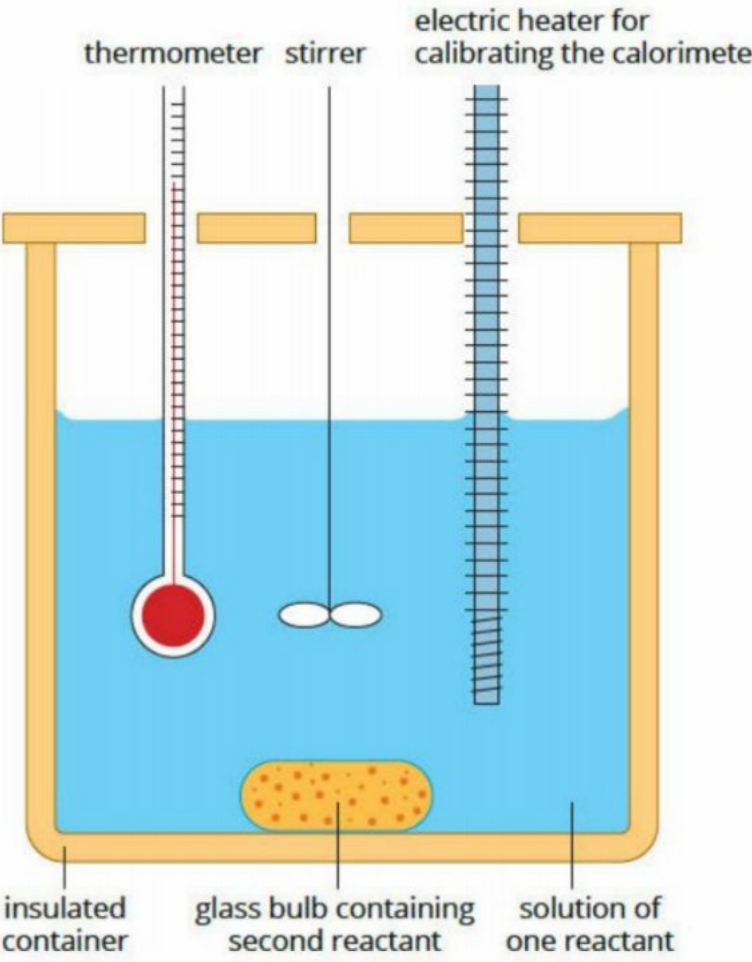
A more sophisticated laboratory solution calorimeter has additional features to improve accuracy. It typically includes:
- An insulated container
- A thermometer for precise temperature measurement
- A stirrer to ensure the temperature is uniform throughout
- An electric heater for calibration purposes
- A glass bulb containing one reactant, which can be broken to start the reaction
Note
The stirrer is particularly important because if the temperature of the solution is not uniform, the measured temperature change will not be accurate. Continuous stirring ensures that hot or cold spots don't form in the solution, giving a true average temperature reading.
Applications and limitations
Solution calorimetry can be used to determine the enthalpy changes for:
- Acid-base reactions (neutralisation reactions)
- Reactions of metals with acids
- Dissolution of solids in water
Important
Limitations:
- The polystyrene container in simple calorimeters absorbs some heat, making the measured temperature change lower than it should be
- Solution calorimeters cannot be used to measure the energy content of fuels or foods because these involve combustion reactions that require oxygen gas
- Heat loss to the surroundings can affect accuracy
Calibration of calorimeters
What is calibration?
When a reaction occurs in a calorimeter, the heat change causes a rise or fall in temperature. Although we could use the formula to calculate the relationship between heat energy and temperature change, heat losses can lead to inaccurate results.
For more accurate measurements, we need to determine how much energy is required to change the temperature of the water by for that particular calorimeter. This value is called the calibration factor (CF) of the calorimeter.
The calibration factor has units of (joules per degree Celsius). Once we know the calibration factor of a calorimeter, we say it is calibrated.
Note
Both solution and bomb calorimeters are usually calibrated before use to ensure accurate results. The calibration accounts for heat absorbed by the calorimeter itself and any minor heat losses, giving us a more realistic measure of the energy changes occurring in our reactions.
Electrical calibration method
A calorimeter can be calibrated by using an electric heater to release a known quantity of thermal energy and measuring the resulting temperature rise.
The thermal energy released when an electric current passes through the heater is calculated using:
Where:
- = energy in joules (J)
- = voltage in volts (V)
- = current in amperes (A)
- = time in seconds (s)
Once we measure the temperature change () caused by adding this known amount of energy, we can calculate the calibration factor using:
Where:
- = calibration factor in
- = change in temperature in °C
Temperature-time graphs in calorimetry
Measuring the temperature change during a calorimetry experiment is not always straightforward. If a calorimeter is not perfectly insulated, it may slowly lose heat during and after the heating process. To get a more accurate determination of , we can plot a graph of temperature against time before, during and after the calibration.
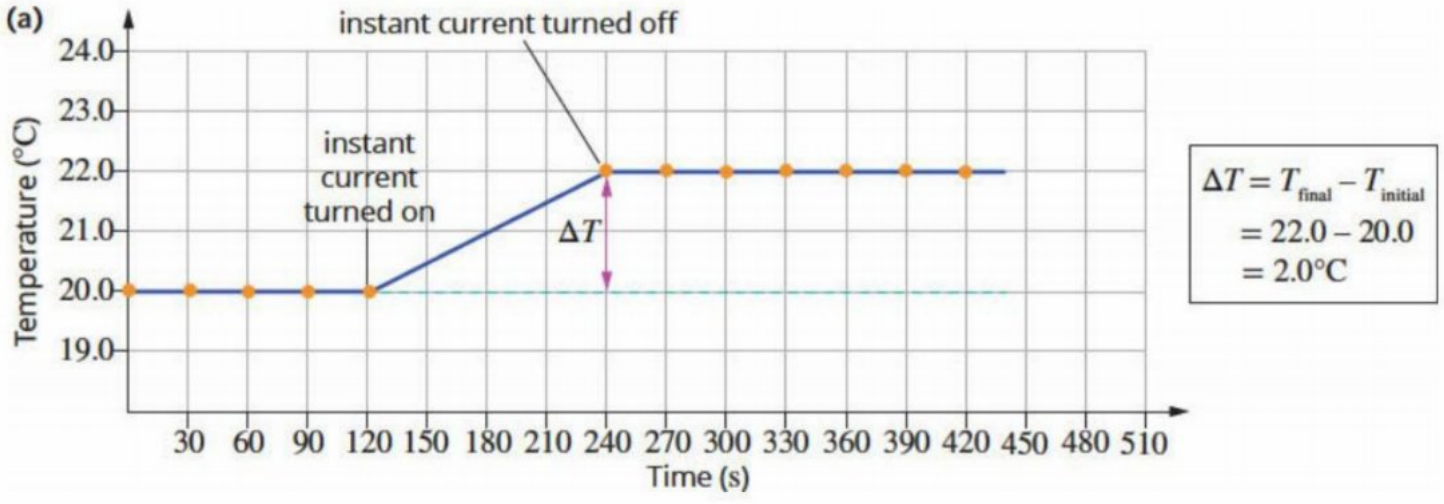
Figure (a) shows results for a calorimeter with perfect insulation and no heat loss. The temperature remains constant until the current is turned on, rises during heating, then remains constant after the current is turned off. The temperature change is simply the difference between the two plateaus: .
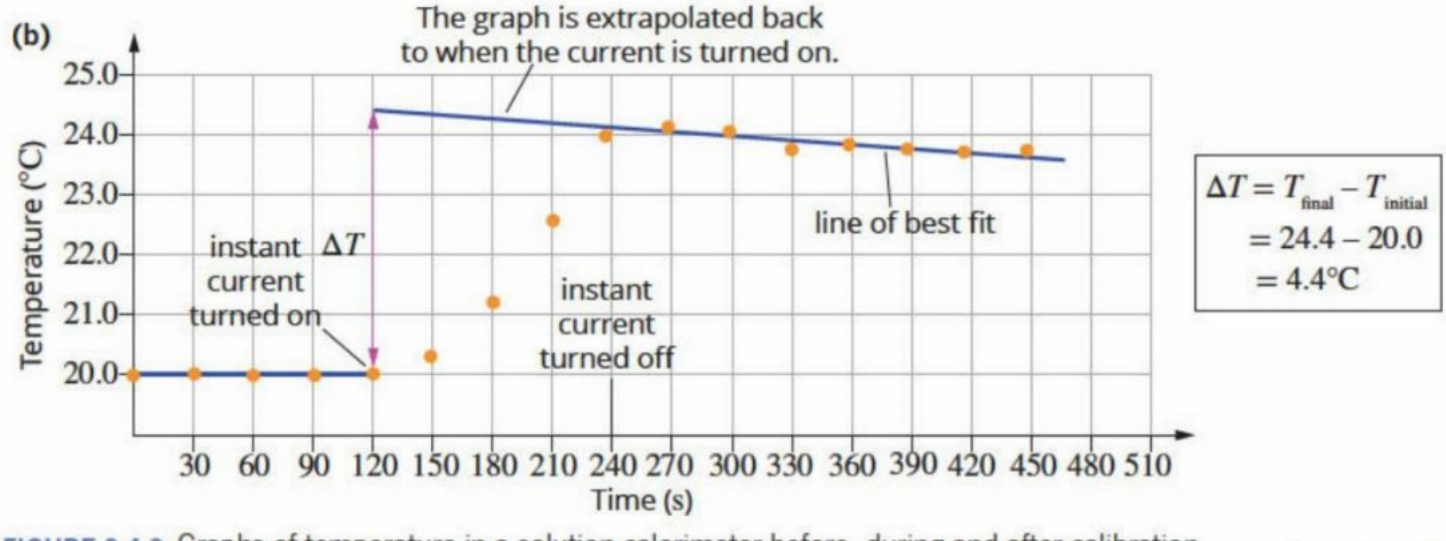
Figure (b) shows more realistic results obtained using school laboratory calorimeters. Heat loss causes a negative slope in the graph after the heater has been turned off. A more accurate estimate of can be found by extrapolating the cooling line back to the time when heating commenced. We then measure the temperature change between this extrapolated value and the initial temperature.
Note
The continuing increase in temperature after the heater is turned off shows a delay in heat transfer through the water. The extrapolation method accounts for this, though it's important to understand that this approach has limitations in terms of accuracy. By extending the cooling line backwards, we can estimate what the temperature would have been at the moment heating stopped, had there been no heat loss.
Example
Worked Example: Electrical Calibration
Question: A solution calorimeter was calibrated by passing through the electric heater for at a potential difference of . The temperature of the water in the calorimeter was initially and rose to during the calibration. Determine the calibration factor of the calorimeter.
Solution:
Step 1: Calculate the thermal energy released by the heater.
Step 2: Calculate the temperature change during calibration.
Step 3: Calculate the calibration factor.
Chemical calibration method
A solution calorimeter can also be calibrated by performing a chemical reaction that releases or absorbs a known quantity of thermal energy, then measuring the resulting temperature change.
A highly soluble salt such as potassium nitrate () is commonly used for calibration. The enthalpy of solution () of potassium nitrate is known to be .
To calibrate using this method:
- Dissolve a known amount (in moles) of potassium nitrate in the calorimeter
- Measure the temperature change ()
- Calculate the calibration factor
The energy released or absorbed during calibration is calculated using:
Where:
- = energy in kJ
- = amount of substance in moles
- = enthalpy of solution in
The calibration factor is then calculated using:
Example
Worked Example: Chemical Calibration
Question: A solution calorimeter was calibrated by completely dissolving of potassium nitrate in of water in a calorimeter. (; ). The temperature of the water in the calorimeter decreased from to during the calibration. Determine the calibration factor of the calorimeter.
Solution:
Step 1: Determine the amount of potassium nitrate that dissolves.
Step 2: Calculate the thermal energy absorbed from the water.
Step 3: Calculate the temperature change during calibration.
Step 4: Calculate the calibration factor.
Using a calibrated calorimeter to determine enthalpy of reaction
Once a solution calorimeter has been calibrated (using either the electrical or chemical method), we can use it to determine the enthalpy change for various reactions. These include acid-base reactions, reactions of metals with acids, and dissolution of solids in water.
Note
Solution calorimeters are not suitable for determining the enthalpy of combustion for fuels or foods, as these require combustion in oxygen gas. For these types of reactions, a bomb calorimeter must be used instead.
Calculating energy change
The calibration factor is used to determine the energy () that is responsible for the temperature change during a reaction:
Where:
- = energy change in joules (J)
- = calibration factor in
- = temperature change when the reaction occurs (not during calibration)
Calculating enthalpy change
The enthalpy change () in is calculated by dividing the energy change (in kJ) by the amount of limiting reactant:
Where:
- = enthalpy change in
- = energy change in kJ
- = amount of limiting reactant in moles
Important
Assigning the correct sign to :
- Temperature increase → exothermic reaction → negative
- Temperature decrease → endothermic reaction → positive
This is a common source of errors in calorimetry calculations. Always check the direction of temperature change before assigning the sign!
Example
Worked Example: Determining Enthalpy of Solution
Question: A solution calorimeter has a calibration factor of . If the temperature decreases by when of glucose () is dissolved in water in the calibrated calorimeter, calculate the enthalpy of solution of glucose.
Solution:
Step 1: Calculate the amount of reactant in moles.
Step 2: Calculate the heat energy released or absorbed.
Step 3: Calculate the energy per mole.
Step 4: State the enthalpy of solution with the correct sign.
Since the temperature decreased, the process is endothermic, so:
(3 significant figures)
Important
Exam Tips
- Always check whether you're calculating CF during calibration or using CF to find for a reaction - these are two different processes that use the calibration factor in different ways
- Remember that for calibration is different from for the actual reaction
- Pay attention to units: convert between J and kJ as needed
- When using temperature-time graphs, use the extrapolation method for more accurate values
- The sign of depends on whether temperature increases (exothermic, negative) or decreases (endothermic, positive)
Summary
Remember!
Key Concepts:
- Calorimetry measures heat energy changes during chemical reactions and physical processes using a device called a calorimeter.
- The calibration factor (CF) represents the energy needed to raise the temperature of the calorimeter contents by . It has units of .
- Electrical calibration uses the formula to provide known energy, while chemical calibration uses a reaction with known .
- For exothermic reactions, temperature increases and is negative. For endothermic reactions, temperature decreases and is positive.
- Use extrapolation on temperature-time graphs to account for heat loss and obtain more accurate values.