Stoichiometry Involving Combustion of Fuels (VCE SSCE Chemistry): Revision Notes
📚Revision Notes
Stoichiometry Involving Combustion of Fuels
What is stoichiometry?
Stoichiometry is the study of mole ratios of substances in chemical reactions. It is based on the law of conservation of mass, which states that atoms are neither created nor destroyed in a chemical reaction. This means the total mass of all products equals the total mass of all reactants.
Stoichiometry is essential for evaluating fuels because it allows us to:
- Calculate how much oxygen is needed for complete combustion
- Determine the amount of atmospheric pollution produced
- Predict the heat energy released per gram of fuel
- Compare different fuels quantitatively
Note
Understanding stoichiometry is crucial not just for theoretical chemistry, but for real-world applications like designing engines, calculating fuel efficiency, and assessing environmental impact. Every time you fill up a car with petrol or use natural gas for heating, stoichiometry is at work behind the scenes!
Understanding mole ratios from balanced equations
When you write a balanced chemical equation, the coefficients (the numbers in front of each chemical formula) tell you the mole ratio between reactants and products.
For example, consider the combustion of methane:
This equation tells us:
- 1 mole of reacts with 2 moles of
- This produces 1 mole of and 2 moles of
The mole ratio between oxygen and methane is 2:1, and between carbon dioxide and methane is 1:1.
Important
The Fundamental Mole Ratio Formula
The coefficients used to balance chemical equations show the mole ratio between the reactants and products involved in the reaction. We can express this as:
This formula is the foundation for all stoichiometric calculations. You use the coefficients from your balanced equation to find the ratio, then apply it to calculate the amount of an unknown substance from a known substance.
Key formulas for stoichiometry calculations
Before solving stoichiometry problems, you need to be familiar with these relationships:
Important
Essential Formulas for Stoichiometry
For converting between mass and moles:
where:
- = amount in moles (mol)
- = mass in grams (g)
- = molar mass in grams per mole (g mol)
This can be rearranged to:
For gases at standard laboratory conditions (SLC):
Standard laboratory conditions means:
- Pressure = 100 kPa
- Temperature = 25°C (298 K)
- Molar volume () = 24.8 L mol
The relationship is:
where:
- = amount in moles (mol)
- = volume in litres (L)
- = molar volume = 24.8 L mol at SLC
This can be rearranged to:
Note
Remember the mnemonic "SLC 24.8" - at Standard Laboratory Conditions, the molar volume is always 24.8 L mol. This makes gas calculations much simpler!
Mass-mass stoichiometry
Mass-mass stoichiometry is used when you know the mass of one substance and need to find the mass of another substance in the reaction. This is one of the most common types of stoichiometry problems you'll encounter when dealing with combustion reactions.
Note
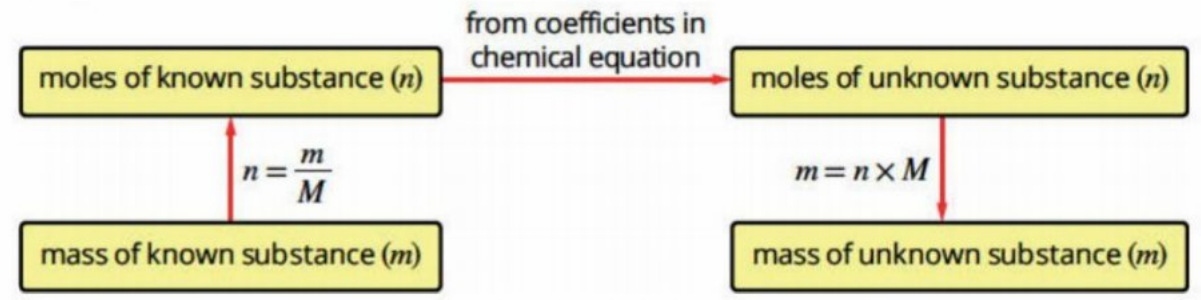
Steps for mass-mass calculations:
Follow this systematic pathway - think of it as "Mass → Moles → Ratio → Moles → Mass":
- Write a balanced chemical equation
- Calculate the number of moles of the known substance using
- Use the mole ratio from the equation to find moles of the unknown substance
- Calculate the mass of the unknown substance using
This process is shown in the following flow chart:
Example
Worked Example: Calculating mass of carbon dioxide produced
Let's calculate the mass of carbon dioxide produced when 540 g of propane burns completely.
Step-by-step solution:
-
Write the balanced equation:
-
Calculate moles of propane:
-
Use mole ratio to find moles of CO₂:
- From equation: 1 mol C₃H₈ produces 3 mol CO₂
-
Calculate mass of CO₂:
Answer: 1.62 kg of carbon dioxide is produced
Note
Key points to remember:
- Always start by writing and balancing the equation
- Convert the given mass to moles first
- Use the coefficient ratio to find moles of the unknown
- Convert moles back to mass using molar mass
- Pay attention to units (convert kg to g where needed)
Mass-volume stoichiometry
Mass-volume stoichiometry is used when the known substance is a mass (usually of fuel) and the unknown substance is a gas volume, or vice versa. This type of calculation is particularly useful when dealing with gaseous combustion products.
The general approach follows these steps:
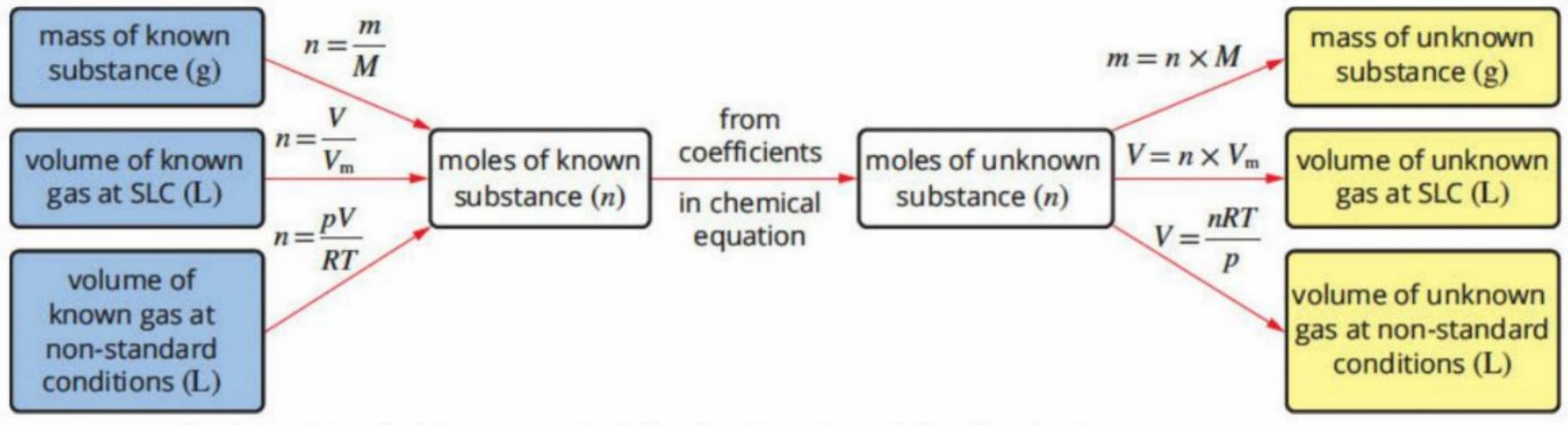
This comprehensive flow chart shows how to convert between mass, volume at SLC, and even volume at non-standard conditions for both known and unknown substances.
Example
Worked Example: Calculating volume of carbon dioxide at SLC
Let's calculate the volume of carbon dioxide produced when 2.00 kg of propane burns completely. The gas volume is measured at SLC.
Step-by-step solution:
-
Write the balanced equation:
-
Convert mass to grams and calculate moles of propane:
- Mass = 2.00 kg = 2000 g
-
Use mole ratio to find moles of CO₂:
- From equation: 1 mol C₃H₈ produces 3 mol CO₂
-
Calculate volume at SLC:
- At SLC,
Answer: 3.38 × 10³ L of carbon dioxide is produced at SLC
Note
Important notes:
- Remember that at SLC, L mol
- Convert masses to grams before calculating moles
- The final volume can be expressed in standard form (scientific notation) for large numbers
- This calculation only works at SLC - different conditions require additional steps
Volume-volume stoichiometry for gases
When all reactants and products in a reaction are gases at the same temperature and pressure, calculations become simpler. This is because mole ratios equal volume ratios when temperature and pressure are constant.
For example, in the combustion of propane:
The mole ratio tells us:
- 1 mole of propane reacts with 5 moles of oxygen
- This also means 1 litre of propane reacts with 5 litres of oxygen (at constant T and P)
Example
Worked Example: Calculating volume of oxygen required
Problem: What volume of oxygen is required for the complete combustion of 150 L of propane gas? Assume constant temperature and pressure.
Solution:
-
Write the balanced equation:
-
Use volume ratio directly:
- From equation: 1 volume C₃H₈ requires 5 volumes O₂
- If V(C₃H₈) = 150 L, then V(O₂) = 150 × 5 = 750 L
Answer: 750 L of oxygen is required
Note
Key advantage: When dealing with gas volumes at constant temperature and pressure, you can skip the mole calculations and directly use the coefficient ratio as a volume ratio. This makes volume-volume stoichiometry the quickest type of calculation!
Stoichiometry and energy released from combustion
The quantity of energy released when a fuel burns is directly proportional to the amount of fuel used. More fuel means more energy released. Understanding this relationship is crucial for evaluating different fuels and their efficiency.
Complete vs incomplete combustion
The type of combustion affects energy release significantly:
Important
Complete combustion occurs when there is plenty of oxygen available:
- Products: carbon dioxide () and water ()
- Releases maximum energy
- Example: with kJ
Incomplete combustion occurs when oxygen supply is limited:
- Products: carbon monoxide (CO) and sometimes carbon (soot), plus water
- Releases less energy than complete combustion
- Example: with kJ
Compare this to complete combustion of ethane:
with kJ
Notice the complete combustion releases significantly more energy (-3120 kJ vs -1989 kJ for the same amount of ethane).
Using thermochemical equations
A thermochemical equation includes the enthalpy change () value. The coefficients indicate the number of moles of each substance that react or are produced to give that specific enthalpy change.
Note
The negative sign in indicates that energy is released (exothermic reaction). All combustion reactions are exothermic, which is why fuels are useful for heating and producing energy!
Example
Worked Example: Calculating energy released from a known mass of fuel
Let's calculate the heat energy released when 10.0 kg of octane undergoes complete combustion.
with kJ
Step-by-step solution:
-
Calculate moles of octane:
- Mass = 10.0 kg = 10000 g
-
Set up proportion relating moles to energy:
- From equation: 2 mol C₈H₁₈ releases 10900 kJ
- For 87.72 mol: kJ
-
Convert to MJ:
- Energy = 478000 kJ = 478 MJ
Answer: 478 MJ of energy is released
Example
Worked Example: Calculating amount of fuel needed for specific energy
Now let's work backwards - finding the volume of fuel needed to produce a certain amount of energy.
What volume of methane at SLC burns completely to provide kJ?
with kJ
Step-by-step solution:
-
Calculate moles of methane needed:
- From equation: 1 mol CH₄ releases 890 kJ
- For 40000 kJ:
-
Convert moles to volume at SLC:
Answer: 1114 L of methane is required
Combustion and greenhouse gas emissions
All carbon-based fuels produce greenhouse gases when they burn. The main greenhouse gases from combustion are:
- Carbon dioxide ()
- Water vapour ()
- Methane () - when it's the fuel itself
Important
A greenhouse gas is a gas that can absorb infrared radiation, trapping heat in the atmosphere. Human activities, particularly the combustion of fossil fuels, are increasing atmospheric greenhouse gas concentrations, leading to an enhanced greenhouse effect and global warming.
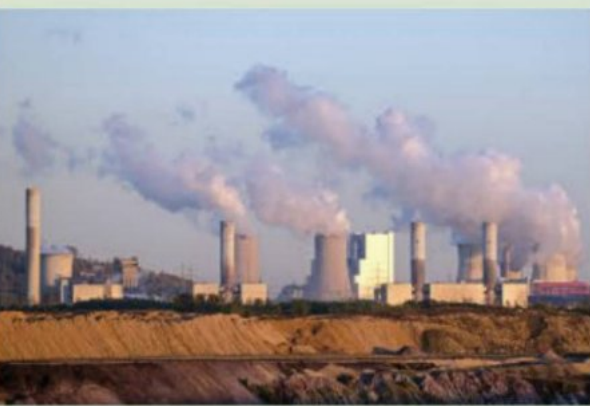
Energy production in Australia
Many Australian power stations produce energy by burning brown or black coal. These combustion reactions produce tonnes of carbon dioxide daily. Stoichiometry helps us predict and compare the carbon dioxide emissions from different fuels, which is important for:
- Climate change negotiations
- Emission reduction targets
- Choosing cleaner energy alternatives
Note
Recent years have seen Australian states accelerating plans to close coal-fired power stations due to economic pressures from cleaner, lower-cost alternatives like solar, wind, and batteries. This has the added environmental benefit of reducing greenhouse gas emissions.
Calculating greenhouse gas volumes from combustion
For most fuels, the carbon dioxide and water produced represent the net increase in greenhouse gases added to the atmosphere.
However, methane is itself a greenhouse gas - and a potent one. Methane has significantly greater warming power than carbon dioxide, especially in the first 20 years after release. When we burn methane (from natural gas or biogas), we're converting it to carbon dioxide and water. While this increases , it removes the more potent methane.
Example
Worked Example: Net greenhouse gas volume from methane combustion
What is the volume of greenhouse gases released when 1.5 L of methane undergoes complete combustion? Assume all reactants and products are gaseous, and temperature and pressure remain constant.
Step-by-step solution:
-
Write the balanced equation:
-
Use volume ratios:
- Starting with 1.5 L CH₄
- 1 volume CH₄ produces 1 volume CO₂ and 2 volumes H₂O(g)
- V(CO₂) = 1.5 L
- V(H₂O) = 3.0 L
-
Calculate total greenhouse gases:
- Total = 1.5 + 3.0 = 4.5 L
Answer: 4.5 L of greenhouse gases are produced
Key insight: All methane is consumed (0 L remaining), and we produce CO₂ and H₂O. The net effect removes potent methane and adds less potent greenhouse gases.
Real-world application: bioethanol as a fuel
Bioethanol is ethanol () produced from plant sources through fermentation of glucose. It can be used as an alternative to petrol (octane) or blended with petrol for vehicles.
Why bioethanol reduces net greenhouse emissions
When bioethanol burns, it produces carbon dioxide and water, just like petrol. However, bioethanol has a crucial advantage:
As the crops (sugarcane, corn, wheat) grow, they remove from the atmosphere through photosynthesis:
Note
This removal of during crop growth offsets the released when the bioethanol burns. The net greenhouse gas emissions are much lower than burning fossil fuels, where the carbon was locked underground for millions of years.
Bioethanol production in Australia
Australia's largest bioethanol producer is in Nowra, NSW. The facility:
- Produces nearly 70% of Australia's approximately 440 million litres annual ethanol capacity
- Uses starch from wheat processing
- Produces bioethanol through fermentation
The enthalpy of combustion of ethanol is -1360 kJ mol at SLC, which means significant energy can be obtained from this renewable fuel source.
Summary
Key Points to Remember:
- Stoichiometry is the study of mole ratios in chemical reactions, based on the law of conservation of mass
- The coefficients in a balanced equation give you the mole ratios between all reactants and products
- For mass-mass stoichiometry: mass → moles → use ratio → moles → mass
- For mass-volume stoichiometry: convert one quantity to moles, use the ratio, then convert to the required unit (use L mol at SLC)
- For volume-volume stoichiometry with gases: mole ratios equal volume ratios when temperature and pressure are constant
- Complete combustion (plenty of oxygen) produces and and releases maximum energy; incomplete combustion (limited oxygen) produces CO and releases less energy
- Use thermochemical equations to calculate energy released from combustion - the value relates to the number of moles shown by the coefficients
- Major greenhouse gases from combustion are , , and (when it's the fuel) - stoichiometry helps calculate their environmental impact
- Bioethanol reduces net greenhouse emissions because crops absorb during growth, offsetting emissions from combustion