Dominance Matrices (VCE SSCE General Mathematics): Revision Notes
📚Revision Notes
Dominance Matrices
Introduction to dominance
In many situations involving groups of people, we need to identify which individuals are most dominant or influential. This is particularly important in sporting competitions, where we want to determine the best player or team. We can analyse dominance problems using the same matrix methods that we use for communication networks.
Understanding dominance relationships helps us make fair decisions about rankings, especially when simple win-loss records don't tell the whole story. Matrix methods give us a systematic way to account for both direct and indirect dominance.
Note
Why Matrix Methods?
Matrix methods provide a mathematical framework that allows us to systematically analyze complex relationships in groups. Rather than relying on subjective judgments, we can use precise calculations to determine dominance hierarchies and resolve ties fairly.
One-step dominance
One-step dominance occurs when one person directly beats or influences another person. For example, if Anna defeats Birgit in a tennis match, Anna has a one-step dominance over Birgit.
To understand how dominance matrices work, let's look at an example involving five tennis players.
Tennis tournament example
Five players—Anna, Birgit, Cas, Di and Emma—competed in a round-robin tournament of tennis. In a round-robin tournament, each participant plays against every other participant exactly once. The goal was to determine who was the dominant (best) player.
The tournament results were:
- Anna defeated Cas and Di
- Birgit defeated Anna, Cas and Emma
- Cas defeated Di
- Di defeated Birgit
- Emma defeated Anna, Cas and Di
We can represent these results using a network diagram, where arrows show who defeated whom:
Note
In this diagram, an arrow from one player to another indicates a victory. For example, the arrow from B to A shows that Birgit defeated Anna when they played. This visual representation helps us quickly see all the win-loss relationships at a glance.
Constructing the one-step dominance matrix
We record one-step dominances in a matrix called . Each entry in the matrix shows whether one player has a direct win over another.
Here's how the one-step dominance matrix works:
- Rows represent the players doing the defeating
- Columns represent the players being defeated
- An entry of 1 means the row player defeated the column player
- An entry of 0 means there was no direct win
- The diagonal is always 0 (a player cannot defeat themselves)
For our tennis tournament:
| A | B | C | D | E | Dominance | |
|---|---|---|---|---|---|---|
| A | 0 | 0 | 1 | 1 | 0 | 2 |
| B | 1 | 0 | 1 | 0 | 1 | 3 |
| C | 0 | 0 | 0 | 1 | 0 | 1 |
| D | 0 | 1 | 0 | 0 | 0 | 1 |
| E | 1 | 0 | 1 | 1 | 0 | 3 |
The dominance score for each player is calculated by adding up all the entries in that player's row. This tells us how many direct wins they achieved.
Looking at our matrix:
- Anna's dominance score is 2 (she defeated Cas and Di)
- Birgit's dominance score is 3 (she defeated Anna, Cas and Emma)
- Cas's dominance score is 1 (she defeated Di only)
- Di's dominance score is 1 (she defeated Birgit only)
- Emma's dominance score is 3 (she defeated Anna, Cas and Di)
Important
The Tie Problem
Based on one-step dominances alone, Birgit and Emma are tied as the best players, each with 3 wins. We need a way to break this tie and determine the true champion. This is where two-step dominance becomes crucial.
Two-step dominance
To resolve ties and get a more complete picture of dominance, we consider two-step dominances. A two-step dominance occurs when a player beats another player who has themselves beaten someone else. This shows indirect strength.
For example, Birgit has a two-step dominance over Di because:
- Birgit defeated Cas (one step)
- Cas defeated Di (second step)
- Therefore, Birgit has an indirect dominance over Di through Cas
Note
Understanding Indirect Dominance
Two-step dominance reveals the quality of a player's victories. Beating someone who has beaten strong opponents is more impressive than beating weak opponents. This concept helps us differentiate between players with similar win-loss records.
Calculating the two-step dominance matrix
We find two-step dominances by squaring the one-step dominance matrix. When we calculate (which means ), each entry tells us how many two-step dominances exist between players.
For our tennis tournament, the two-step dominance matrix is:
| A | B | C | D | E | Dominance | |
|---|---|---|---|---|---|---|
| A | 0 | 1 | 0 | 1 | 0 | 2 |
| B | 1 | 0 | 2 | 3 | 0 | 6 |
| C | 0 | 1 | 0 | 0 | 0 | 1 |
| D | 1 | 0 | 1 | 0 | 1 | 3 |
| E | 0 | 1 | 1 | 2 | 0 | 4 |
Let's look at Birgit's row (row B) to understand what these numbers mean:
- The 1 in column A represents one two-step dominance: Birgit defeated Emma, who defeated Anna
- The 2 in column C represents two two-step dominances: Birgit defeated Emma who defeated Cas, AND Birgit defeated Anna who defeated Cas
- The 3 in column D represents three two-step dominances: Birgit defeated Emma who defeated Di, Birgit defeated Anna who defeated Di, AND Birgit defeated Cas who defeated Di
- The 0 in column E tells us there are no two-step dominances for Birgit over Emma, even though Birgit had a one-step dominance over Emma
The dominance score from two-step dominances is again found by summing each row. Birgit now has a two-step dominance score of 6, which is higher than Emma's score of 4.
Total dominance scores
To get the complete picture of dominance, we combine both one-step and two-step information by adding the two matrices together:
This gives us the total dominance matrix:
| A | B | C | D | E | Total | |
|---|---|---|---|---|---|---|
| A | 0 | 1 | 1 | 2 | 0 | 4 |
| B | 2 | 0 | 3 | 3 | 1 | 9 |
| C | 0 | 1 | 0 | 1 | 0 | 2 |
| D | 1 | 1 | 1 | 0 | 1 | 4 |
| E | 1 | 1 | 2 | 3 | 0 | 7 |
The total dominance score for each player is the sum of their row entries in matrix . This score accounts for both direct wins and indirect dominance.
Based on total dominance scores, we can now rank the players:
- Birgit is the top-ranked player with a total dominance score of 9
- Emma is second with a total score of 7
- Anna and Di are equal third with a total score of 4 each
- Cas is bottom-ranked with a total score of 2
Important
Resolving the Tie
Even though Birgit and Emma both won 3 matches directly, Birgit's additional indirect dominances make her the clear winner when we account for two-step dominances. This demonstrates the power of considering both direct and indirect relationships in determining true dominance.
Worked example: determining dominance
Example
Worked Example: Committee Influence Analysis
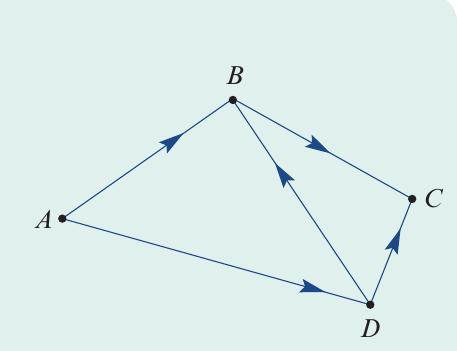
Four people, A, B, C and D, have been asked to form a committee to decide on the location of a new toxic waste dump. From previous experience, it is known that:
- A influences the decisions of B and D
- B influences the decisions of C
- C influences the decisions of no one
- D influences the decisions of C and B
The network diagram shows these influence relationships:
a) Use the graph to construct a dominance matrix that takes into account both one-step and two-step dominances.
b) From this matrix, determine who is the most influential person on the committee.
Solution
Part a: Constructing the matrices
First, we construct the one-step dominance matrix :
| A | B | C | D | One-step | |
|---|---|---|---|---|---|
| A | 0 | 1 | 0 | 1 | 2 |
| B | 0 | 0 | 1 | 0 | 1 |
| C | 0 | 0 | 0 | 0 | 0 |
| D | 0 | 1 | 1 | 0 | 2 |
Reading from the network diagram:
- A influences B and D, so row A has 1s in columns B and D
- B influences C only, so row B has a 1 in column C
- C influences no one, so row C contains all 0s
- D influences B and C, so row D has 1s in columns B and C
Next, we calculate the two-step dominance matrix by squaring matrix :
| A | B | C | D | Two-step | |
|---|---|---|---|---|---|
| A | 0 | 1 | 2 | 0 | 3 |
| B | 0 | 0 | 0 | 0 | 0 |
| C | 0 | 0 | 0 | 0 | 0 |
| D | 0 | 0 | 1 | 0 | 1 |
Now we add the two matrices to get the total dominance matrix:
| A | B | C | D | Total | |
|---|---|---|---|---|---|
| A | 0 | 2 | 2 | 1 | 5 |
| B | 0 | 0 | 1 | 0 | 1 |
| C | 0 | 0 | 0 | 0 | 0 |
| D | 0 | 1 | 2 | 0 | 3 |
Part b: Finding the most influential person
The person with the highest total dominance score is the most influential member of the committee.
Looking at the total scores:
- Person A has a total dominance score of 5
- Person B has a total dominance score of 1
- Person C has a total dominance score of 0
- Person D has a total dominance score of 3
Answer: Person A is the most influential person on the committee, with a total dominance score of 5.
This makes sense because A not only directly influences B and D, but also has several indirect influences through them.
Summary
Key Points to Remember:
- One-step dominance records direct wins or influence in matrix
- Two-step dominance shows indirect dominance through an intermediary, calculated as
- Total dominance is found by adding , giving the most complete picture
- Dominance scores are calculated by summing the entries in each row
- The person or player with the highest total dominance score is the most dominant or influential
- This method is particularly useful for breaking ties when simple win-loss records are equal