Matrix Inverse, the Determinant, and Matrix Equations (VCE SSCE General Mathematics): Revision Notes
📚Revision Notes
Matrix Inverse, the Determinant, and Matrix Equations
Understanding the inverse matrix
You've already learned how to add, subtract, and multiply matrices. But what about dividing them? Matrix division works differently from regular division - it's more complex, similar to how matrix multiplication differs from regular multiplication.
The foundation of matrix division is the inverse matrix. When we have a square matrix , its inverse is written as .
Key property of inverse matrices
The inverse matrix has a special property that defines it:
where is the identity matrix (a matrix with s along the main diagonal and s everywhere else).
Note
This property is similar to how a number multiplied by its reciprocal equals . For matrices, when you multiply a matrix by its inverse, you get the identity matrix instead.
Do all matrices have inverses?
Not all matrices have inverses. To understand which matrices have inverses and which don't, we first need to learn about another important concept: the determinant.
Before we get to that, let's see an example of matrices that are inverses of each other.
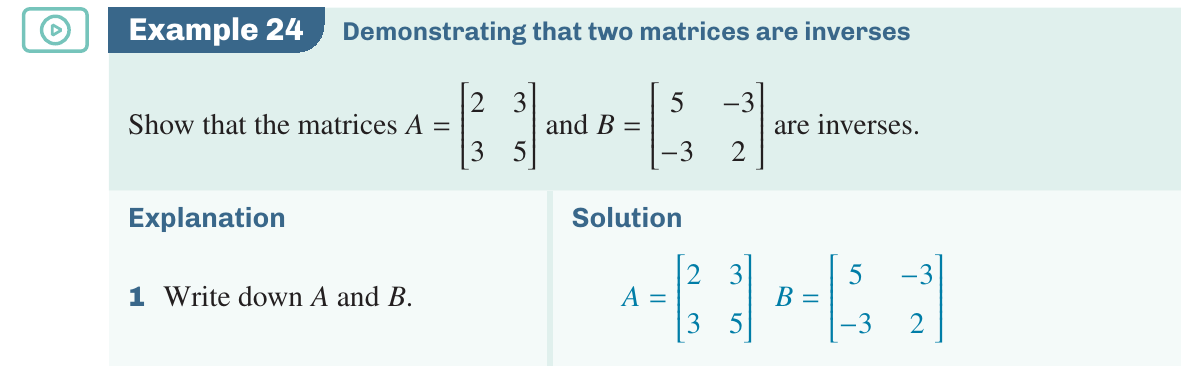
Demonstrating that two matrices are inverses
To prove that two matrices are inverses, we need to show that when we multiply them together (in both orders), we get the identity matrix.
Example
Worked Example: Verifying Inverse Matrices
Consider the matrices:
To show these are inverses, we need to verify that and .
Step 1: Calculate
Multiply row by column:
Step 2: Calculate
Conclusion: Since both AB = I and BA = I, we can confirm that and are inverses of each other.
Note
Exam Tip: You can use your calculator to speed up matrix multiplication, but make sure you understand the manual process for simple matrices.
The determinant of a matrix
While the example above shows that some matrices have inverses, many square matrices do not. To understand why, we need to introduce the determinant.
The determinant of a matrix
For a matrix, the determinant is a single number calculated using a simple formula.
Important
Definition:
If , then:
Memory aid: "Multiply down-right, subtract up-left"
- Multiply the elements on the main diagonal:
- Subtract the product of the off-diagonal elements:
Calculating determinants - worked examples
Let's calculate the determinants of three different matrices to see what values they can take.
Example
Worked Example 1:
Example
Worked Example 2:
Example
Worked Example 3:
Note
Key observation: The determinant can be positive (like ), negative (like ), or zero. This value is crucial for determining whether a matrix has an inverse.
Why the determinant matters for inverses
For a matrix to have an inverse, its determinant must be non-zero. If , the matrix is called singular and does not have an inverse.
Important
A matrix has an inverse if and only if its determinant is non-zero. Matrices with zero determinant are called singular matrices and cannot be inverted.
Finding the inverse of a matrix
While you'll typically use a calculator to find matrix inverses, understanding the formula helps you see why some matrices don't have inverses.
The formula for a inverse
Important
Rule:
If , then:
provided , that is, provided
Memory aid for the formula:
- Calculate the determinant:
- Swap the positions of and (the main diagonal elements)
- Change the signs of and (the off-diagonal elements)
- Divide everything by the determinant
Note
This formula immediately shows why you can't calculate an inverse when the determinant is zero - you would be dividing by zero!
Using the formula - worked examples
Example
Worked Example 1: Find the inverse of
Step 1: Calculate the determinant
Step 2: Apply the inverse formula
Example
Worked Example 2: Find the inverse of
Step 1: Calculate the determinant
Conclusion: Since det(B) = 0, matrix does not have an inverse. It's a singular matrix.
Using a CAS calculator for larger matrices
For square matrices larger than , the formulas become very complicated. In practice, we use calculators to find determinants and inverses of matrices.
TI-Nspire CAS method
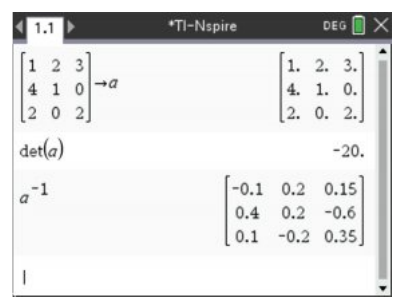
Here's how to find the determinant and inverse of a matrix using the TI-Nspire CAS calculator.
Example: For matrix , find and
Steps:
-
Press
ctrl + Nand select Add Calculator -
Enter the matrix into your calculator
-
To find the determinant:
- Type
det(a)and pressenterto evaluate - Alternatively: Press
menu> Matrix & Vector > Determinant - Result:
- Type
-
To find the inverse:
- Type
a^-1and pressenterto evaluate - For fractional form: Type
exact(a^-1)and pressenter
- Type
Note
Important notes:
- Using
exact()gives fractions instead of long decimals - If a matrix has no inverse, you'll get a "Singular matrix" error message
ClassPad method
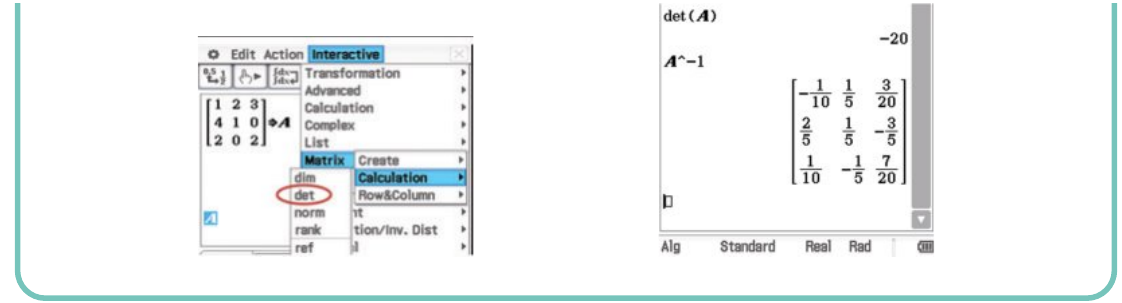
For the same matrix :
Steps:
-
Enter matrix into your calculator
- Note: Change calculator status to Standard (not Decimal) for fractions to display
-
To find the determinant:
- Type and highlight (swipe with stylus)
- Select Interactive from menu bar
- Tap Matrix-Calculation, then tap det
- To find the inverse:
- Type
A^-1 - Press
EXEto evaluate
- Type
Note
If the matrix has no inverse, you'll get an "Undefined" message.
Solving matrix equations
Matrix equations can be solved using techniques similar to those for solving linear equations. However, there are important differences to remember:
Important
Key Differences from Regular Equations:
- Matrix multiplication is not commutative ( in general)
- You must ensure operations are defined (matrices must have compatible dimensions)
- You multiply by the inverse rather than dividing
General approach to solving matrix equations
The key principle is to isolate the unknown matrix by pre-multiplying or post-multiplying by the appropriate inverse matrix.
Important
The order of multiplication matters! You must multiply in the correct order to maintain the equation's validity.
Worked examples of matrix equations
For these examples, let:
Example
Worked Example 1: Solve for
This is the simplest type - just rearrange:
Example
Worked Example 2: Solve for
When is multiplied on the right by , we need to pre-multiply both sides by :
Pre-multiply both sides by :
Since (the identity matrix):
Example
Worked Example 3: Solve for
When is multiplied on the left side, we need to post-multiply both sides by :
Post-multiply both sides by :
Since :
Example
Worked Example 4: Solve for
Example
Worked Example 5: Solve for
(Using calculator to find ):
Example
Worked Example 6: Solve for
First, rearrange to isolate the term:
Note
Exam Tip: When solving matrix equations:
- Always check the dimensions of matrices to ensure multiplication is defined
- Remember: pre-multiply when the unknown appears on the right, post-multiply when it appears on the left
- Use your calculator for finding inverses of larger matrices, but show your working for the equation solving steps
Summary
Key Points to Remember:
-
The inverse of a square matrix , written , has the property that , where is the identity matrix.
-
The determinant of a matrix is calculated as .
-
A matrix only has an inverse if its determinant is non-zero. Matrices with zero determinant are called singular matrices.
-
For a matrix, the inverse is: (swap diagonal elements, negate off-diagonal elements, divide by determinant).
-
When solving matrix equations, multiply by the inverse matrix in the correct order - pre-multiply if is on the right, post-multiply if is on the left.