Matrix Multiplication (VCE SSCE General Mathematics): Revision Notes
📚Revision Notes
Matrix Multiplication
Matrix multiplication is a fundamental operation in linear algebra that allows us to combine matrices in a specific way. Unlike simple arithmetic multiplication, this process follows a unique algorithm that requires careful attention to the dimensions and positions of elements in the matrices.
What is matrix multiplication?
Matrix multiplication involves multiplying one matrix by another matrix to produce a new matrix. When we multiply matrix by matrix , we write this as or simply .
Note
This operation is not simply multiplying corresponding numbers together. Instead, it uses a specific process that combines rows from the first matrix with columns from the second matrix. Each element in the resulting matrix comes from adding together the products of pairs of numbers.
Understanding when multiplication is possible
Not all matrices can be multiplied together. For matrix multiplication to work, there is an important rule about the dimensions of the matrices involved.
Important
The Dimension Rule: The number of columns in the first matrix must equal the number of rows in the second matrix. If this condition is not met, the multiplication is undefined and cannot be performed.
For example, if matrix has order 3 × 2 (meaning 3 rows and 2 columns) and matrix has order 2 × 1 (meaning 2 rows and 1 column), then multiplication is possible because the middle numbers match - both are 2.
The order of the resulting product matrix is determined by the outer numbers. For with order multiplied by with order , the product will have order .
Example
Worked Example: Checking if Multiplication is Defined
Consider matrices with the following orders:
Matrix : order
Matrix : order
For :
The inside numbers are 2 and 2 - they match, so multiplication is defined.
The outside numbers are 3 and 1, so the product has order 3 × 1.
For :
Matrix : order
Matrix : order
The inside numbers are 1 and 3 - they don't match, so multiplication is not defined.
A practical example
Let's look at a real-world situation to understand how matrix multiplication works. Imagine Fatima and Gaia are selling books and puzzles. We can record their sales and prices in matrices.
Example
Worked Example: Calculating Total Sales
Matrix shows the number of items sold:
where Fatima sold 7 books and 4 puzzles, while Gaia sold 5 books and 6 puzzles.
Matrix shows the prices:
where books cost $20 and puzzles cost $30.
To find the total value of sales for each person, we multiply :
Fatima's total:
Gaia's total:
The result is:
This shows Fatima made $260 in total sales and Gaia made $280.
The "run and dive" method
A helpful way to remember the matrix multiplication process is the "run and dive" description. This method helps you systematically work through the calculation.
Note
The "Run and Dive" Process:
To multiply :
- Run along the first row of matrix and dive down the first column of matrix
- Multiply pairs of numbers as you go and add them together
- This gives you the element in the first row, first column of your answer
- Repeat by running along the first row of and diving down the next column of
- Continue until all columns of have been used
- Now start running along the second row of and repeat the diving process
- Your results go in a new row
- Continue until all rows of have been used

Performing matrix multiplication step by step
Let's work through a complete example to see the process in action.
Example
Worked Example: Complete Matrix Multiplication
Given matrices:
To find :
First row of , column of :
Second row of , column of :
Third row of , column of :
Therefore:
For a row matrix multiplied by a column matrix, the process is simpler:
The result is a single number (a matrix):
Matrix multiplication is not commutative
Important
Critical Property: Matrix multiplication does not follow the commutative law. This means that changing the order of multiplication usually gives a different result.
In ordinary arithmetic, , but with matrices, generally .
In many cases, even if is defined, might not be defined at all because the dimensions don't match when reversed.
Matrix powers
Once we understand matrix multiplication, we can extend this to calculate powers of matrices. This is similar to how we calculate powers of numbers.
Just as:
For matrices:
Important
Square Matrices Only: Only square matrices (matrices with the same number of rows and columns) can be raised to a power, because we need to multiply the matrix by itself, which requires matching dimensions.
Calculating with matrix powers
Example
Worked Example: Matrix Powers
For matrices and :
To find , we calculate :
To find , we first calculate , then multiply the result by :
Note: When using a calculator, you must include a multiplication symbol between A and B², otherwise it may interpret this as .
The identity matrix
A special matrix that plays an important role in matrix multiplication is the identity matrix, denoted by the letter .
The identity matrix is a square matrix with the number 1 along the leading diagonal (top-left to bottom-right) and 0 in all other positions.
Note
Examples of identity matrices of different sizes:
The identity matrix behaves like the number 1 in ordinary multiplication. When any matrix is multiplied by the identity matrix, the result is the original matrix .
Important
Key Property:
The identity matrix leaves any matrix unchanged when multiplied.
Identity matrix example
Example
Worked Example: Verifying the Identity Property
For and :
Finding :
Finding :
Both products give us back the original matrix .
Using a calculator for matrix multiplication
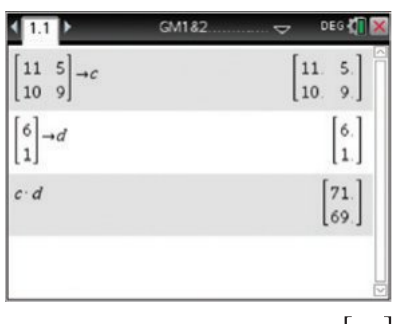
For more complex matrix multiplications, using a CAS calculator is highly recommended. The process involves entering your matrices into the calculator memory and then typing the multiplication expression.
Example
Worked Example: Using a Calculator for Matrix Multiplication
To find where and :
Steps:
- Enter matrix into your calculator and store it as variable c
- Enter matrix into your calculator and store it as variable d
- Type c × d (you must include the multiplication symbol)
- Press enter to evaluate
The result is:
Always check that your answer has the correct dimensions based on the orders of the original matrices.

Summary of key formulas
Summary
Formula for Multiplying Two Matrices:
Example:
Remember!
Summary
Key Points to Remember:
-
Matrix multiplication requires matching dimensions: The number of columns in the first matrix must equal the number of rows in the second matrix for multiplication to be defined.
-
The product has predictable dimensions: When multiplying an matrix by an matrix, the result is an matrix.
-
Order matters: Matrix multiplication is not commutative, meaning in general. Always maintain the correct order.
-
The identity matrix leaves matrices unchanged: Multiplying any matrix by the identity matrix gives back the original matrix: .
-
Use calculators for complex calculations: While understanding the process by hand is essential, CAS calculators are valuable tools for more involved matrix multiplications and can help verify your work.