Scalar Multiplication (VCE SSCE General Mathematics): Revision Notes
📚Revision Notes
Scalar Multiplication
What is scalar multiplication?
In matrix mathematics, a scalar is simply a number. When we multiply a matrix by a scalar, we call this scalar multiplication.
Scalar multiplication involves taking a single number (the scalar) and multiplying every element in the matrix by that number. This is a fundamental operation that allows us to scale matrices up or down.
Note
Think of "scalar" as "scale" - you're scaling all the values in your matrix up or down by the same amount. This is similar to zooming in or out on an image, where everything gets bigger or smaller proportionally.
The process
To perform scalar multiplication:
- Take your scalar (the number you want to multiply by)
- Multiply each element in the matrix by this scalar
- The result is a new matrix with the same dimensions as the original
This means that if you multiply a matrix by a scalar, you'll get another matrix where every element has been multiplied by that number.
Performing scalar multiplication
Let's look at a worked example to understand how this works in practice.
Example
Worked Example: Basic Scalar Multiplication
Question: If , find .
Solution:
Step 1: Write out the scalar multiplication
Step 2: Multiply each element in the matrix by
Step 3: Evaluate each element
Key point: Notice that every element has been multiplied by , including the zero. Even though , we still need to perform the multiplication.
Practice
Try this yourself: If , find .
Following the same steps:
- Write
- Multiply each element by
- Your answer should be
Combining scalar multiplication with other operations
Scalar multiplication becomes even more powerful when combined with matrix addition and subtraction. The key rule to remember is: perform scalar multiplication before addition or subtraction.
Important
Order of Operations
Always complete the scalar multiplication for each matrix before performing the addition or subtraction. This follows the standard order of operations in mathematics - multiplication comes before addition and subtraction.
Think of it like BODMAS/PEMDAS: you wouldn't add before multiplying in regular arithmetic, and the same principle applies here!
Example
Worked Example: Scalar Multiplication with Subtraction
Question: If and , find the matrix equal to .
Solution:
Step 1: Write the expression in expanded form
Step 2: Multiply the elements in by and the elements in by
Step 3: Subtract the elements in corresponding positions
Practice
Try this yourself: If and , find .
Following the steps, your answer should be .
Applications of scalar multiplication
Scalar multiplication has many practical uses in real-world situations. It's particularly helpful when we need to scale data, such as doubling quantities, adding taxes, or adjusting prices.
Example
Worked Example: Scaling Enrolments
Question: A gymnasium has the enrolments shown in this matrix:
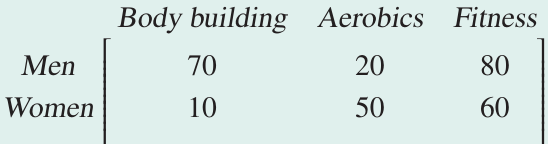
The manager wishes to double the enrolments in each course. Construct a matrix showing the new enrolments for men and women in each course.
Solution:
Step 1: Multiply each element in the matrix by
Step 2: Evaluate each element to show the new enrolments
| Body building | Aerobics | Fitness | |
|---|---|---|---|
| Men | 140 | 40 | 160 |
| Women | 20 | 100 | 120 |
Interpretation: This shows that if enrolments double, the men's body building class would grow from 70 to 140 participants, the women's aerobics class would grow from 50 to 100 participants, and so on.
Real-world application: GST
Another common use of scalar multiplication is calculating prices with tax. In Australia, GST (Goods and Services Tax) is 10%. To add GST to a price, we multiply by (since adding 10% is the same as multiplying by ).
Note
Adding Percentages Using Scalar Multiplication
If a burger shop has a matrix of prices and wants to know the prices including GST, they would multiply the entire price matrix by . This single scalar multiplication adds the tax to all prices at once, making it much more efficient than calculating each price individually!
Important
Exam Tip: Working with Percentages
When working with percentages, remember:
- To increase by 10%, multiply by
- To increase by 20%, multiply by
- To decrease by 10%, multiply by
- To find 50% of a value, multiply by
The pattern is: to increase by %, multiply by , and to decrease by %, multiply by .
Summary
Key Points to Remember:
- A scalar is just a number
- Scalar multiplication means multiplying every element in a matrix by the same number
- When multiplying a matrix by a scalar, the dimensions of the matrix don't change - a matrix multiplied by a scalar is still
- When combining scalar multiplication with addition or subtraction, always do the scalar multiplication first
- Scalar multiplication is useful for scaling real-world data, such as doubling quantities or adding percentages like GST
- Think "scalar = scale" to remember that you're scaling all values proportionally