Using Matrices to Represent Information (VCE SSCE General Mathematics): Revision Notes
📚Revision Notes
Using Matrices to Represent Information
Introduction to matrices for representing information
Matrices are powerful mathematical tools that can organize and store information in a structured format. Beyond simple numerical calculations, matrices have practical applications in many areas including:
- Storing data from tables and surveys
- Encoding information for secure transmission (like credit card numbers)
- Representing connections in networks such as friendship groups, airline routes, electrical circuits, and road systems
- Solving systems of simultaneous equations
This note focuses on two main applications: converting data tables into matrix form and representing network diagrams using matrices.
Note
Learning Objectives
By the end of this topic, you should be able to:
- Represent data given in a table using a matrix
- Convert sequential information into matrix form
- Represent a network diagram with a matrix
- Interpret matrix elements in the context of network connections
Using a matrix to represent data tables
Why use matrices for data tables?
Data tables naturally organize information into rows and columns. Since matrices also use a row-and-column structure, converting tabular data into matrix form is straightforward and creates a compact way to store and manipulate the information mathematically.
Note
The Conversion Process
To convert a data table into a matrix, follow these steps:
- Identify the dimensions needed for your matrix (number of rows × number of columns)
- Create an empty matrix with the appropriate dimensions
- Label the rows and columns to match the table categories (optional but helpful)
- Fill in the matrix elements row by row, starting from the top-left corner
- Transfer each value from the table to its corresponding position in the matrix
Example
Worked Example: Gym Membership Data
Question: The table below shows three types of membership at a local gym and the number of males and females enrolled in each category. Construct a matrix to display this numerical information.
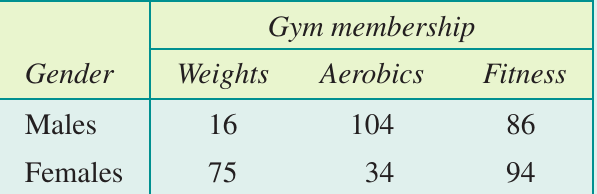
Solution:
Step 1: Create a blank matrix (2 rows for the two genders, 3 columns for the three activity types).
Label the rows: for males and for females.
Label the columns: for weights, for aerobics, and for fitness.
Step 2: Fill in the matrix elements row by row, starting at the top-left corner.
Transfer the values from the table:
- Row 1 (Males): 16, 104, 86
- Row 2 (Females): 75, 34, 94
The completed matrix is:
With labels, this can be written as:
This matrix has an order of , meaning it has 2 rows and 3 columns.
Converting sequences to matrix form
Matrices can also be used to organize sequential data, such as long number strings. This has practical applications in data encryption and transmission.
Example
Worked Example: Encoding a Credit Card Number
Question: Convert the 16-digit credit card number 4454 8178 1029 3161 into a matrix, listing the digits in pairs, one under the other. Ignore the spaces.
Solution:
Step 1: Write out the complete sequence of numbers.
Writing the numbers in groups of four (as they appear on the credit card) helps you keep track of the digits:
4454 8178 1029 3161
Step 2: Fill in the matrix elements row by row.
Create a matrix and enter the digits systematically from left to right, filling the first row completely before moving to the second row:
The original 16-digit number is now encoded in a matrix format, which could be used for secure transmission or further mathematical processing.
Using matrices to represent network diagrams
What are network diagrams?
Network diagrams are visual representations consisting of points (also called nodes or vertices) connected by lines (also called edges or links). These diagrams can represent many different systems in the real world:
- Social networks showing friendships or connections
- Transportation networks showing routes between locations
- Communication networks showing how devices are linked
- Electrical circuits showing component connections
While network diagrams provide a visual way to understand connections, matrices offer a mathematical way to store and analyze the same information.
Note
How Network Matrices Work
To represent a network diagram as a matrix:
- Create a square matrix where the number of rows and columns equals the number of points in the network
- Label both rows and columns with the point names or numbers
- Use the following rule for filling in matrix elements:
- Enter 1 if two points are connected by a line
- Enter 0 if two points are not connected
Example
Worked Example: Representing a Network Diagram
Question: Represent the network diagram shown below as a matrix , where the matrix element equals 1 if two points are joined by a line and 0 if the two points are not connected.
The network shows four points: A, B, C, and D, with the following connections:
- Point A connects to points B and D
- Point B connects to points A, C, and D
- Point C connects only to point B
- Point D connects to points A and B
Solution:
Step 1: Create a blank matrix.
Label both the rows and columns A, B, C, D to represent the four points in the network.
Step 2: Fill in the matrix elements row by row.
For each position, ask: "Is there a line connecting these two points?"
Starting with row A:
- (no line joining point A to itself)
- (a line joins points A and B)
- (no line joins points A and C)
- (a line joins points A and D)
Continue for rows B, C, and D:
Important
In a network with no "loops" (lines connecting a point to itself), the leading diagonal elements will always be zero. The leading diagonal runs from the top-left to the bottom-right of the matrix. Knowing this property can save time when creating network matrices.
Interpreting network matrices
Once a network is represented as a matrix, we can extract useful information by examining specific elements or calculating sums.
Example
Worked Example: Interpreting Road Connections
Question: The diagram shows roads connecting four towns: A, B, C, and D. This network has been represented by the matrix below. The elements show the number of roads between each pair of towns.
The network shows:
- One road between towns A and B
- Two roads between towns B and C
- One road between towns B and D
- Three roads between towns C and D
Answer the following questions:
a) In matrix , . What does this tell us?
Solution: The element represents the connection from town B (row 2) to town D (column 4). Therefore, there is one road between town B and town D.
b) In matrix , . What does this tell us?
Solution: The element represents the connection from town C (row 3) to town D (column 4). Therefore, there are three roads between town C and town D.
c) In matrix , . What does this tell us?
Solution: The element represents the connection from town D (row 4) to town A (column 1). Therefore, there is no road directly connecting town D to town A.
d) What is the sum of the elements in row 3 of matrix , and what does this tell us?
Solution: Row 3 represents town C. The elements are:
This tells us there are 5 roads in total connecting town C to all other towns in the network.
e) What is the sum of all elements in matrix , and what does this tell us?
Solution: Adding all elements:
This sum of 14 represents the total number of different ways you can travel between towns in the network.
Note
For each road, there are two ways to travel (e.g., from A to B and from B to A). This is why both and in the matrix - they represent the same physical road but traveled in different directions.
Summary
Key Points to Remember:
-
Data tables convert easily to matrices because both use rows and columns to organize information. Simply transfer values systematically from the table to the matrix.
-
Matrix dimensions matter: Always identify the order (rows × columns) needed before creating your matrix. The order depends on the structure of your data.
-
Network matrices use 1s and 0s: In a basic network representation, use 1 to show connections and 0 to show no connection between points.
-
Leading diagonal is special: In network matrices without loops, all leading diagonal elements equal zero because points don't connect to themselves.
-
Matrix elements tell a story: Each element in a network matrix has meaning - it represents the number of connections between specific points. Sums of rows, columns, or all elements can provide useful information about the network's structure.