What is a Matrix? (VCE SSCE General Mathematics): Revision Notes
📚Revision Notes
What is a Matrix?
Introduction to matrices
A matrix (plural: matrices) is a rectangular arrangement of numbers or symbols organised in rows and columns. Think of it as a table of values enclosed in square brackets.
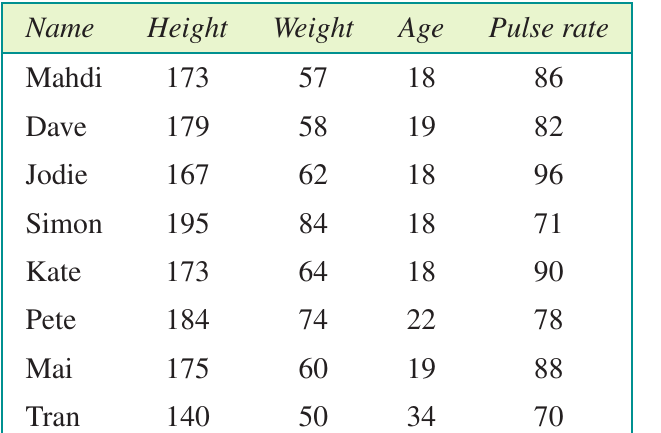
Matrices are useful for organising data in a structured way. For example, if we collect information about students' heights, weights, ages and pulse rates, we can arrange this data in a table:
Note
To create a matrix from this table, we extract just the numbers and enclose them in square brackets:
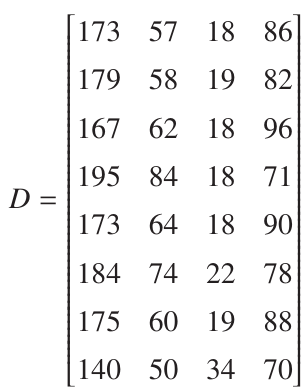
We call this matrix (for data matrix). Matrices are typically named using capital letters such as , , , and so on.
Rows and columns
Rows and columns are the fundamental building blocks of any matrix.
Rows are numbered from the top downwards: row , row , row , etc.
Columns are numbered from left to right: column , column , column , etc.
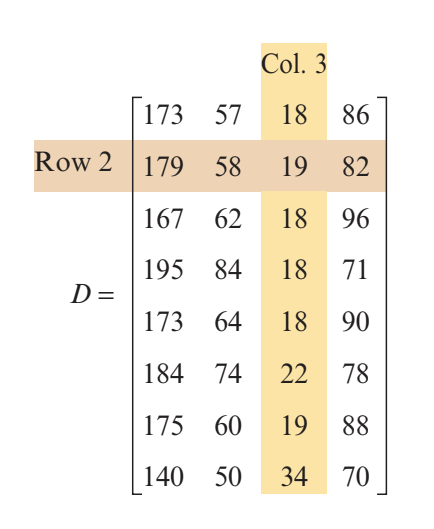
In the matrix shown above, Row 2 is highlighted in orange and Column 3 is highlighted in yellow.
Order of a matrix
The order (or size) of a matrix tells us its dimensions.
Important
Order of a matrix = number of rows number of columns
The order is always stated with rows first, then columns.
For example, matrix above has eight rows and four columns, so its order is (read as "eight by four").
When we state the order as , this means:
- rows
- columns
Example
Understanding Matrix Order
If a matrix has 5 rows and 3 columns, its order is (read as "five by three").
Remember: The first number always represents the number of rows, and the second number represents the number of columns.
Elements in a matrix
The individual numbers or values inside a matrix are called elements (or entries).
Note
The total number of elements in a matrix equals the number of rows multiplied by the number of columns.
For example, an matrix has elements.
Types of matrices
Matrices come in many different shapes and sizes. Here are the main types you need to know:
Row matrices
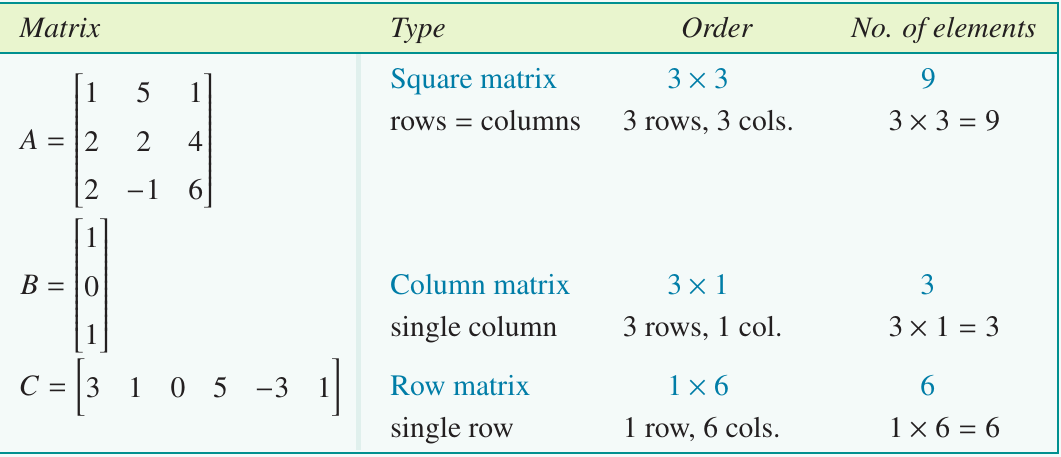
A row matrix (also called a row vector) contains only one row of numbers.
Example
Row Matrix Example
This matrix represents data for one student (Kate) from our original table. It has order (one row, four columns) and contains elements.
Column matrices
A column matrix (also called a column vector) contains only one column of numbers.
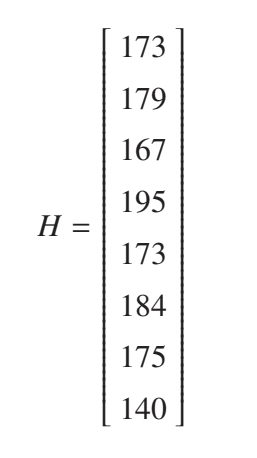
The matrix shown above represents the heights of all students. It has order (eight rows, one column) and contains elements.
Square matrices
A square matrix has an equal number of rows and columns.
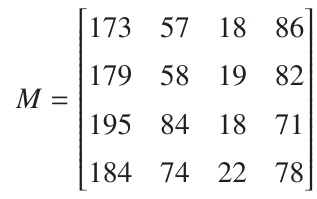
Matrix shown above is a square matrix containing data for male students. It has rows, columns, and elements in total.
Summary of basic matrix types
Diagonal matrices
Before understanding diagonal matrices, we need to identify the leading diagonal of a square matrix.
A square matrix has two diagonals, but the one running from the top-left to the bottom-right is called the leading diagonal. This is the most important diagonal in matrix mathematics.
Important
A diagonal matrix is a square matrix where all elements off the leading diagonal are zero. The elements on the leading diagonal itself may be zero or non-zero.
Example
Examples of Diagonal Matrices
Notice that in each case, every element not on the leading diagonal is zero.
Identity matrices
An identity matrix (also called a unit matrix) is a special type of diagonal matrix where each element on the leading diagonal equals , and all other elements are .
Identity matrices are denoted by the symbol .
Every size of square matrix has its own identity matrix:
Important
Identity matrices play a crucial role in matrix arithmetic, similar to how the number works in regular multiplication.
Symmetric matrices
A symmetric matrix is a square matrix that remains unchanged when we transpose it (swap its rows and columns).
In a symmetric matrix, the elements above the leading diagonal are a mirror image of the elements below it.
Example
Examples of Symmetric Matrices
Notice how in each matrix, if you were to fold along the leading diagonal, the top-right and bottom-left sections would match perfectly.
Triangular matrices
Triangular matrices come in two forms:
Upper triangular matrix: A square matrix where all elements below the leading diagonal are zeros.
Lower triangular matrix: A square matrix where all elements above the leading diagonal are zeros.
Example
Examples of Triangular Matrices
Upper triangular matrix (zeros below the diagonal):
Lower triangular matrix (zeros above the diagonal):
Transpose of a matrix
The transpose of a matrix is obtained by switching (interchanging) its rows and columns.
We denote the transpose of matrix by .
Example
Transposing a Matrix
The first row becomes the first column, the second row becomes the second column, and so on.
Key points about transposition
Note
Understanding Transposition:
- The transpose of a row matrix is a column matrix, and vice versa
- The transpose of a matrix is a matrix
- If a matrix equals its own transpose, it is a symmetric matrix
For example:
Matrix notation using subscripts
When we need to refer to individual elements within a matrix without specifying actual numbers, we use subscript notation.
For a matrix , each element is identified by two subscripts:
- The first subscript indicates the row number
- The second subscript indicates the column number
So represents the element in row and column of matrix .
Example
Using Subscript Notation
In the matrix:
- (element in row , column )
- (element in row , column )
- (element in row , column )
This notation is particularly useful when describing matrices in general terms or when working with matrix formulas.
Remember!
Summary
Key Points to Remember:
- A matrix is a rectangular array of numbers arranged in rows and columns, enclosed in square brackets
- Order is always stated as rows columns (e.g., means rows and columns)
- A row matrix has only one row; a column matrix has only one column
- A square matrix has equal numbers of rows and columns
- The transpose of a matrix is formed by switching its rows and columns, denoted by
- Special square matrices include: diagonal (zeros off the leading diagonal), identity (ones on the diagonal, zeros elsewhere), symmetric (unchanged by transposition), and triangular (zeros either above or below the diagonal)
- Use subscript notation to identify the element in row and column of matrix