Absolute Maximum and Minimum Values (VCE SSCE Mathematical Methods): Revision Notes
📚Revision Notes
Absolute Maximum and Minimum Values
Understanding absolute extrema
When working with functions on specific intervals, we need to distinguish between local extrema (maximum and minimum values in a small neighbourhood) and absolute extrema (the actual highest and lowest values over the entire interval).
For a function defined on an interval:
- The absolute maximum is the highest value that the function reaches anywhere on its domain
- The absolute minimum is the lowest value that the function reaches anywhere on its domain
Important
Absolute extrema don't necessarily occur at stationary points. They can occur at:
- Stationary points (where the derivative equals zero)
- Endpoints of the domain
- Points where the derivative doesn't exist
Formal definitions
For a continuous function defined on a closed interval :
Absolute maximum: If is a value of the function such that for all , then is the absolute maximum value of the function.
This means that is greater than or equal to every other value of the function on the interval.
Absolute minimum: If is a value of the function such that for all , then is the absolute minimum value of the function.
This means that is less than or equal to every other value of the function on the interval.
Note
The inequalities in these definitions ensure that the absolute extrema represent the true highest and lowest values across the entire interval, not just in a local neighborhood.
Worked example: Finding absolute extrema of a quadratic function
Example
Worked Example: Quadratic Function on a Closed Interval
Problem: Let , . Find the absolute maximum value and the absolute minimum value of the function.
Solution:
First, we sketch the graph to visualise the function on the given domain.
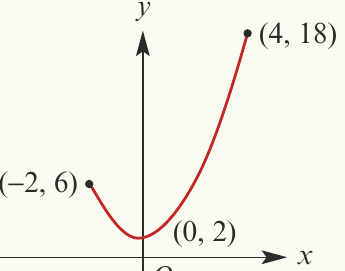
From the graph, we can identify the extreme values:
The maximum value is 18 and is reached when .
The minimum value is 2 and is reached when .
Important
Key observation: The absolute minimum occurs at a stationary point of the graph (the turning point at the vertex). However, the absolute maximum occurs at an endpoint of the domain, not at a stationary point.
This demonstrates why you must always check both stationary points AND endpoints when finding absolute extrema.
Worked example: Absolute extrema at endpoints
Example
Worked Example: Cubic Function with Extrema at Endpoints
Problem: Let , . Find the maximum and minimum values of the function.
Solution:
We sketch the graph of the cubic function on the given domain.
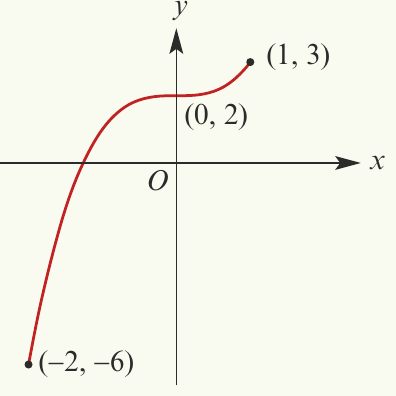
From the graph, we identify:
The maximum value is 3 and is reached when .
The minimum value is -6 and is reached when .
Note
Key observation: For this cubic function, both the absolute maximum and absolute minimum values occur at the endpoints of the domain. Neither occurs at a stationary point.
This example shows that stationary points aren't always where extrema occur—sometimes the endpoints give the most extreme values.
Worked example: Volume optimization with domain restriction
Example
Worked Example: Box Volume Optimization
Problem: From a square piece of metal of side length m, four squares are removed as shown in the diagram. The metal is then folded along the dashed lines to form an open box with height m.
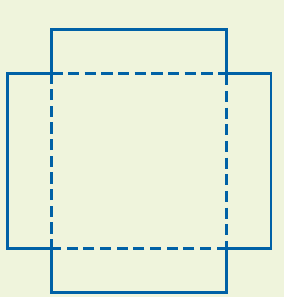
Part a: Show that the volume of the box, m³, is given by .
Part b: Find the value of that gives the box its maximum volume and show that the volume is a maximum for this value.
Part c: Sketch the graph of against for a suitable domain.
Part d: If the height of the box must be less than m, i.e. , what will be the maximum volume of the box?
Solution:
Part a:
When we fold up the box, the height is metres.
The length and width of the box are both metres.
Therefore, the volume is:
Expanding the bracket:
Part b:
Let .
A local maximum will occur when .
Finding the derivative:
Setting the derivative equal to zero:
Dividing by :
Factorising:
Therefore: or
When , the length of the box is , which is not physically meaningful. Therefore, the only value to consider is .
We can verify this is a maximum using a variation table:
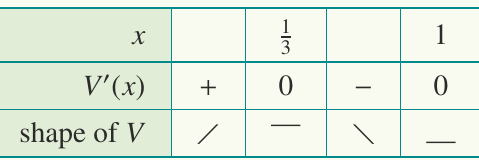
The table shows that for (function increasing) and for (function decreasing). This confirms a maximum at .
The maximum occurs when .
Maximum volume:
Part c:
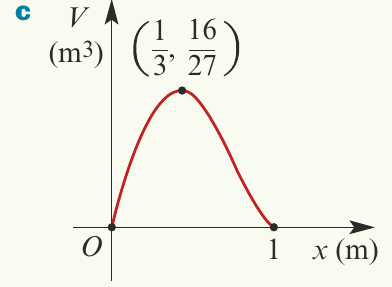
The graph shows the volume function with its maximum at .
Part d:
This part demonstrates how domain restrictions affect absolute maxima.
The local maximum of defined on is at .
However, is not in the restricted interval .
Since for all (the function is increasing throughout this interval), the maximum volume for this situation occurs at the right endpoint.
The maximum volume occurs when and is m³.
Important
Exam tip: When a domain is restricted, always check whether your critical points fall within the new domain. If they don't, the absolute maximum or minimum will occur at an endpoint of the restricted domain.
Remember!
Summary
Key Points to Remember:
- The absolute maximum is the highest value a function reaches over its entire domain, while the absolute minimum is the lowest value
- Absolute extrema can occur at stationary points OR at endpoints of the domain—always check both
- For continuous functions on closed intervals , test the function values at all critical points and at both endpoints
- Domain restrictions can change where the absolute maximum or minimum occurs—always consider the full restricted interval
- Use variation tables or sign analysis of the derivative to confirm whether critical points are maxima or minima