Maximum and Minimum Problems (VCE SSCE Mathematical Methods): Revision Notes
📚Revision Notes
Maximum and Minimum Problems
Introduction to optimisation problems
In many real-world situations, we need to find the best possible outcome by making a quantity either as large or as small as possible. This process is called optimisation.
Maximisation means making a quantity as large as possible. Examples include:
- Maximising profit from sales
- Maximising attendance at an event
- Maximising the area of an enclosure
Minimisation means making a quantity as small as possible. Examples include:
- Minimising manufacturing costs
- Minimising fuel consumption
- Minimising time taken
We use differentiation to solve optimisation problems by finding where the derivative equals zero, which identifies potential maximum or minimum values.
General technique for solving maximum and minimum problems
Follow these systematic steps:
Note
Step 1: Define variables
Clearly identify what you're trying to maximise or minimise, and define appropriate variables.
Step 2: Write the equation
Express the quantity to be optimised as a function of a single variable. If there are multiple variables, use constraint equations to eliminate all but one.
Step 3: Differentiate
Find the derivative of your function.
Step 4: Find stationary points
Solve the equation where the derivative equals zero. These are your stationary points.
Step 5: Test the nature
Use a gradient chart (sign chart) to determine whether each stationary point is a maximum, minimum, or neither.
Step 6: Check practical constraints
Verify that your answer makes sense in the practical context. If the domain is restricted, also check the boundary values.
Worked example: Maximising area with fixed perimeter
Example
Worked Example: Maximising Area with Fixed Perimeter
Question: A farmer has sufficient fencing to make a rectangular pen of perimeter metres. What dimensions will give an enclosure of maximum area?
Solution:
Let the length of the rectangle be metres.
Then the width is metres.
The area is m², where:
The maximum value of occurs when .
implies
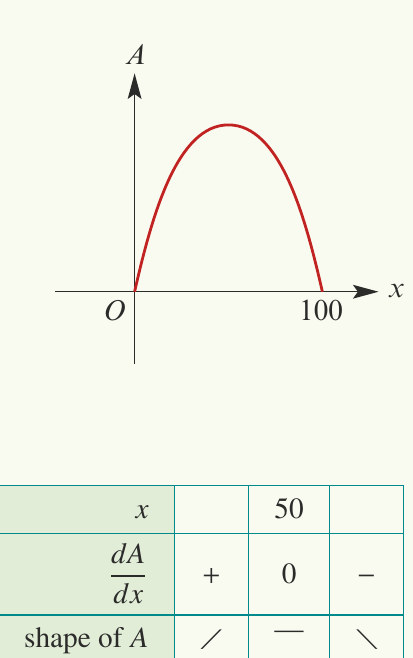
From the gradient chart, the maximum area occurs when .
The pen with maximum area has dimensions 50 m by 50 m, giving an area of 2500 m².
Important
Key observation: The maximum area occurs when the rectangle is actually a square. This is a useful result to remember.
Worked example: Minimising with a constraint equation
Example
Worked Example: Minimising with a Constraint Equation
Question: Two variables and are such that . A third variable is defined by . Find the values of and that give a stationary value and show that this value of is a minimum.
Solution:
From the constraint equation , we can express in terms of :
Substitute into the equation :
Now is expressed as a function of one variable, . Differentiate:
A stationary point occurs where :
When , the corresponding value is .
Substitute into the equation for :
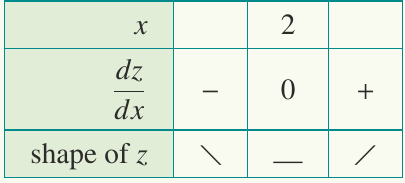
The gradient chart confirms this is a minimum.
The minimum value of is 2½ and occurs when and .
Worked example: Maximising volume with a surface area constraint
Example
Worked Example: Maximising Volume with Surface Area Constraint
Question: A cylindrical tin canister closed at both ends has a surface area of cm². Find, correct to two decimal places, the greatest volume it can have. If the radius of the canister can be at most cm, find the greatest volume it can have.
Solution:
Let the radius be cm, the height be cm, and the volume be cm³.
The surface area equation:
(two circular ends plus curved surface)
The volume equation:
From the surface area equation, express in terms of :
Substitute into the volume equation:
A stationary point occurs when :
implies
Since radius must be positive, cm.
When , cm³.
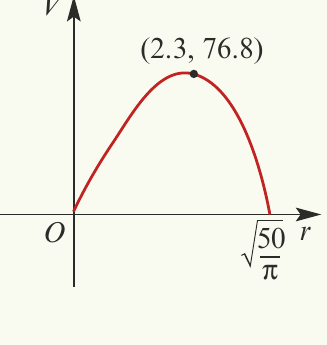
The gradient chart confirms this is a maximum.
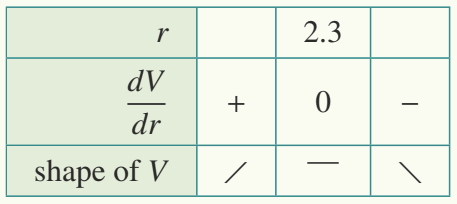
Part 2: If the radius can be at most cm, the domain is restricted to [0, 2].
We've shown that for all . This means the volume is increasing throughout this interval.
Therefore, the maximum occurs at the boundary value .
The maximum volume is cm³.
Important
Important principle: When working with restricted domains, always check both stationary points AND boundary values to find the absolute maximum or minimum.
Worked example: Maximising cross-sectional area using trigonometry
Example
Worked Example: Maximising Cross-Sectional Area Using Trigonometry
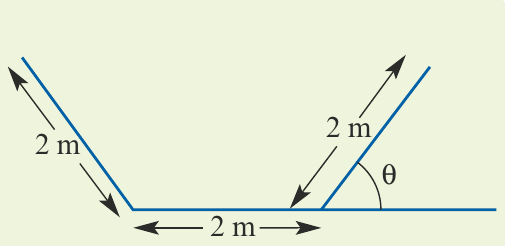
Question: The cross-section of a drain is to be an isosceles trapezium, with three sides of length metres, as shown. Find the angle that maximises the cross-sectional area, and find this maximum area.
Solution:
Let m² be the area of the trapezium.
The area formula is:
From the diagram:
- Height =
- Parallel sides are m and m
Differentiate using the product rule:
Set the derivative equal to zero:
The practical restriction is .
Therefore (which is ).
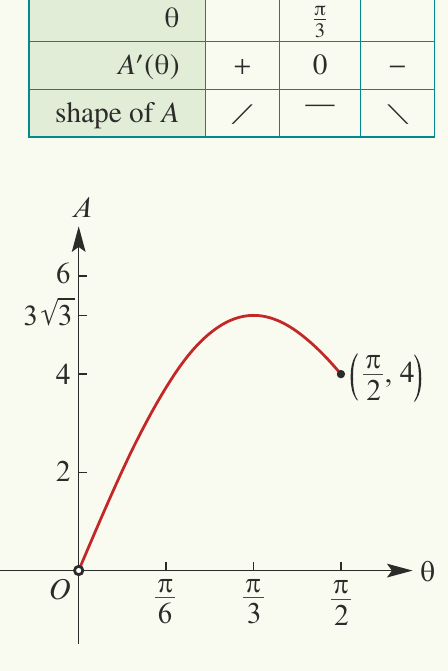
When :
The maximum cross-sectional area is 3√3 m².
Maximum rates of increase and decrease
The derivative of a function tells us the instantaneous rate of change. By differentiating the derivative (finding the second derivative), we can determine when the rate of change itself is at a maximum or minimum.
Note
Remember:
- If , then is increasing as increases
- If , then is decreasing as increases
Worked example: Maximum rate of population change
Example
Worked Example: Maximum Rate of Population Change
Question: The number of bacteria in a culture at time is given by .
a) Sketch the graphs of against and against .
b) Find the maximum rates of increase and decrease of the population and the times at which these occur.
Solution:
Part a)
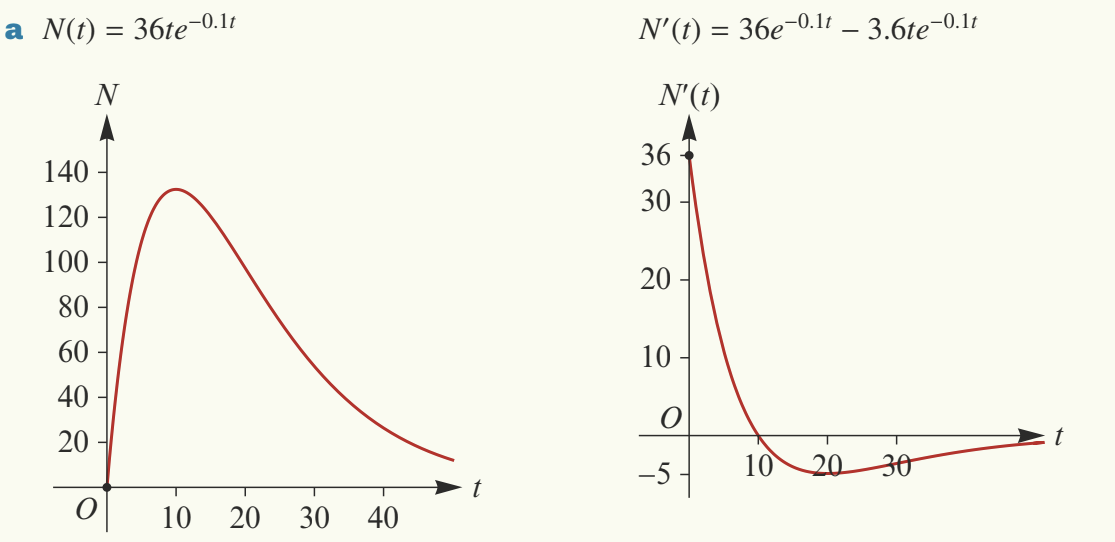
Part b)
Let represent the rate of change of the population.
From the graph, the maximum value of occurs at .
The maximum rate of increase is bacteria per unit time.
To find the maximum rate of decrease, we need to find the minimum value of .
Differentiate :
implies
At :
The maximum rate of decrease is approximately bacteria per unit time, occurring at .
Important
Exam tip: When asked about "maximum rate of decrease", you're looking for the most negative value of the derivative, which is the minimum of the rate function.
The second derivative and points of inflection
The second derivative of a function , denoted or , is found by differentiating the derivative.
The second derivative provides information about the concavity of a curve and helps identify points of inflection.
Concave up and concave down
Concave up: When for all in an interval, the gradient is increasing. The curve is concave up (shaped like a cup or smile).
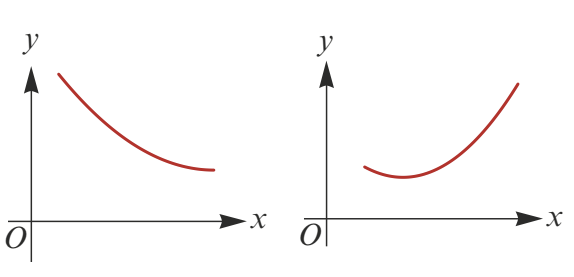
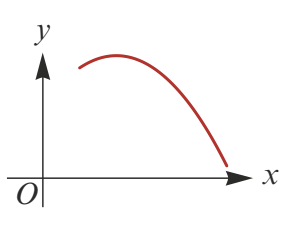
Concave down: When for all in an interval, the gradient is decreasing. The curve is concave down (shaped like a cap or frown).
Note
Visual Memory Aid:
- Concave up = Happy face (smile) =
- Concave down = Sad face (frown) =
Points of inflection
A point of inflection is where a curve changes from concave up to concave down, or vice versa.
At a point of inflection of a twice differentiable function:
- (necessary condition)
- There must be a change in concavity (also required)
Important
Important: Having alone does not guarantee a point of inflection. You must verify that the concavity actually changes.
Example
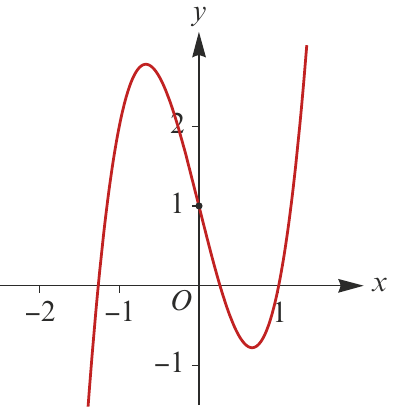
Example: Finding a Point of Inflection
For :
At :
For : (concave down)
For : (concave up)
Since the concavity changes at , there is a point of inflection at (0, 1).
Using gradient charts effectively
A gradient chart (or sign chart) is a powerful tool for determining the nature of stationary points. Here's how to construct one:
Note
Constructing a Gradient Chart:
Step 1: Draw a table with rows for , , and shape of .
Step 2: Mark the critical point where .
Step 3: Test the sign of the derivative on either side of the critical point.
Step 4: Use these symbols:
- for increasing
- for decreasing
- for horizontal (at the stationary point)
Step 5: Interpret:
- If the derivative changes from to to , you have a maximum
- If the derivative changes from to to , you have a minimum
Remember!
Summary
Key Points to Remember:
- Optimisation problems involve finding maximum or minimum values using differentiation
- Set the derivative equal to zero to find stationary points
- Use gradient charts to determine whether stationary points are maxima or minima
- For restricted domains, always check boundary values as well as stationary points
- The second derivative indicates concavity: positive means concave up, negative means concave down
- Points of inflection occur where concavity changes and
- When solving practical problems, always verify your answer makes sense in the real-world context