Newton’s Method for Finding Solutions to Equations (VCE SSCE Mathematical Methods): Revision Notes
📚Revision Notes
Newton's Method for Finding Solutions to Equations
What is Newton's method?
Newton's method is a powerful numerical technique we use to find approximate solutions to equations of the form . When we cannot solve an equation algebraically (using standard methods), Newton's method provides a way to get very close to the actual solution through an iterative process.
The fundamental idea behind this method is to use tangent lines drawn at successive points on the graph of to gradually improve our approximation of where the function crosses the x-axis.
Note
Newton's method is particularly useful when dealing with complex equations that cannot be solved using standard algebraic techniques. It's a cornerstone of numerical analysis and has applications in many fields including engineering, physics, and computer science.
The iterative formula
The core of Newton's method is this iterative formula:
where
This formula tells us how to move from one approximation () to the next, better approximation ().
Understanding the formula:
- x_n is our current approximation
- f(x_n) is the function value at
- f'(x_n) is the derivative (gradient) at
- x_{n+1} is our improved approximation
Important
The derivative must never equal zero when applying this formula, as division by zero is undefined. This is one of the key conditions for Newton's method to work successfully.
Worked example: solving for
Let's work through a complete example to see how Newton's method works in practice.
Example
Worked Example: Finding the Square Root of 2
Setting up the problem:
We want to solve for positive values. This is equivalent to finding .
Let
Then
We'll start with an initial approximation of .
First iteration:
The tangent line to the curve at the point has the equation:
To find where this tangent crosses the x-axis, we set :
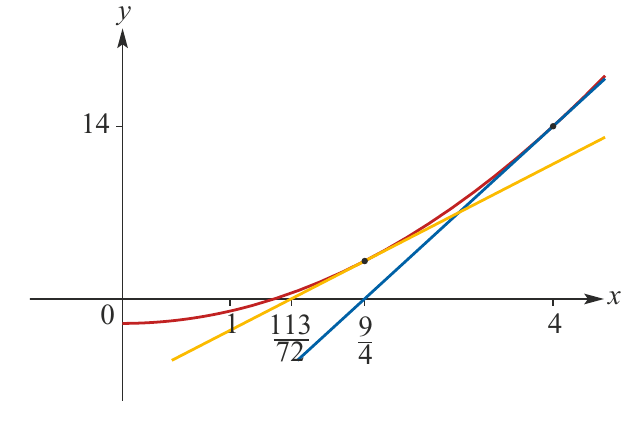
This gives us our first improved approximation: x_1 = 2.25.
Second iteration:
Now we repeat the process starting from :
The general pattern:
For this specific function , the iterative formula becomes:
where
Observing convergence:
Starting with , we get the sequence:
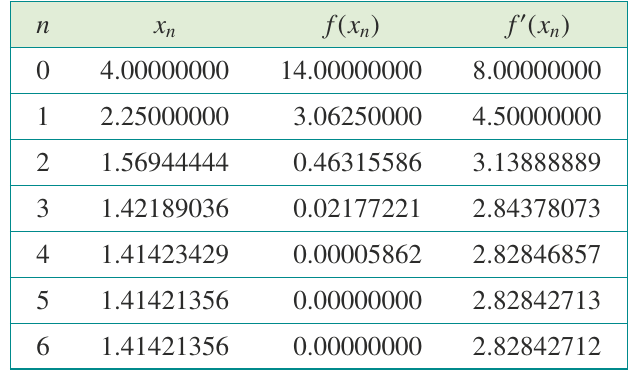
Notice how quickly the approximations converge to ! By the sixth iteration, we have achieved very high accuracy.
Note
Calculator tip:
You can perform these iterations on your calculator by defining the function:
Then repeatedly apply this function starting with . You can even use nested functions like to perform four iterations at once.
The general procedure
Newton's method can be applied to any differentiable function. Here's the step-by-step process:
Step 1: Choose a starting point
Suppose the equation has a solution at . Choose an initial approximation that is reasonably close to .
Step 2: Find the first improved approximation
Start with the point on the curve .
Find , the x-axis intercept of the tangent line at . Generally, will be a better approximation to the true solution .
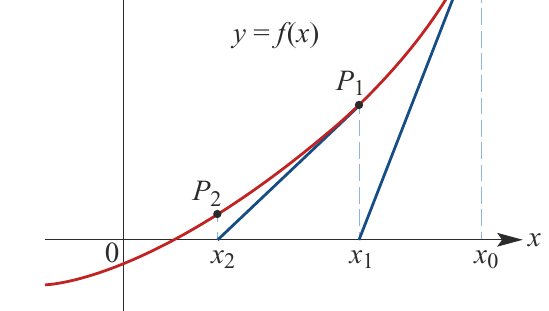
Step 3: Iterate the process
Consider the next point and repeat the process.
This creates a sequence of values with each one typically getting closer to the actual solution .
The formula for each step:
Moving from to uses the iterative formula:
where
Important
This process does not always work successfully, as we'll see in the next section. The method can fail when the derivative equals zero or when the sequence oscillates without converging.
Worked example: solving a cubic equation
Example
Worked Example: Solving a Cubic Equation
Problem: Use Newton's method to solve for .
Solution:
Let
The derivative is:
The iterative formula becomes:
Starting with , we obtain:
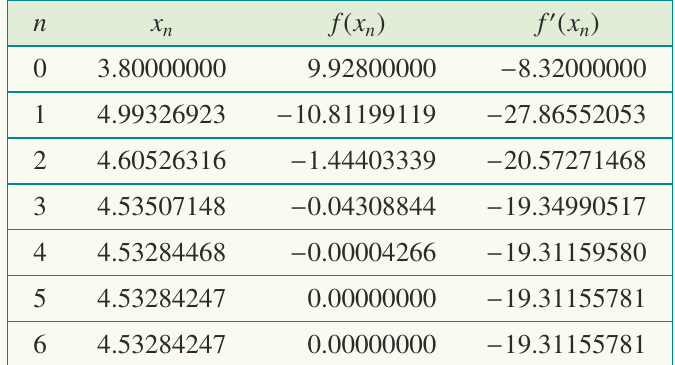
The convergence is rapid:
The solution is x ≈ 4.53284247
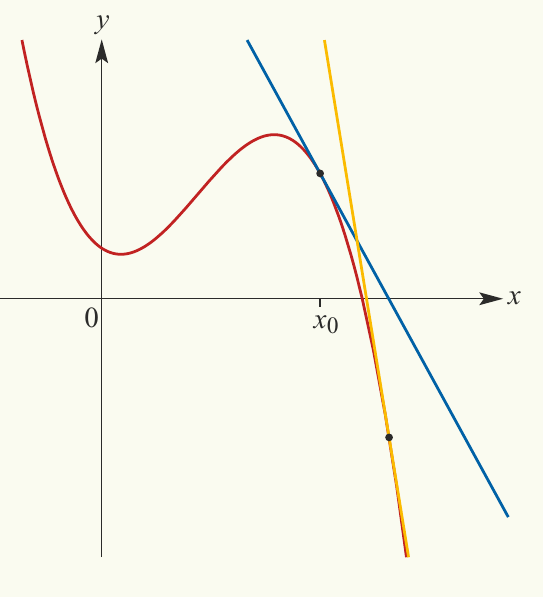
The graph below shows the first two tangent lines when starting at . Notice that the second tangent line passes through a point on the curve below the x-axis, demonstrating how the method works even when the function values are negative.
Note
Effect of different starting points:
The choice of starting point can significantly affect convergence speed:
- Starting at requires over 100 iterations to reach the solution
- Starting at requires only 12 iterations
- Starting at requires about 6 iterations
This shows the importance of choosing a good initial approximation when possible.
When Newton's method doesn't work
While Newton's method is powerful, there are situations where it fails to find a solution. The function provides excellent examples of these failure modes.
Oscillating sequences
What happens:
If you start with , the tangent line is:
This gives .
The tangent at is , which gives .
Important
Result: You get an oscillating sequence:
The method never converges to a solution; it just bounces back and forth between two values. This is a clear sign that Newton's method is failing.
Terminating sequences
What happens:
The function has stationary points at .
At these points, , which means the tangent line is horizontal (parallel to the x-axis).
Important
Result: The tangent never crosses the x-axis, so the method cannot proceed. The sequence terminates without finding a solution.
This happens whenever you encounter a point where the derivative equals zero.
Successful application
Despite these potential problems, Newton's method can be used successfully with if you choose appropriate starting points:
- For any starting point in the interval , you will get convergence to x = 0
- For any starting point in except for , you will get convergence to x = √5
- For any starting point in except for , you will get convergence to x = -√5
Note
Key insight: The success of Newton's method depends heavily on choosing an appropriate starting point that avoids problematic regions of the function, such as stationary points or regions that lead to oscillation.
Exam tips
Note
Important points for exams:
- Always check that before applying the formula, as division by zero is undefined
- Show your working clearly for each iteration when asked to demonstrate the method
- Be prepared to recognize when the method is failing (oscillating or terminating)
- Remember that faster convergence usually occurs when you start closer to the actual root
- Use a table format to organize your iterations clearly - this helps avoid errors and makes your work easy to follow
Remember!
Summary
Key Points to Remember:
-
Newton's method finds approximate solutions to equations of the form using an iterative process based on tangent lines.
-
The iterative formula is:
which generates successively better approximations.
-
Convergence is typically very fast when starting with a reasonable initial approximation, often achieving high accuracy within just a few iterations.
-
The method can fail in certain situations, including when it produces oscillating sequences or when the derivative equals zero (creating a horizontal tangent).
-
Choosing a good starting point is crucial for success - it should be reasonably close to the actual solution and away from stationary points or other problematic regions.