Miscellaneous Exercises (VCE SSCE Mathematical Methods): Revision Notes
📚Revision Notes
Miscellaneous Exercises
This section explores additional integration techniques and introduces methods for tackling more complex integrals. You'll learn how to use differentiation to help solve integration problems and when to employ CAS calculators for integrals that are beyond manual calculation.
Note
This section builds on your existing integration knowledge by showing you how to leverage differentiation patterns and modern calculators to solve challenging integration problems.
Using derivatives to evaluate integrals
Sometimes, finding an antiderivative becomes easier when you first differentiate a related function. By recognizing the derivative pattern in an integral, you can work backwards to find the solution.
Example
Worked Example: Integration using logarithmic differentiation
Let .
Part a: Show that
Part b: Hence evaluate
Solution:
Part a:
Let and .
Then .
Using the chain rule:
Therefore:
Part b:
Now we can use this result to evaluate the integral:
Important
Key insight: Notice how we factored out to match the derivative we found in part a. This technique of recognising derivative patterns is extremely useful.
Example
Worked Example: Integration using the quotient rule
Let .
Part a: Show that
Part b: Hence evaluate
Solution:
Part a:
Using the quotient rule:
Since :
Part b:
Using the result from part a:
Note
Exam tip: When evaluating trigonometric values, remember that , , and .
Integration involving logarithmic functions
Logarithmic functions often appear in integration problems, and recognizing derivative patterns involving the product rule can help you find their antiderivatives.
Example
Worked Example: Finding antiderivatives of logarithmic functions
Part a: If , find and hence find , where is a positive real constant.
Part b: If , find and hence find , where is a positive real constant.
Solution:
Part a:
Using the product rule:
Now we antidifferentiate both sides with respect to :
Rearranging:
Part b:
Using the product rule:
Antidifferentiating both sides with respect to :
Rearranging to isolate the desired integral:
Important
These results work because we can recognise the derivative pattern and work backwards. This technique is particularly useful for functions involving products of logarithms with polynomials.
Using CAS calculators for complex integrals
Some continuous functions don't have antiderivatives that can be expressed using elementary functions. For example, has no simple antiderivative formula. However, CAS calculators can evaluate definite integrals of such functions exactly.
Example
Worked Example: Calculator evaluation of complex integrals
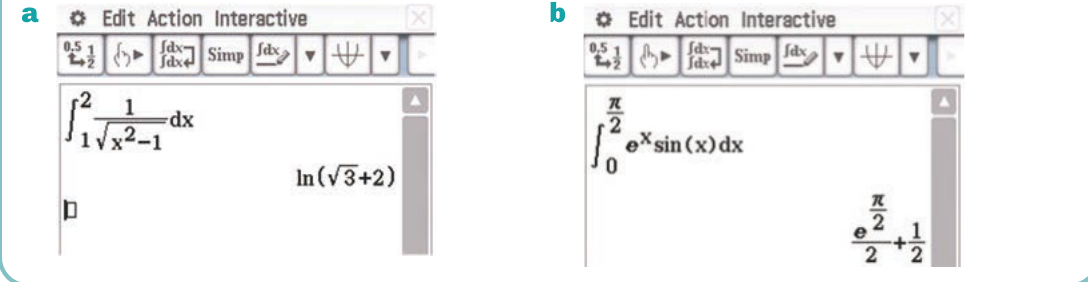
Part a: Find
Part b: Find
Using the TI-Nspire:
Use the Integral template from the Calculus menu and complete as shown below.
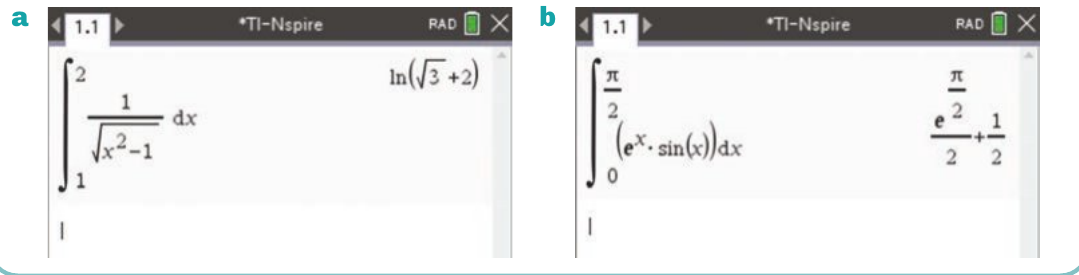
Results:
- Part a: or depending on which version is shown
- Part b:
Using the Casio ClassPad:
Follow these steps:
- Enter and highlight the expression or the expression
- Go to Interactive > Calculation > and select Definite
- Enter the lower limit and upper limit and tap OK
Note
When to use CAS: Use your calculator when:
- The integral involves complex expressions beyond your current techniques
- You need an exact answer for verification
- The antiderivative is not expressible in elementary functions
Important
Exam tip: Always check whether you're expected to find the answer by hand or if calculator use is permitted. Show all your working when using a calculator, including the integral setup.
Summary
Key Points to Remember:
-
Recognise derivative patterns: When you see an integral that looks like a derivative you know, try working backwards from the differentiation result.
-
Key integration formulas:
-
Use CAS wisely: CAS calculators are powerful tools for evaluating complex definite integrals, but make sure you understand when and how to use them appropriately.
-
Chain and quotient rules help: Differentiation techniques like the chain rule and quotient rule can guide you in recognising integration patterns and solving otherwise difficult integrals.
-
Check your answers: When possible, differentiate your result to verify it matches the original integrand.