Signed Area (VCE SSCE Mathematical Methods): Revision Notes
📚Revision Notes
Signed Area
Understanding signed area
When we work with areas under curves, we need to distinguish between total area and signed area.
Consider the graph of shown below. This line crosses both above and below the -axis, creating two distinct regions.
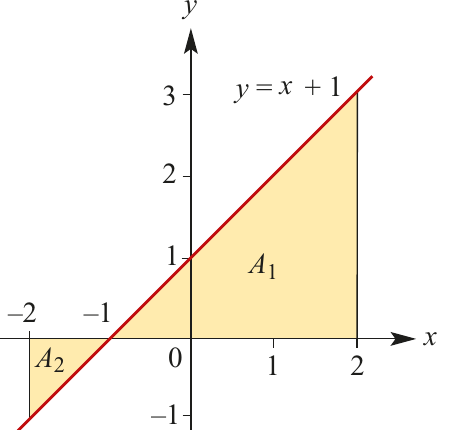
For this graph:
- Region (above the -axis) has an area of square units
- Region (below the -axis) has an area of square units
Note
The total area is found by adding all regions together, regardless of their position relative to the -axis. The signed area takes into account whether regions are above (positive) or below (negative) the -axis.
The total area is found by adding all regions together:
The signed area takes into account whether regions are above or below the -axis:
Positive and negative signed areas
Important
The fundamental rule for signed area:
- Regions above the -axis have positive signed area
- Regions below the -axis have negative signed area
Here's a more complex example showing multiple regions:
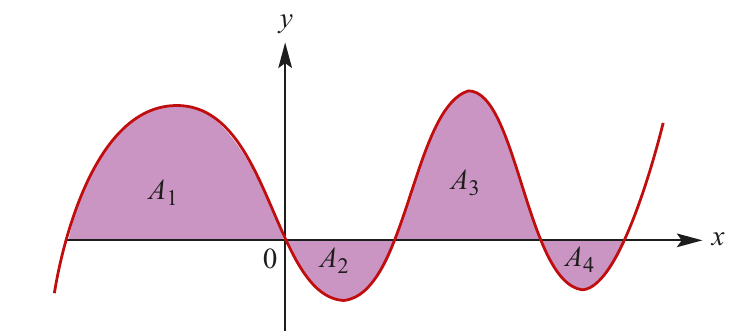
For the shaded regions shown:
- Total area =
- Signed area =
Notice how we add regions above the -axis and subtract regions below it when calculating signed area.
The definite integral and signed area
Important
The definite integral gives the signed area enclosed by the graph of between and .
This is important to understand: when you evaluate a definite integral, you automatically get the signed area. If part of the graph is below the -axis, that contribution will be negative.
Finding areas in different situations
The method for finding areas depends on whether the function is above or below the -axis in the given interval.
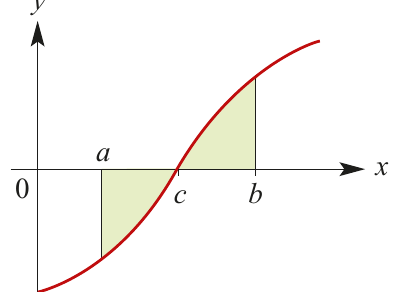
When the function is above the -axis
If f(x) ≥ 0 for all , then the area of the region between the curve, the -axis, and the vertical lines and is:
When the function is below the -axis
If f(x) ≤ 0 for all , then the area of the region between the curve, the -axis, and the vertical lines and is:
Note
We need the negative sign because the integral gives a negative value, but area must be positive.
When the function crosses the -axis
If the function crosses the -axis at point where , with , for , and for , then the total area is:
Important
When finding the area enclosed by a curve , the sign of f(x) in the given interval is the most important thing to consider.
Worked example: Area below the -axis
Example
Worked Example: Finding Area Below the -axis
Find the area of the shaded region.
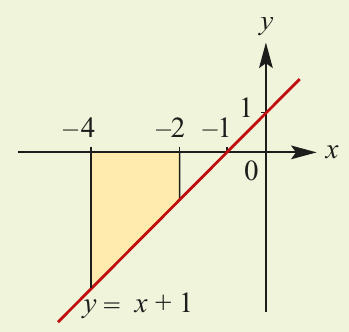
Solution:
Since the region is below the -axis, its signed area is negative. To find the actual area, we need to negate the integral:
The area of the shaded region is 4 square units.
Explanation: The integral gives us the signed area. Since the region is below the -axis, its signed area is negative, so we take the negative of the integral from to to get the positive area value.
Worked example: Areas above and below the -axis
Example
Worked Example: Areas Above and Below the -axis
a) Find the total area of the shaded regions.
b) Find the signed area of the shaded regions.
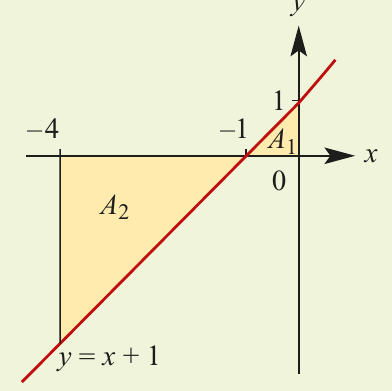
Solution:
Area is above the -axis and area is below the -axis.
Step 1: Find (above the -axis):
Step 2: Find (below the -axis), using the negative of the integral:
Step 3: Calculate the answers:
a) Total area = 5 square units
b) Signed area = -4 square units
Note
You can also find the signed area directly by evaluating .
Worked example: Parabola crossing the -axis
Example
Worked Example: Parabola Crossing the -axis
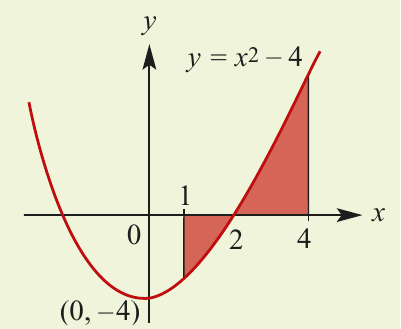
Find the area of the shaded region.
Solution:
The parabola crosses the -axis, so we need to split the region into two parts:
The area is square units.
Using a CAS calculator
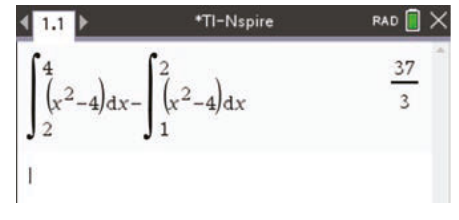
You can verify this result using a TI-Nspire calculator:
Note
Use menu > Calculus > Integral and enter the definite integrals as shown. The calculator confirms our answer of .
Worked example: Cubic function
Example
Worked Example: Cubic Function
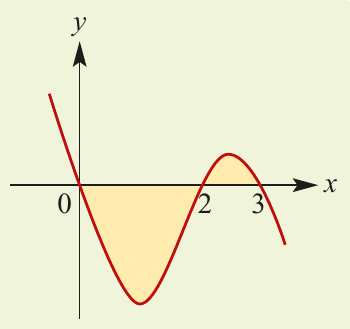
Find the area enclosed by the graph of and the -axis.
Solution:
Step 1: Expand the expression:
Step 2: Determine the sign of the function in each region.
The function is positive between and , and negative between and . Therefore:
Step 3: Evaluate the integrals:
The area is square units.
Note
There is no need to find the coordinates of any stationary points when calculating areas.
Properties of the definite integral
These algebraic properties are useful when working with definite integrals:
Note
Properties of Definite Integrals:
Splitting intervals:
Zero width interval:
Constant multiple:
Sum and difference:
Reversing limits:
Quick example
Example
Worked Example: Using Properties of Definite Integrals
Given that , evaluate:
a)
b)
c)
Remember!
Summary
Key Points to Remember:
- Regions above the -axis contribute positive signed area; regions below contribute negative signed area
- The definite integral automatically gives you the signed area, not the total area
- When finding total area with regions crossing the -axis, split the integral at the -intercepts and add the absolute values
- Always check the sign of f(x) in your interval—this determines whether you need to negate the integral to get positive area
- Use the properties of definite integrals to simplify calculations when possible