The Fundamental Theorem of Calculus and the Definite Integral (VCE SSCE Mathematical Methods): Revision Notes
📚Revision Notes
The Fundamental Theorem of Calculus and the Definite Integral
Introduction to definite and indefinite integrals
In previous sections, you learned about indefinite integrals. These are called "indefinite" because they include an arbitrary constant in their solution. For example, when we integrate , we write:
More generally, we express this as:
where is an antiderivative of .
Note
The constant appears in indefinite integrals because differentiation of a constant equals zero, meaning there are infinitely many antiderivatives that differ only by a constant value.
Now we'll explore the definite integral and discover its powerful connection to the indefinite integral through the Fundamental Theorem of Calculus.
Signed area
When working with definite integrals, we need to understand the concept of signed area. This is crucial because the area under a curve can be above or below the -axis.
Regions above and below the x-axis
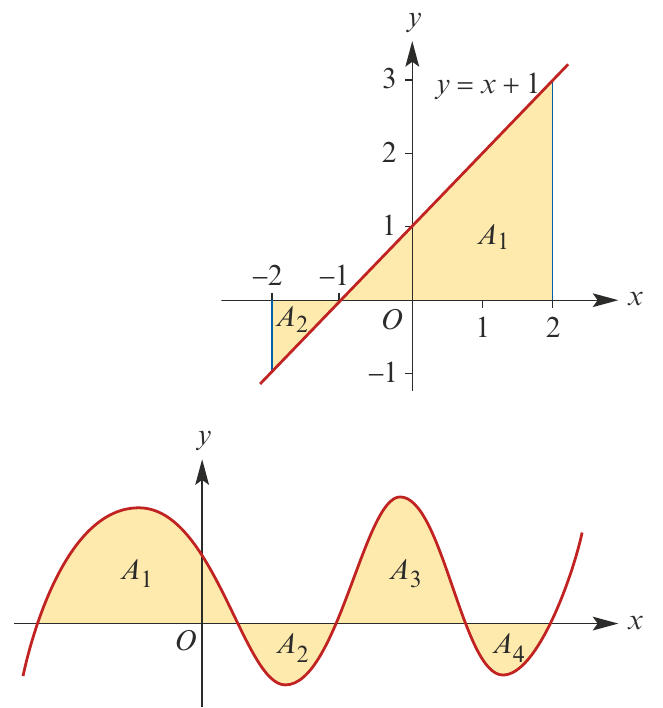
Important
Key principle:
- Regions above the x-axis have positive signed area
- Regions below the x-axis have negative signed area
Example: the line y = x + 1
Consider the graph of . Looking at the shaded regions:
(triangle above the -axis)
(triangle below the -axis)
The total area is:
The signed area is:
General case with periodic functions
For a curve with multiple regions above and below the -axis (such as a sine wave), the calculations work as follows:
Total area:
Signed area:
Formal definition
Note
For any continuous function on an interval , the definite integral gives the signed area enclosed by the graph of between and .
This means the definite integral accounts for whether regions are above or below the -axis, making some contributions positive and others negative.
The Fundamental Theorem of Calculus
This theorem creates a remarkable bridge between antiderivatives and areas under curves. It tells us that we can calculate definite integrals by using antiderivatives.
Statement of the theorem
Important
Fundamental Theorem of Calculus:
If is a continuous function on an interval , then:
where is any antiderivative of .
Notation for evaluation
To make our working clearer, we use the notation:
This notation means: "evaluate at the upper limit , then subtract the value of at the lower limit ."
Evaluating definite integrals
Let's see how the Fundamental Theorem works in practice through several worked examples.
Worked example: basic polynomial
Example
Evaluate:
Solution:
First, find the antiderivative of :
Now apply the Fundamental Theorem:
Important
The arbitrary constant cancels out when we subtract from . Because of this, we can ignore the constant when evaluating definite integrals.
Worked example: power functions
Example
Evaluate:
a)
b)
c)
Solution:
a)
b)
Notice that this is the negative of part (a). This illustrates the property that reversing the limits changes the sign of the integral.
c)
Worked example: exponential functions
Example
Evaluate:
a)
b)
c)
Solution:
a)
b)
c)
Worked example: logarithmic functions
Example
Evaluate:
a)
b)
Solution:
a)
b)
Properties of the definite integral
Understanding these properties will help you manipulate and simplify definite integrals efficiently:
Note
Properties of Definite Integrals:
1. Additive property over intervals:
This means you can split an integral at any point between and .
2. Zero interval:
An integral over an interval with no width equals zero.
3. Constant multiple:
You can factor out constants from integrals.
4. Sum and difference:
You can split the integral of a sum or difference into separate integrals.
5. Reversal of limits:
Swapping the upper and lower limits changes the sign of the integral.
Remember!
Summary
Key Points to Remember:
- The definite integral represents the signed area between the curve and the -axis from to .
- Areas above the -axis contribute positively; areas below contribute negatively.
- The Fundamental Theorem of Calculus states: , where is any antiderivative of .
- When evaluating definite integrals, the arbitrary constant always cancels out, so we don't need to include it.
- Remember the notation: "top minus bottom" – evaluate at the upper limit and subtract the value at the lower limit.