Two Antiderivatives (VCE SSCE Mathematical Methods): Revision Notes
📚Revision Notes
Two Antiderivatives
When we integrate expressions involving linear functions raised to a power, we encounter two distinct cases that require different approaches. Understanding these two antiderivatives is essential for solving a wide range of integration problems.
The power rule for when
When integrating a linear expression raised to any power except , we can use a straightforward formula derived from reversing the chain rule.
Consider a function of the form where . Using the chain rule to differentiate this gives us:
Therefore, when we integrate , we must reverse this process:
Summary
Key points to remember:
- Increase the power by (from to )
- Divide by the coefficient of (which is ) multiplied by the new power
- Don't forget the constant of integration
- This formula does NOT work when
Example
Worked Example: Power Functions
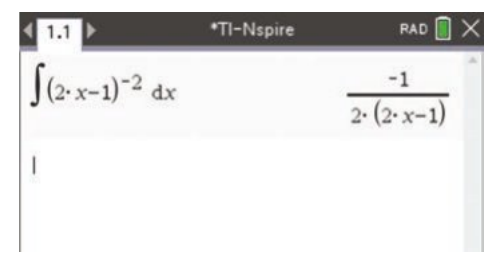
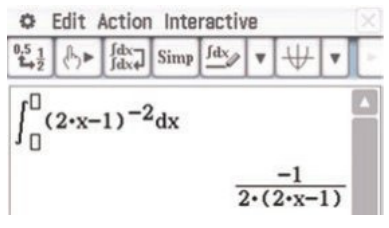
Let's find the general antiderivative of .
Now consider :
This can also be written as:
The logarithmic case when
The special case occurs when , which means we're trying to integrate . The power rule cannot be used here because it would involve division by zero.
Instead, we need to recall that the derivative of is . This connection to logarithms is what makes a special case.
Understanding the positive and negative cases
The antiderivative of depends on whether is positive or negative:
Note
For :
For :
We need to use instead. This is because when , the derivative of equals :
Therefore:
Simplifying with absolute value
To avoid dealing with separate cases, we can use the absolute value function. The absolute value is defined as:
For example, and .
Important
Using absolute value notation, we can write a single formula that works for all cases where :
This approach is recommended because it avoids confusion and is consistent with how calculators display the result.
Example
Worked Example: Logarithmic Integration
Find the general antiderivative of for .
Since , we know that , so:
For , we would have , giving:
Using absolute value notation, we can write both cases as:
Example
Worked Example: Finding a Particular Solution
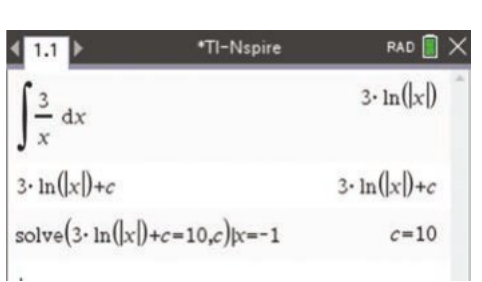
Given for and when , find an expression for in terms of .
First, integrate to find the general solution:
Now use the initial condition when :
Therefore:
Note
For with the same derivative but when :
Notice that using absolute value notation, both solutions can be written as .
Example
Worked Example: Another Logarithmic Case
Find the general antiderivative of .
Note the negative sign appears because the coefficient of in the denominator is .
Summary of the two cases
Summary
Case 1: When :
Case 2: When (and ):
Remember!
Summary
Essential Points to Remember:
- The power rule for works for all values of except
- When , the antiderivative involves a natural logarithm, not a power function
- Always use absolute value notation in logarithmic antiderivatives:
- Don't forget to divide by the coefficient in both cases
- The constant of integration must be included for general antiderivatives