Conditional Probability (VCE SSCE Mathematical Methods): Revision Notes
📚Revision Notes
Conditional Probability
What is conditional probability?
When we're dealing with probability, we often want to know how likely something is based on information we already have. Conditional probability helps us answer questions like: "If we know event B has happened, what's the probability that event A will also happen?"
This type of probability is written as , which we read as "the probability of A given B". The vertical line symbol means "given" or "knowing that".
Note
Think of conditional probability as adjusting our expectations based on new information. For example, if you're tossing a coin twice, the probability that the second toss is heads might be affected by what happened on the first toss.
Understanding through sample space restriction
The key idea behind conditional probability is that when we know event B has occurred, we can restrict our sample space to only include outcomes where B happens.
Example
Worked Example: Rolling a die
Imagine rolling a fair six-sided die. Let's define:
- Event A: rolling a six
- Event B: rolling an even number
Question: What is the probability of rolling a six, given that we know an even number was rolled?
Solution:
Since we know an even number was rolled, the only possible outcomes are 2, 4, or 6. We've restricted our sample space from all six faces to just these three.
Notice that without the condition, the probability of rolling a six would be , but knowing an even number was rolled changes this to .
Example
Worked Example: Language study
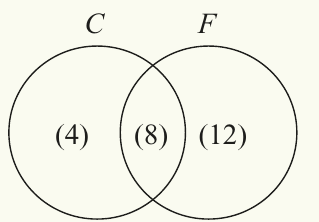
In Stephen's class, 12 students study Chinese, 20 study French, and 8 study both languages.
Question a: Given that a student studies Chinese (C), what is the probability they also study French (F)?
Question b: Given that a student studies French, what is the probability they also study Chinese?
Solution:
Part a:
If we know a student studies Chinese, our sample space is restricted to those 12 students. Of these 12, we can see from the Venn diagram that 8 also study French.
Part b:
If we know a student studies French, our sample space is restricted to those 20 students. Of these 20, we can see that 8 also study Chinese.
Important
Notice that . In general, the probability of A given B is NOT the same as the probability of B given A. This is a crucial concept to remember - the order matters in conditional probability!
Example
Worked Example: Social media survey
500 people were surveyed and classified by age group and whether they regularly use social media.
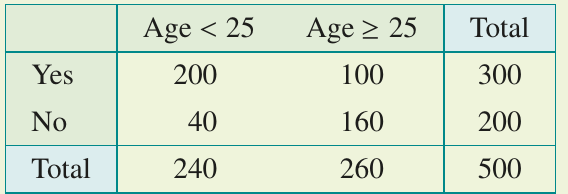
Question: One person is selected at random. Given that they are less than 25 years old, what is the probability they regularly use social media?
Solution:
Since we know the person is less than 25 years old, our sample space is restricted to the 240 people in that age group. From the table, we can see that 200 of these people answered "Yes" to using social media regularly.
The conditional probability formula
Looking at the social media example above, we can derive a general formula. Notice that:
If we divide the first by the second:
This equals our conditional probability! This gives us the general formula:
Note
This formula tells us that the conditional probability of A given B equals the probability of both A and B occurring, divided by the probability of B occurring. This algebraic approach is particularly useful when you have probability values rather than counting outcomes directly.
The multiplication rule
We can rearrange the conditional probability formula to get another useful relationship called the multiplication rule:
This formula is particularly useful when we know conditional probabilities and want to find the probability of both events occurring together.
Example
Worked Example: Using the multiplication rule
Given that for two events A and B, , , and , find:
Question a:
Question b:
Solution:
Part a:
Using the multiplication rule:
Part b:
Using the conditional probability formula:
Example
Worked Example: Mathematics preferences
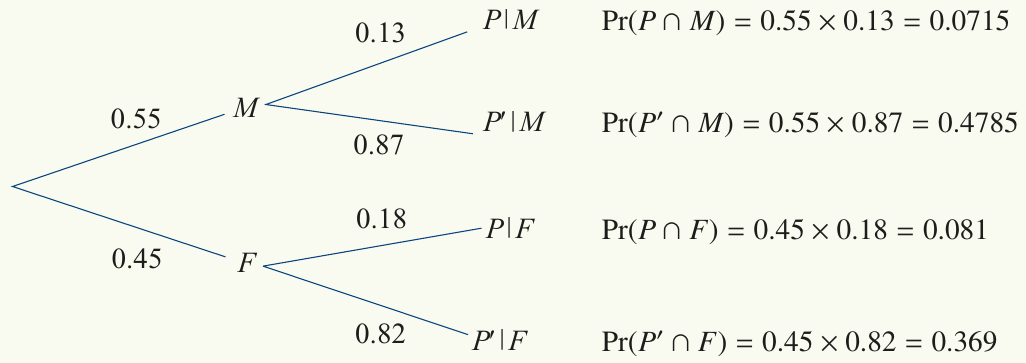
In a school, 55% of students are male and 45% are female. Of the male students, 13% say mathematics is their favourite subject, while 18% of female students prefer mathematics.
Find the probability that a randomly chosen student:
Question a: prefers mathematics and is female
Question b: prefers mathematics and is male
Solution:
Let M represent male, F represent female, and P represent prefers mathematics.
Given information:
Part a:
The event "prefers mathematics and is female" is .
Part b:
The event "prefers mathematics and is male" is .
Using tree diagrams
Tree diagrams provide a visual way to organise and calculate probabilities in multi-stage situations. The probabilities on each branch are conditional probabilities showing the chance of taking that path.
Note
The Tree Diagram Rule: To find the probability of reaching the end of any branch, we multiply the probabilities along that branch. To find the probability of an event that can happen in multiple ways, we add the probabilities from all relevant branches.
Remember: "Multiply along, add across"
Example
Worked Example: Tree diagram application
Using the information from the previous mathematics preference example, construct a tree diagram and use it to find:
Question a: the probability a student is female and does not prefer mathematics
Question b: the overall percentage of students who prefer mathematics
Solution:
Part a:
To find the probability that a student is female and does not prefer mathematics, we multiply along the appropriate branch:
Part b:
A student prefers mathematics if they are either male and prefer mathematics, or female and prefer mathematics. These are mutually exclusive events (they can't both happen), so we add their probabilities:
Therefore, 15.25% of all students prefer mathematics.
The law of total probability
The solution to part b above uses an important principle called the law of total probability. This law allows us to find the overall probability of an event by considering all the different ways it can occur.
For two events A and B, the law states:
Note
In words: the probability of A equals the probability of A given B (multiplied by the probability of B), plus the probability of A given B doesn't occur (multiplied by the probability B doesn't occur).
This is particularly useful when you can break down an event into mutually exclusive cases.
Example
Worked Example: Weather prediction
In a certain town, the probability of rain on any Monday is 0.21. If it rains on Monday, the probability of rain on Tuesday is 0.83. If it doesn't rain on Monday, the probability of rain on Tuesday is 0.3.
Find the probability that it rains:
Question a: on both Monday and Tuesday
Question b: on Tuesday
Solution:
Let M represent rain on Monday and T represent rain on Tuesday.
Given information:
We can represent this with a tree diagram showing all four possible outcomes:
Part a:
The probability it rains on both Monday and Tuesday:
Part b:
The probability it rains on Tuesday (using the law of total probability):
Summary
Key Points to Remember:
-
Conditional probability represents the probability of event A occurring when we know event B has already occurred
-
The key formula is: (when )
-
The multiplication rule rearranges this to:
-
In general, - the order matters!
-
Tree diagrams help visualise multi-stage probability problems: multiply along branches, add across branches
-
The law of total probability states: