Sample Spaces and Probability (VCE SSCE Mathematical Methods): Revision Notes
📚Revision Notes
Sample Spaces and Probability
Introduction
Probability is built on two essential components: the sample space, which represents all possible outcomes of an experiment, and a set of probabilities, one assigned to each outcome. Understanding these concepts forms the foundation for working with probability.
Sample spaces
When we perform an experiment with uncertain outcomes, we call this a random experiment. A single performance of this experiment is known as a trial. Although we cannot predict the exact outcome before conducting the trial, we know the outcome must be one from a specific set of possibilities.
The sample space is the complete set of all possible outcomes that could occur in a random experiment. We use the Greek letter (epsilon) to denote the sample space throughout probability.
Note
Throughout probability theory, we use the Greek letter (epsilon) to represent the sample space. This notation is standard and helps distinguish the sample space from other sets.
Notation and representation
We express sample spaces using set notation with curly brackets. For example, when tossing a coin, the sample space is:
where represents heads and represents tails.
Types of sample spaces
Sample spaces can be classified in two ways:
Finite or infinite:
- A finite sample space contains a countable, limited number of outcomes
- An infinite sample space contains unlimited outcomes
Discrete or continuous:
- A discrete sample space has separate, distinct outcomes (like counting numbers)
- A continuous sample space has outcomes forming a continuous range (like time or distance)
Examples of sample spaces
The following table shows various random experiments and their corresponding sample spaces:
| Random experiment | Sample space |
|---|---|
| The number observed when a die is rolled | |
| The number of brown eggs in a carton of 12 eggs | |
| The result when two coins are tossed | |
| The number of calls to your phone in the next two hours | |
| The time, in hours, it takes to complete your homework |
The first three examples show discrete, finite sample spaces. The phone calls example is discrete but infinite (indicated by the dots). The homework time example is continuous (time can take any non-negative value).
Events
An event is a subset of the sample space. It represents a particular outcome or collection of outcomes that we are interested in. Events can consist of a single outcome or multiple outcomes.
We use capital letters (, , , etc.) to denote events and express them using set notation.
Examples of events
Consider rolling a die where :
- The event "getting a six" = (single outcome)
- The event "getting an odd number" = (multiple outcomes)
The table below shows sample spaces with corresponding events:
| Sample space | An event |
|---|---|
| Rolling a die: | "An even number" = |
| Brown eggs in a carton: | "More than half brown" = |
| Two coins tossed: | "Two heads" = |
| Phone calls in two hours: | "Fewer than two phone calls" = |
| Homework time: | "More than two hours" = |
Example
Worked Example: Drawing Marbles
A bag contains seven marbles numbered from 1 to 7 and a marble is withdrawn.
a) Give the sample space for this experiment.
b) List the outcomes of the event "a marble with an odd number is withdrawn".
Solution:
a)
Any number from 1 to 7 could be observed when drawing a marble.
b)
This set contains the odd numbers from the sample space.
Determining probabilities for equally likely outcomes
In many situations, we can reasonably assume all outcomes are equally likely to occur. For example, when rolling a fair die, each number from 1 to 6 has the same chance of appearing.
Important
Basic probability requirements:
- Each probability must be a non-negative number
- Probabilities lie in the interval
- The probabilities of all outcomes in the sample space must sum to 1
Probability for equally likely outcomes
When the sample space contains outcomes that are all equally likely, we assign a probability of to each outcome.
For example, when rolling a die with six equally likely outcomes:
Calculating event probabilities
The probability of an event equals the sum of the probabilities of all outcomes in that event.
For equally likely outcomes, we can use the formula:
where:
- represents the number of elements in event (= )
- represents the total number of elements in the sample space (= )
Example: Let be the event that an even number is rolled on a die.
, so and
Example
Worked Example: Choosing a Prime Number
A number is drawn at random from the numbers 7, 8, 9, 10, 11, 12, 13, 14. What is the probability of choosing a prime number?
Solution:
Let be the event that the chosen number is prime.
and
Since the number is drawn at random, each number is equally likely to be drawn.
Note
Not all situations involve equally likely outcomes. For instance, the probability of a male birth is actually 0.51, not 0.5. However, the assumption of equally likely outcomes is valid in many common situations and allows us to assign probabilities reasonably.
Rules of probability
For finite sample spaces, probability must follow two fundamental rules:
Important
Rule 1: for any event
Every probability must be non-negative.
Rule 2: The sum of the probabilities of all outcomes of a random experiment must equal 1
These rules help us determine unknown probabilities.
Example
Worked Example: Finding Missing Probability
A random experiment may result in 1, 2, 3 or 4. If , and , find the probability of obtaining a 4.
Solution:
The sum of all probabilities equals 1.
Probabilities with spinners
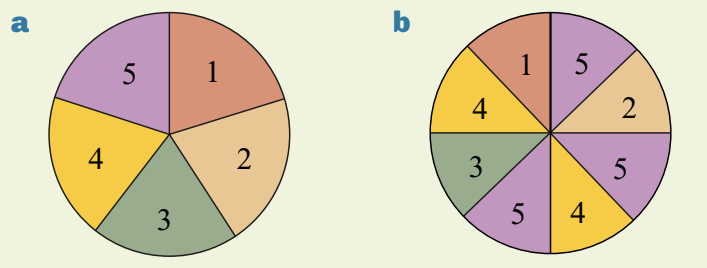
When working with spinners divided into sectors, we can determine probabilities based on the relative sizes of the sectors.
Example
Worked Example: Spinner Probabilities
Find the probability that each of the possible outcomes is observed for the spinners shown above.
Solution:
Spinner a: Five equal sectors, so each outcome is equally likely.
Spinner b: Eight equal sectors total. Count how many times each number appears:
- Numbers 1, 2, and 3 each appear once
- Number 4 appears twice
- Number 5 appears three times
In both cases, the probabilities sum to 1:
Complementary events
Complementary events are two events that have no elements in common and together make up the entire sample space. The complement of event is written as (read as "A prime" or "A complement").
The complement contains all outcomes in that are not in .
Important
Formula for complementary events:
Since the probabilities of all outcomes must sum to 1:
This formula is extremely useful for calculating probabilities when it's easier to find the probability of the complement.
Example
Worked Example: Drawing Cards
A card is drawn at random from a pack of 52 cards. What is the probability that the card is:
a) not a heart
b) not an ace?
Solution:
a) Let be the event that a heart is drawn.
There are 13 hearts in a pack of 52 cards, so
b) Let be the event that an ace is drawn.
There are 4 aces in a pack of 52 cards, so
Example
Worked Example: Unequal Probabilities
A random experiment may result in outcomes , , , or , where , , , are equally likely and is twice as likely as . Find:
a)
b)
Solution:
a) Let
Then (since is twice as likely as )
The sum of all probabilities equals 1:
Therefore:
b) Since is the complement of :
Summary
Key Points to Remember:
- The sample space contains all possible outcomes of a random experiment
- An event is a subset of the sample space, representing specific outcomes of interest
- For equally likely outcomes in a sample space with elements, each outcome has probability
- The probability of an event is calculated as: when outcomes are equally likely
- All probabilities must be non-negative and the sum of all outcome probabilities equals 1
- Complementary events and satisfy: