Combinations of Transformations (VCE SSCE Mathematical Methods): Revision Notes
📚Revision Notes
Combinations of Transformations
When working with function graphs, you'll often need to apply more than one transformation sequence. This section shows you how to combine dilations, reflections, and translations in sequence to create new graphs.
Note
Combining transformations allows you to create complex graphs from simple ones. Instead of memorizing dozens of different function shapes, you can learn how to transform a few basic functions to get the graphs you need.
Why transformation order matters
Important
The order in which you apply transformations is crucial. Different sequences produce different results. Think of it like getting dressed - putting on socks then shoes gives a different result than shoes then socks!
When combining transformations, you build up the mapping step by step. Each transformation takes the output from the previous one.
Building transformation sequences
Let's look at how to combine transformations systematically.
Example: Dilation followed by reflection
Start with a dilation of factor from the -axis, followed by a reflection in the -axis.
We write the mapping as:
First we apply the dilation, then the reflection.
For instance, the point transforms like this:
Example: Dilation followed by translation
Now consider a dilation of factor from the -axis, followed by a translation of units right and units down.
The mapping becomes:
For the point :
Finding equations after combined transformations
Important
When you need to find the equation of a transformed graph, follow this systematic method. The key is to work with primed coordinates for the image, then work backwards to express the original coordinates in terms of the new ones.
Step 1: Write out the complete mapping by applying each transformation in order
Step 2: Let be the coordinates of the image point. Express and in terms of and
Step 3: Rearrange these expressions to write and in terms of and
Step 4: Substitute these expressions into the original equation
Step 5: Simplify and rewrite using and (dropping the primes)
Let's see this method in action with some examples.
Worked example: Square root function with dilation and reflection
Example
Worked Example: Square Root Function with Dilation and Reflection
Find the equation of the image of under a dilation of factor from the -axis followed by a reflection in the -axis.
Solution
The mapping is:
If maps to , then:
Rearranging these:
Substitute into the original equation :
Therefore:
The equation of the image is y = -2√x
Worked example: Square root function with dilation and translation
Example
Worked Example: Square Root Function with Dilation and Translation
Find the equation of the image of under a dilation of factor from the -axis followed by a translation of units right and units down.
Solution
The mapping is:
If maps to , then:
Rearranging:
Substitute into :
Therefore:
The equation of the image is y = 2√(x - 2) - 3
Sketching sequential transformations
When sketching the result of multiple transformations, it helps to draw each stage separately. This lets you track how the graph changes at each step.
Worked example: Sketching step by step
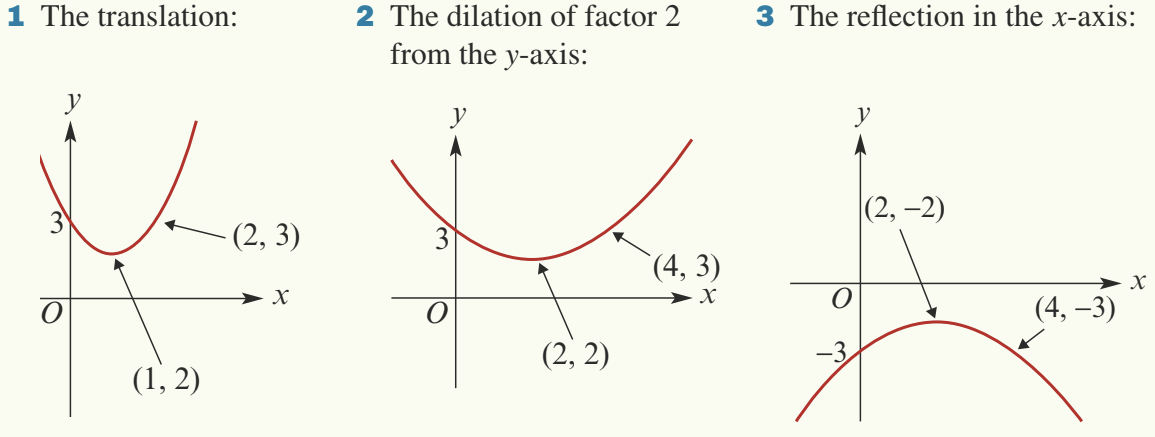
Consider a parabola transformed by:
- Translation of unit right and units up
- Dilation of factor from the -axis
- Reflection in the -axis
Note
At each stage, key points move according to the transformation rule. By tracking these points, you can sketch the final image accurately. The diagram above shows how the parabola changes at each transformation stage.
Worked example: Complex transformation sequence
Example
Worked Example: Complex Transformation Sequence
The graph of is transformed by:
- Translation units left
- Reflection in the -axis
- Dilation by factor from the -axis
Find the equation of the final image.
Solution
Apply each transformation in sequence:
Translation units left:
Reflection in the -axis:
Dilation factor from -axis:
The complete mapping is:
Let be the image coordinates. Then:
Rearranging:
Substitute into :
Therefore:
The rule of the transformed function is y = 2√(6 - x)
Worked example: Parabola transformation sequence
Example
Worked Example: Parabola Transformation Sequence
For the graph of , sketch the image and state its rule after these transformations:
- Translation unit right and units up
- Dilation factor from the -axis
- Reflection in the -axis
Solution
The complete mapping is:
Let be the image of . Then:
Rearranging:
Substitute into :
The rule of the image is y = -¼(x - 2)² - 2
Using technology to verify transformations
Graphing calculators can help you verify transformation equations and visualize the results.
Note
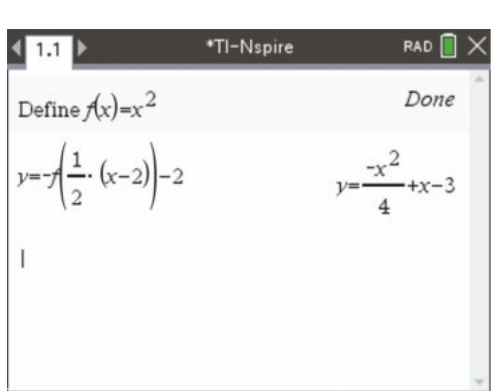
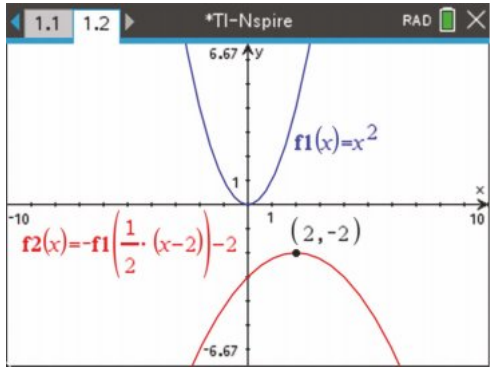
Using the TI-Nspire:
- Define the original function, for example f(x) = x²
- Enter the transformation in function notation: -f(½(x-2)) - 2
- The calculator will simplify this to standard form
- You can also graph both functions to see the transformation visually
Note
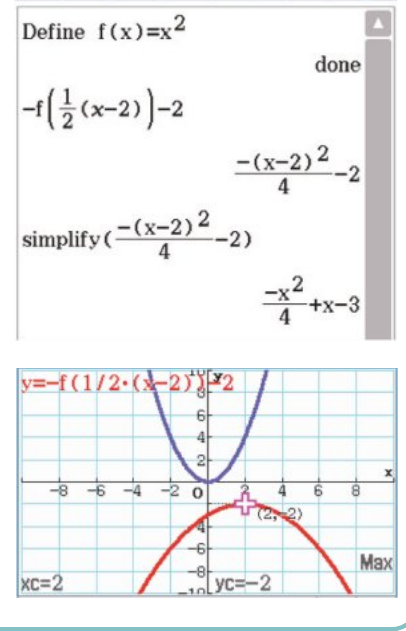
Using the Casio ClassPad:
- Define f(x) = x²
- Enter the transformed function: -f(½(x-2)) - 2
- Use the simplify function to expand the expression
- Graph both functions to compare them
Remember!
Summary
Key Points to Remember:
-
Order matters: Apply transformations in the exact sequence given. Different orders produce different results.
-
Build step by step: Write out the complete mapping by applying each transformation one at a time.
-
Use primed coordinates: Let represent the final image, then work backwards to express the original coordinates in terms of the new ones.
-
Substitute carefully: After finding and in terms of and , substitute these into the original equation and simplify.
-
Verify with technology: Use your calculator to check your transformed equation and visualize the graph.