Dilations (VCE SSCE Mathematical Methods): Revision Notes
📚Revision Notes
Dilations
Introduction
A dilation is a transformation that stretches or shrinks a graph away from or towards a coordinate axis. Think of it like pulling or pushing the graph in one direction while keeping it anchored to one of the axes.
Note
To understand dilations, we'll start with a simple example using a circle centered at the origin. This makes it easy to see how points move during the transformation.
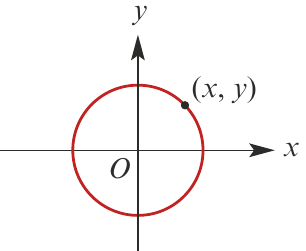
A dilation can stretch a graph (make it larger) or compress it (make it smaller), depending on the dilation factor used.
Dilation from the x-axis
A dilation from the x-axis is a vertical transformation. It changes the y-coordinates of points while leaving the x-coordinates unchanged.
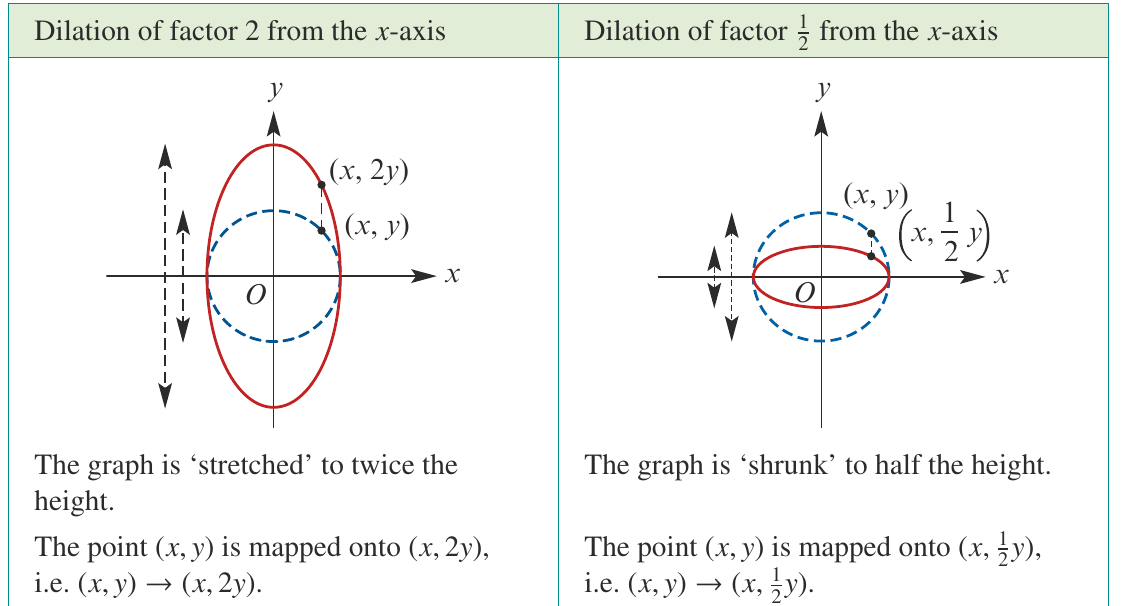
Understanding vertical dilations
When we dilate a graph by a factor from the x-axis:
- Factor greater than 1: The graph stretches vertically (becomes taller)
- Factor between 0 and 1: The graph compresses vertically (becomes shorter)
Note
For example:
- A dilation of factor 2 from the x-axis makes the graph twice as tall
- A dilation of factor from the x-axis makes the graph half as tall
The general rule
Important
For a positive constant, a dilation of factor from the x-axis follows the rule:
This means:
- (x-coordinate stays the same)
- (y-coordinate is multiplied by )
Finding the equation after dilation
For the graph of , there are two equivalent ways to find the equation after dilation from the x-axis:
- Apply the transformation rule to the graph
- Replace with in the original equation to get
Both methods produce the same result.
Worked example: Dilation from the x-axis
Example
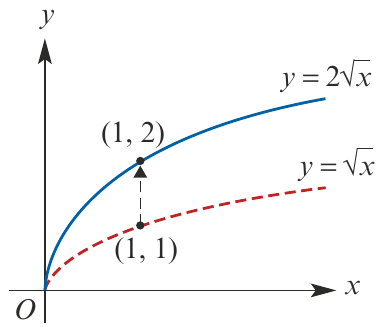
Worked Example: Dilating y = √x from the x-axis
Consider the curve with a dilation of factor 2 from the x-axis.
Let be the image of a point on the original curve.
Step 1: Using the transformation rule:
Step 2: Solving for and :
Step 3: Since the original point satisfies , we substitute:
Step 4: Multiplying both sides by 2:
Result: The curve transforms to the curve y = 2√x.
Dilation from the y-axis
A dilation from the y-axis is a horizontal transformation. It changes the x-coordinates of points while leaving the y-coordinates unchanged.
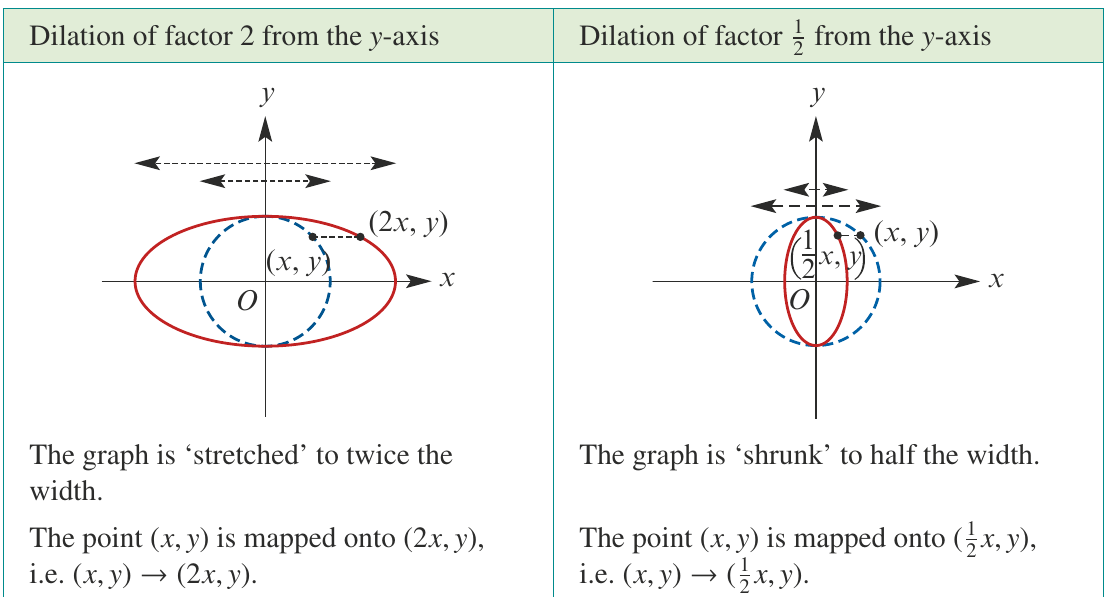
Understanding horizontal dilations
When we dilate a graph by a factor from the y-axis:
- Factor greater than 1: The graph stretches horizontally (becomes wider)
- Factor between 0 and 1: The graph compresses horizontally (becomes narrower)
Note
For example:
- A dilation of factor 2 from the y-axis makes the graph twice as wide
- A dilation of factor from the y-axis makes the graph half as wide
The general rule
Important
For a positive constant, a dilation of factor from the y-axis follows the rule:
This means:
- (x-coordinate is multiplied by )
- (y-coordinate stays the same)
Finding the equation after dilation
For the graph of , there are two equivalent ways to find the equation after dilation from the y-axis:
- Apply the transformation rule to the graph
- Replace with in the original equation to get
Both methods produce the same result.
Worked example: Dilation from the y-axis
Example
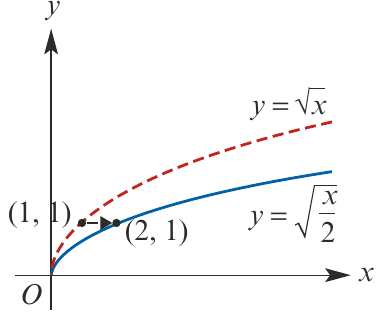
Worked Example: Dilating y = √x from the y-axis
Consider the curve with a dilation of factor 2 from the y-axis.
Let be the image of a point on the original curve.
Step 1: Using the transformation rule:
Step 2: Solving for and :
Step 3: Since the original point satisfies , we substitute:
Result: This can be written as y = √(x/2).
Worked example: Finding equations after dilation
Example
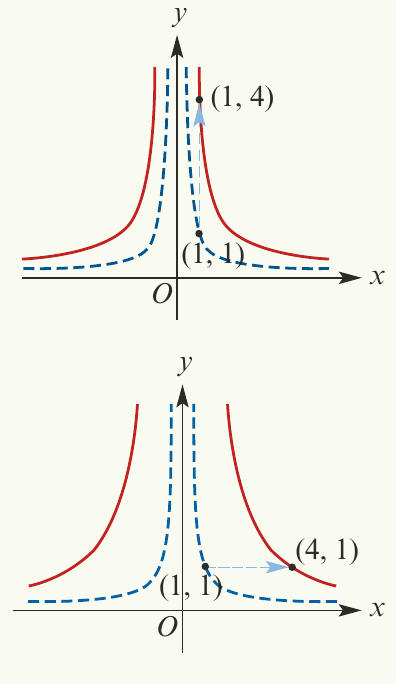
Worked Example: Dilating y = 1/x²
Question: Determine the rule of the image when the graph of is dilated by a factor of 4:
a) from the x-axis
b) from the y-axis
Solution to part a) - Dilation from the x-axis
The transformation rule is .
Let be the coordinates of the image of :
Solving for and :
Substituting into the original equation :
Multiplying both sides by 4:
Answer: The equation of the transformed function is y = 4/x²
Example
Solution to part b) - Dilation from the y-axis
The transformation rule is .
Let be the coordinates of the image of :
Solving for and :
Substituting into the original equation :
Answer: The equation of the transformed function is y = 16/x²
Worked example: Finding the dilation factor
Example
Worked Example: Finding Dilation Factors
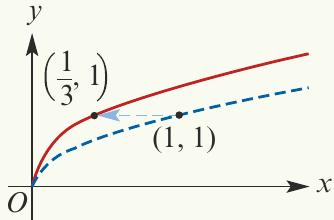
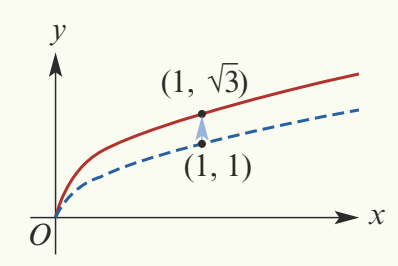
Question: Determine the factor of dilation when the graph of is obtained by dilating the graph of :
a) from the y-axis
b) from the x-axis
Solution to part a) - From the y-axis
A dilation from the y-axis affects x-values. We need to write the transformed function showing how x has changed.
Write: where are the coordinates of the image of .
This means and (note that x is changed).
Solving for and :
The transformation rule is .
Answer: The graph of is dilated by a factor of 1/3 from the y-axis to produce the graph of .
Example
Solution to part b) - From the x-axis
A dilation from the x-axis affects y-values. We need to write the transformed function showing how y has changed.
Write: where are the coordinates of the image of .
This means and (note that y is changed).
Solving for and :
The transformation rule is .
Answer: The graph of is dilated by a factor of √3 from the x-axis to produce the graph of .
Remember!
Summary
Key Points to Remember:
-
Dilation from the x-axis creates vertical stretching (if ) or compression (if ). The equation becomes .
-
Dilation from the y-axis creates horizontal stretching (if ) or compression (if ). The equation becomes .
-
To find the equation after dilation: Use the substitution method - express the primed coordinates in terms of unprimed, then solve for unprimed coordinates and substitute into the original equation.
-
x-axis dilations change y-coordinates only; y-axis dilations change x-coordinates only. A helpful reminder: "x-axis dilations touch y, y-axis dilations touch x."
-
Factor greater than 1 means stretching; factor between 0 and 1 means compression. The larger the factor, the more stretched the graph becomes.