Transformations of Power Functions With Positive Integer Index (VCE SSCE Mathematical Methods): Revision Notes
📚Revision Notes
Transformations of Power Functions With Positive Integer Index
Introduction to power functions
A power function is a function with the form , where is a positive integer. These functions form the building blocks for many polynomial expressions.
Not all polynomials can be written in transformation form, but many can be expressed as:
where , , and are real constants.
Note
This transformation form allows us to understand how the basic power function has been transformed through:
- Dilations - controlled by parameter
- Reflections - when is negative
- Translations - controlled by parameters (horizontal) and (vertical)
Power functions with odd positive integer index
Basic characteristics of odd power functions
When is an odd positive integer (such as ), the function has distinctive properties that set it apart from other function types.
Key features of odd power functions:
- The graph passes through the origin
- The graph has an S-shaped curve
- The function is always increasing
- The graph extends from negative infinity to positive infinity
Graphs of odd power functions
The diagrams below show the fundamental shapes of and .
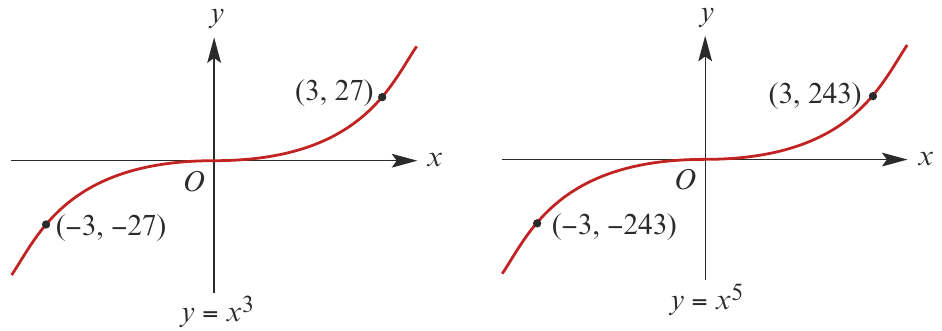
Notice that both graphs:
- Pass through the origin
- Have the same general S-shape
- Are steeper as we move away from the origin
- Show marked points demonstrating the rapid growth of higher powers
Comparing odd power functions
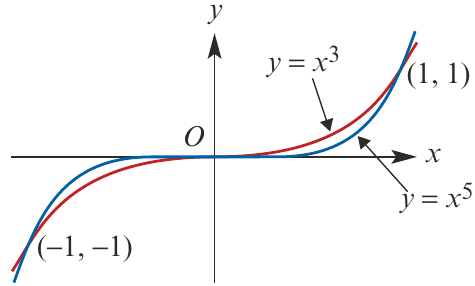
When we compare two odd power functions where (both odd), several important relationships emerge that help us understand their relative behavior.
Important
Key comparison rules for odd power functions:
When (both odd):
- for
- for and for
- for and for
This means the higher power function grows faster outside the interval , but grows slower inside this interval (excluding the endpoints).
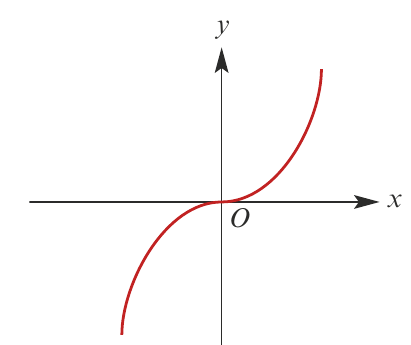
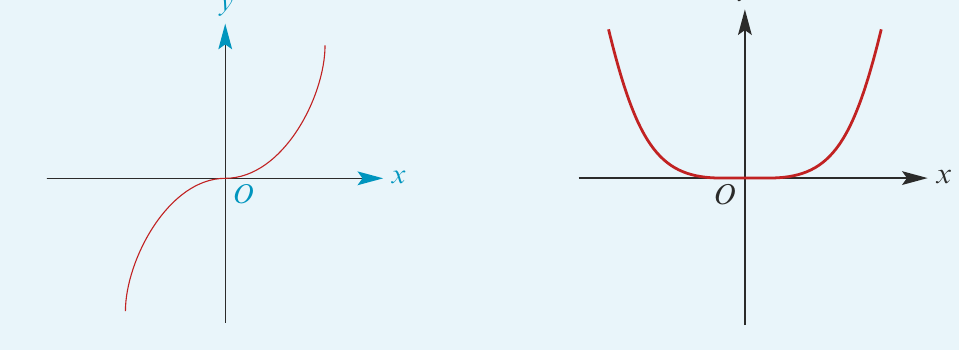
The appearance of these graphs depends on the scale used on the axes. A typical representation of an odd power function shows the characteristic S-curve:
Derivative properties of odd power functions
For where is an odd integer with , the derivative is:
This derivative tells us about the gradient (slope) of the function. Since is odd, is even, which has important implications:
- The gradient is zero when
- Therefore for all non-zero
Note
What this means: The gradient is positive everywhere except at the origin. The function is always increasing, but has a stationary point of inflection at . At this special point, the gradient is zero but the function doesn't change from increasing to decreasing (or vice versa).
Transformations of odd power functions
Transformations of (where is odd) result in graphs with rules of the form:
where:
- affects vertical stretching/compression and reflection
- represents horizontal translation
- represents vertical translation
The point of zero gradient moves from to .
Worked example: Sketching transformed cubic functions
Example
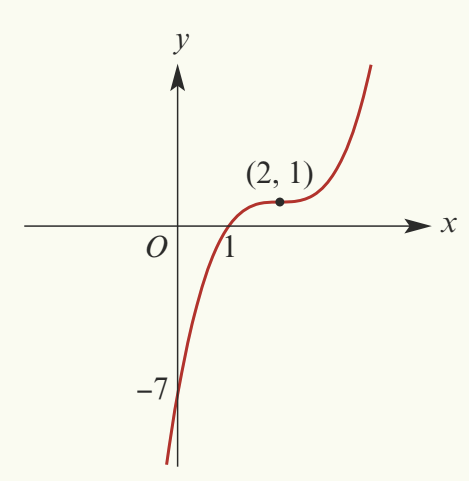
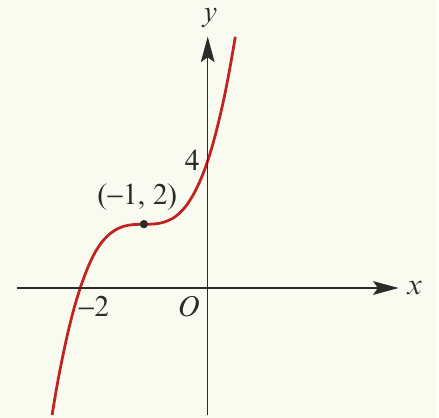
Worked Example 14a: Sketch the graph of
Solution:
The translation maps the graph of onto the graph of .
Therefore is the point of zero gradient.
Finding the axis intercepts:
When :
When :
The graph has -intercept at and -intercept at .
Example
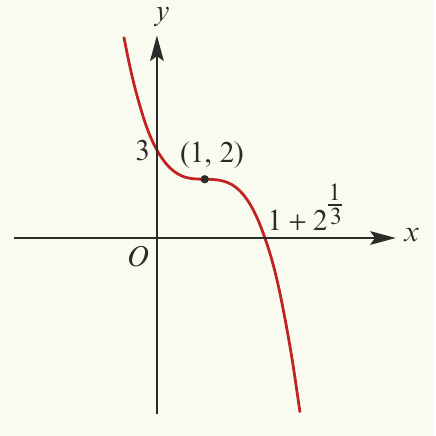
Worked Example 14b: Sketch the graph of
Solution:
A reflection in the -axis followed by the translation maps the graph of onto the graph of .
Therefore is the point of zero gradient.
Finding the axis intercepts:
When :
When :
Example
Worked Example 14c: Sketch the graph of
Solution:
A dilation of factor from the -axis followed by the translation maps the graph of onto the graph of .
Therefore is the point of zero gradient.
Finding the axis intercepts:
When :
When :
Worked example: Finding parameters
Example
Worked Example 15: Finding transformation parameters
The graph of has a point of zero gradient at and passes through the point . Find the values of , , and .
Solution:
Since is the point of zero gradient:
Therefore
Since the graph passes through :
Power functions with even positive integer index
Basic characteristics of even power functions
When is an even positive integer (such as ), the function has these properties that create a fundamentally different shape from odd power functions:
- The graph has a U-shape (parabola-like)
- There is a minimum point at the origin
- The graph is symmetric about the -axis
- The function decreases for and increases for
Comparing even power functions
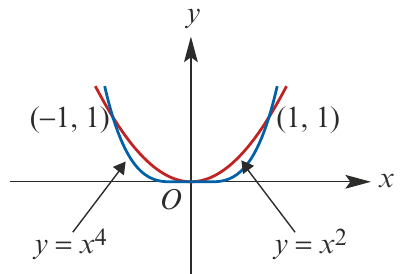
When we compare two even power functions where (both even), we observe similar patterns to odd functions but with important differences.
Important
Key comparison rules for even power functions:
When (both even):
- for
- for and for
- for and for
The higher power creates a steeper curve away from the origin but a flatter curve near the origin.
Here's a comparison showing the different shapes of odd versus even power functions:
Derivative properties of even power functions
For where is an even integer with , the derivative is:
Since is even, is odd. This means:
- The gradient is zero when
- for (function is increasing)
- for (function is decreasing)
Note
What this means: The graph has a turning point at , which is a local minimum. The function decreases as we approach the origin from the left and increases as we move away from the origin to the right.
Transformations of even power functions
Similar to odd power functions, transformations of (where is even) produce graphs with the form:
The turning point moves from to .
Worked example: Finding parameters for even functions
Example
Worked Example 17: Finding parameters for even power functions
The graph of has a turning point at and passes through the point . Find the values of , , and .
Solution:
Since is the turning point:
Therefore
Since the graph passes through :
Remember!
Summary
Key Points to Remember:
- Power functions have the form where is a positive integer
- Transformation form is where is the key point
- Odd power functions () have:
- S-shaped curves with a stationary point of inflection at the origin
- Derivative for all
- Always increasing behavior
- Even power functions () have:
- U-shaped curves with a minimum turning point at the origin
- for and for
- Decreasing then increasing behavior
- When comparing powers of the same type, they intersect at , with higher powers being steeper away from the origin but flatter near it
- To sketch transformed power functions:
- Identify the key point
- Find the axis intercepts by substituting and