Translations (VCE SSCE Mathematical Methods): Revision Notes
📚Revision Notes
Translations
What are transformations?
The Cartesian plane is the set of all ordered pairs of real numbers, written as . In mathematical notation:
A transformation of the plane is a rule that maps each point in the plane to exactly one new point. Every point becomes the image of another point under the transformation.
Note
For instance, if you shift every point 3 units to the right along the -axis, each point maps to a new point . This is a transformation because:
- Each point moves to exactly one new location
- Every point in the plane is an image of some other point
Understanding mapping notation
When we translate points, we use mapping notation to show where points move.
Consider translating 2 units right (positive -direction) and 4 units up (positive -direction). We write this as:
This reads as "the point maps to ."
Example
Worked Example: Applying Translation
For the point , translating 2 units right and 4 units up gives:
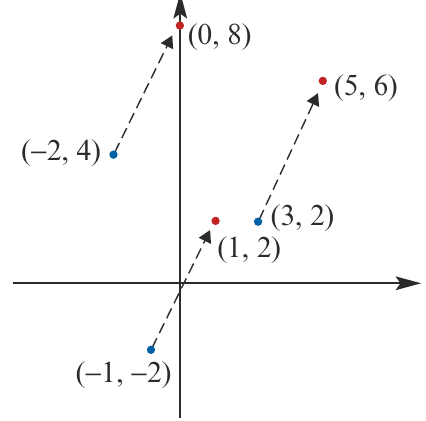
We can also express translations using primed coordinates. If is the image of point , then:
These equations tell us how to calculate the new coordinates from the original ones.
Translation rules
Translations in positive directions
Important
A translation of units in the positive -direction (right) and units in the positive -direction (up) is described by:
Or equivalently:
where and are positive numbers.
Translations in negative directions
Important
A translation of units in the negative -direction (left) and units in the negative -direction (down) is described by:
Or equivalently:
where and are positive numbers.
Applying translations to sketch graphs
When you translate a graph, every point on it moves the same distance in the same direction. This means the shape stays exactly the same, just in a different position.
Translations parallel to the -axis
Let's look at what happens when we translate the basic parabola horizontally.
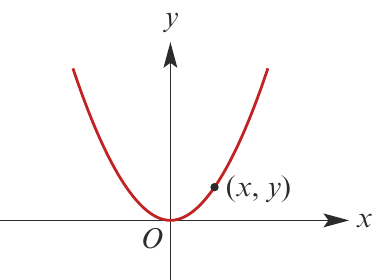
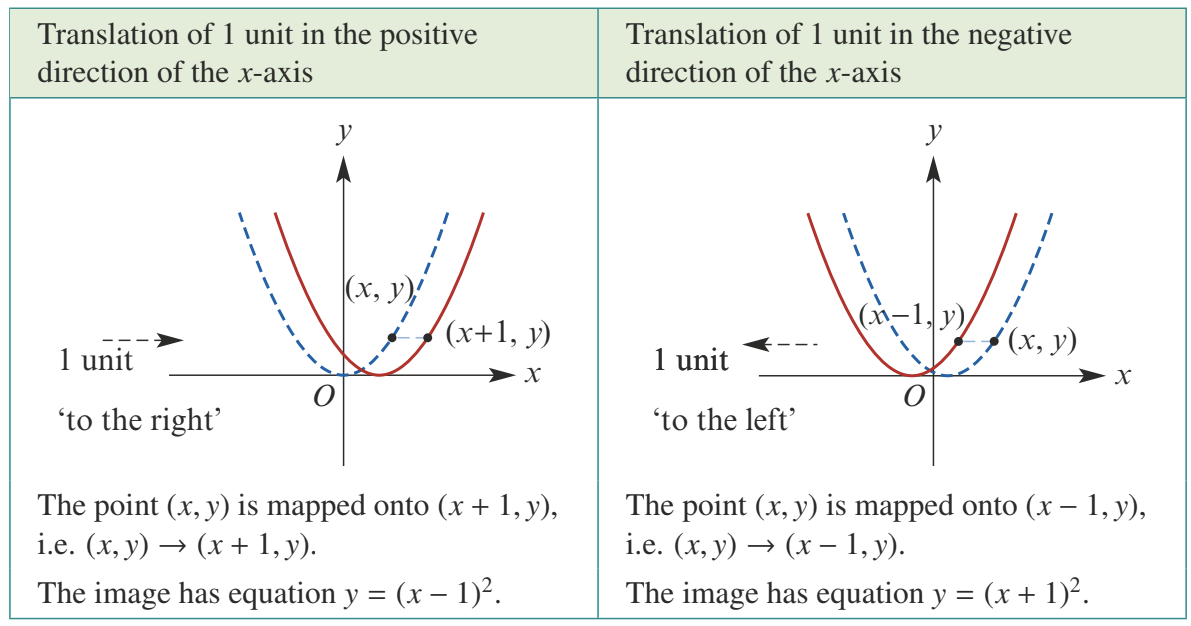
Translation 1 unit to the right:
Each point maps to . The image has equation:
Important
Notice that we subtract 1 from in the equation, even though we're moving right. This is because we're asking "what -value gave us this new position?"
Translation 1 unit to the left:
Each point maps to . The image has equation:
Note
Again, notice the sign reversal: moving left means we add in the equation.
Translations parallel to the -axis
Now let's translate the parabola vertically.
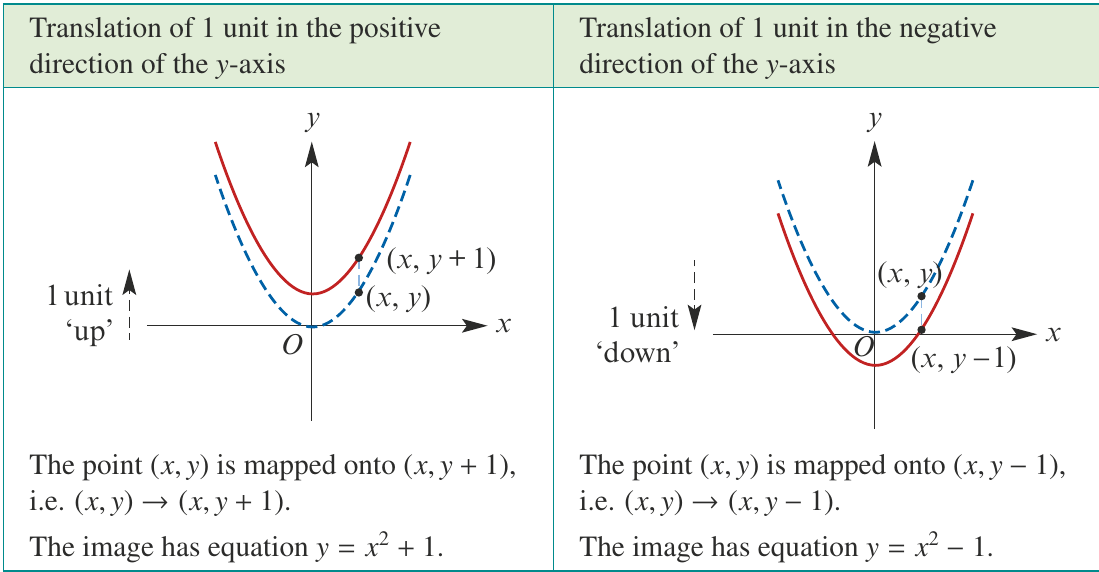
Translation 1 unit up:
Each point maps to . The image has equation:
When moving up, we add to the function.
Translation 1 unit down:
Each point maps to . The image has equation:
When moving down, we subtract from the function.
General translations of curves
Every translation can be described by combining two components:
- A horizontal translation (parallel to the -axis)
- A vertical translation (parallel to the -axis)
Finding the equation of a translated curve
Consider translating by 2 units right and 4 units up. The translation rule is:
This means: and
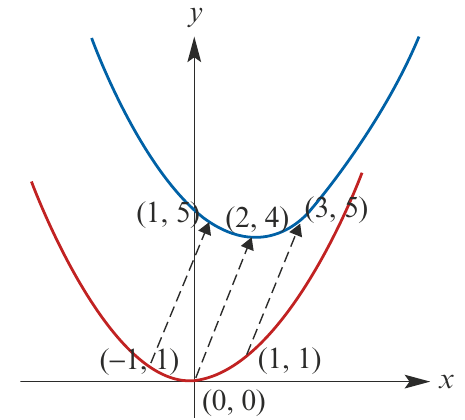
To find the image equation, we need to express the original coordinates in terms of the new ones:
Substituting into the original equation :
The image curve has equation: (dropping the primes for simplicity).
Important relationship
Important
Key Translation Principle
For the graph of , these two processes give the same result:
- Apply the translation to the graph
- Replace with and with in the equation to get:
Notice the sign changes: moving right by means replacing with , and moving up by means replacing with .
Worked example
Example
Worked Example: Translating a Rational Function
Find the equation for the image of the curve , where , under a translation 3 units right and 2 units down.
Solution:
The translation rule is .
Let be the image of point on the original graph.
Then:
Rearranging to express the original coordinates:
Substitute these into the original equation :
The equation of the image is:
This shows the curve has been shifted 3 units right and 2 units down.
Summary
Summary
Key Translation Principles
For the graph of , the following two approaches give the same result:
- Apply the translation to the graph of
- Replace with and with to obtain , then graph the result
Remember!
Summary
Essential Translation Rules
- A translation moves every point the same distance in the same direction
- Moving right by units: replace with in the equation
- Moving left by units: replace with in the equation
- Moving up by units: add to the function (or replace with )
- Moving down by units: subtract from the function (or replace with )
- To find a translated curve's equation, express original coordinates in terms of new ones and substitute