Charge (Q) and Current (I) (VCE SSCE Physics): Revision Notes
📚Revision Notes
Charge (Q) and Current (I)
Introduction to atomic structure
Everything around us is made of atoms, the building blocks of matter. For a long time, people believed atoms were indivisible (the word "atom" comes from Greek meaning "cannot be cut"). However, scientists now know that atoms have an internal structure made up of even smaller particles.
Note
Although we cannot directly see inside atoms, we can test models experimentally and use the results to understand their structure. This experimental approach has allowed us to build a detailed picture of atomic structure over many decades of research.
This understanding is essential for learning about electricity.
The structure of an atom
An atom consists of a central nucleus surrounded by orbiting electrons.
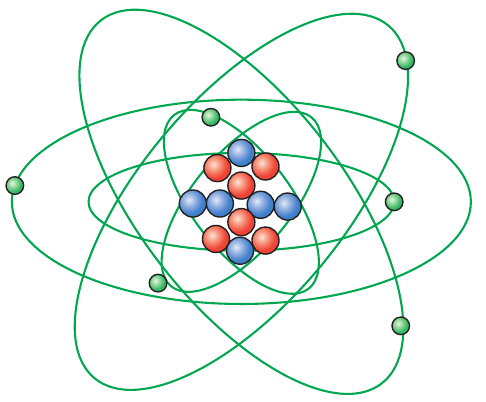
Components of an atom
The nucleus contains:
- Protons: positively charged particles
- Neutrons: particles with no charge
Orbiting around the nucleus:
- Electrons: negatively charged particles
Note
Key characteristics of atomic structure:
- Protons and neutrons are tightly bound in the nucleus
- Changes to the nucleus require very large amounts of energy
- Electrons are much lighter and easier to remove from atoms
- Each electron carries a negative charge of coulombs
What is charge?
Charge is a property of matter that causes electric effects. There are two types of charge:
- Positive charge (carried by protons)
- Negative charge (carried by electrons)
Important
Fundamental rule of charges:
Like charges repel each other, opposite charges attract each other.
This simple rule governs all electrostatic interactions and is essential for understanding electrical phenomena.
Electrons in materials
In metals, the outer electrons behave as a "sea" or "cloud" of electrons. These electrons are not bound to any particular nucleus but are free to move through the metal. This makes metals electrical conductors.
Note
The "sea of electrons" model explains why metals are such good conductors. Unlike insulators where electrons are tightly bound to individual atoms, the free electrons in metals can respond immediately to an applied voltage and begin moving through the material.
Electric circuits
A simple electric circuit consists of:
- Energy source: usually a battery or power supply
- Load: a component that converts electrical energy to another form (e.g., light, heat, movement)
- Conductors: usually metal wires that connect the components in a complete loop
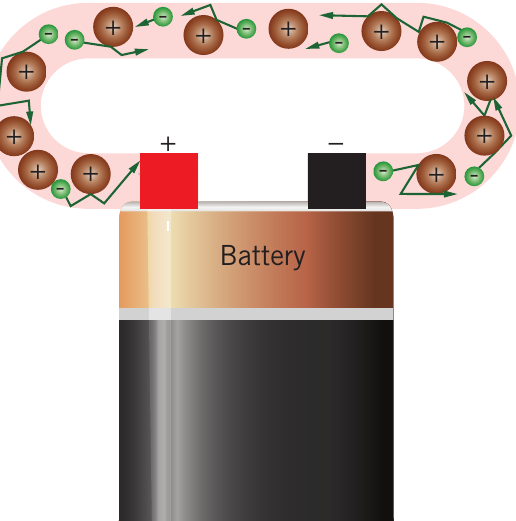
How circuits work
When a battery is connected to a circuit:
- Free electrons in the metal wires drift towards the positive terminal of the battery
- This creates a flow of charge called an electric current
- The circuit must be a complete closed loop for current to flow
- If the circuit is broken (called an "open circuit"), no current flows
Important
About electron drift speed:
The drift of electrons is quite slow (about ) because electrons collide with each other and with positive ions in the metal. However, the current begins flowing in all parts of the wire as soon as the circuit is completed.
Think of it like a pipe full of water - when you turn on the tap, water comes out immediately even though it takes time for individual water molecules to travel the length of the pipe.
Conventional current vs electron current
Here's an important historical point that often confuses students:
- Electron current: electrons (negative charges) flow from the negative terminal to the positive terminal
- Conventional current: defined as flowing from positive to negative (opposite to electron flow)
Why the difference?
Electric current was discovered around 70 years before electrons were identified in 1897. By convention, scientists had already decided that current flows from positive to negative. When electrons were discovered, it turned out they actually flow the opposite way.
Important
Convention to remember:
In physics, when we refer to "current", we mean conventional current (positive to negative), as if positive charges are moving. The energy transferred is the same regardless of which direction the charges move.
This can be confusing at first, but stick with conventional current in all your work unless specifically asked about electron flow.
Conductors, insulators, and semiconductors
Conductors
Materials that allow electric charge to flow readily. Metals are good conductors because they have free electrons that can move through the material.
Note
The "sea of electrons" in metals means that when a voltage is applied, these electrons can immediately respond and create a current. This is why copper and aluminum are commonly used for electrical wiring.
Insulators
Materials that have few or no free electrons and do not conduct electricity. Examples include:
- Rubber
- Plastic
- Glass
- Wood (when dry)
Note
In insulators, electrons are tightly bound to their atoms and cannot move freely. This property makes them useful for protecting us from electric shocks and for separating conductors in electrical devices.
Semiconductors
Materials that conduct electricity only partially or only under certain conditions. These are important in modern electronics.
Note
Semiconductors like silicon can have their conductivity controlled by adding impurities or applying voltage. This property makes them essential for transistors, computer chips, and solar cells.
Current in liquids and gases
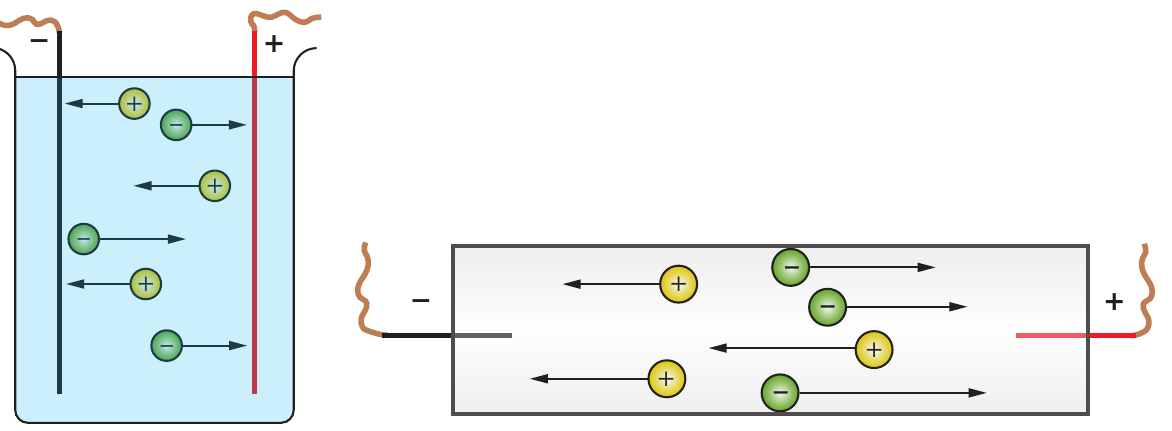
In some liquids and gases, ions (atoms or molecules carrying net positive or negative charge) can move freely. When a battery is connected:
- Positive ions move to the negative terminal
- Negative ions move to the positive terminal
- The "current" is defined as the direction positive charges move
Analogies for understanding electric current
Bicycle chain analogy
Think of an electric circuit like a bicycle chain:
- Chain links = free electrons
- Pedals = battery (supplies energy)
- Rear wheel cog = load (where energy is converted)
Note
How the analogy works:
When you turn the pedals (connect the battery), every link in the chain begins to move immediately. The wheel starts turning instantly, even though it takes time for an individual link to travel from the pedals to the wheel.
Similarly, when a circuit is completed, current begins flowing everywhere in the circuit immediately, even though individual electrons move slowly.
Limitations of this analogy:
- Electrons are much smaller than chain links
- Electrons can move in three dimensions, not locked in a chain
- The electrical energy carried by electrons is more like potential energy than kinetic energy
Fountain analogy
A pump in a fountain causes water to flow upwards, just as a battery causes charge to flow through a conductor. However, unlike water that can flow away from the fountain, electrons must return to the battery in a complete circuit.
Circuit diagrams and symbols
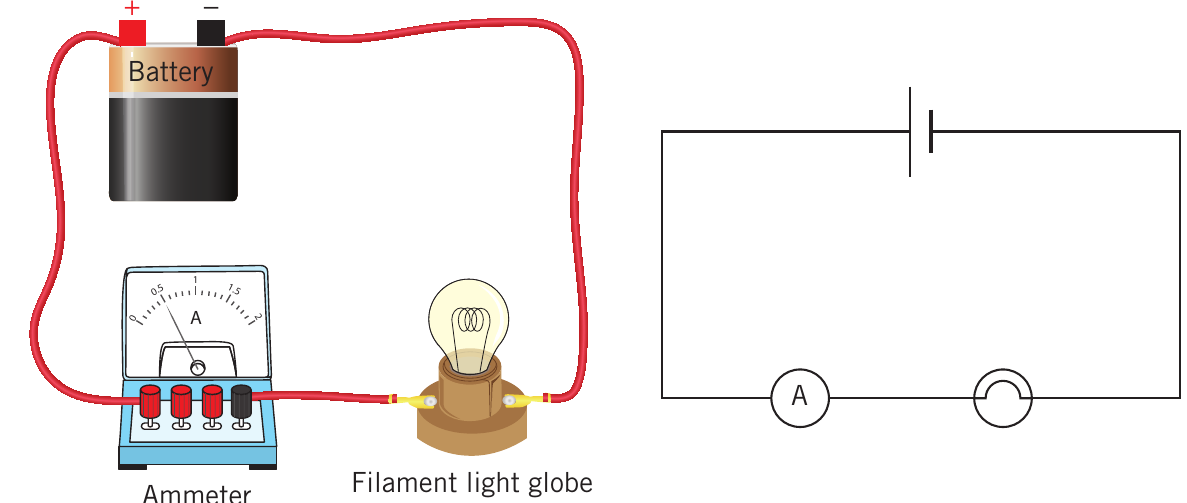
To understand and analyze circuits, scientists use agreed-upon symbols instead of pictures. These symbols are universal and represent the function of components rather than their physical appearance.
Note
Circuit symbols are standardized internationally, allowing physicists and engineers around the world to communicate circuit designs clearly. Learning these symbols is like learning a universal language of electronics.
Common circuit symbols
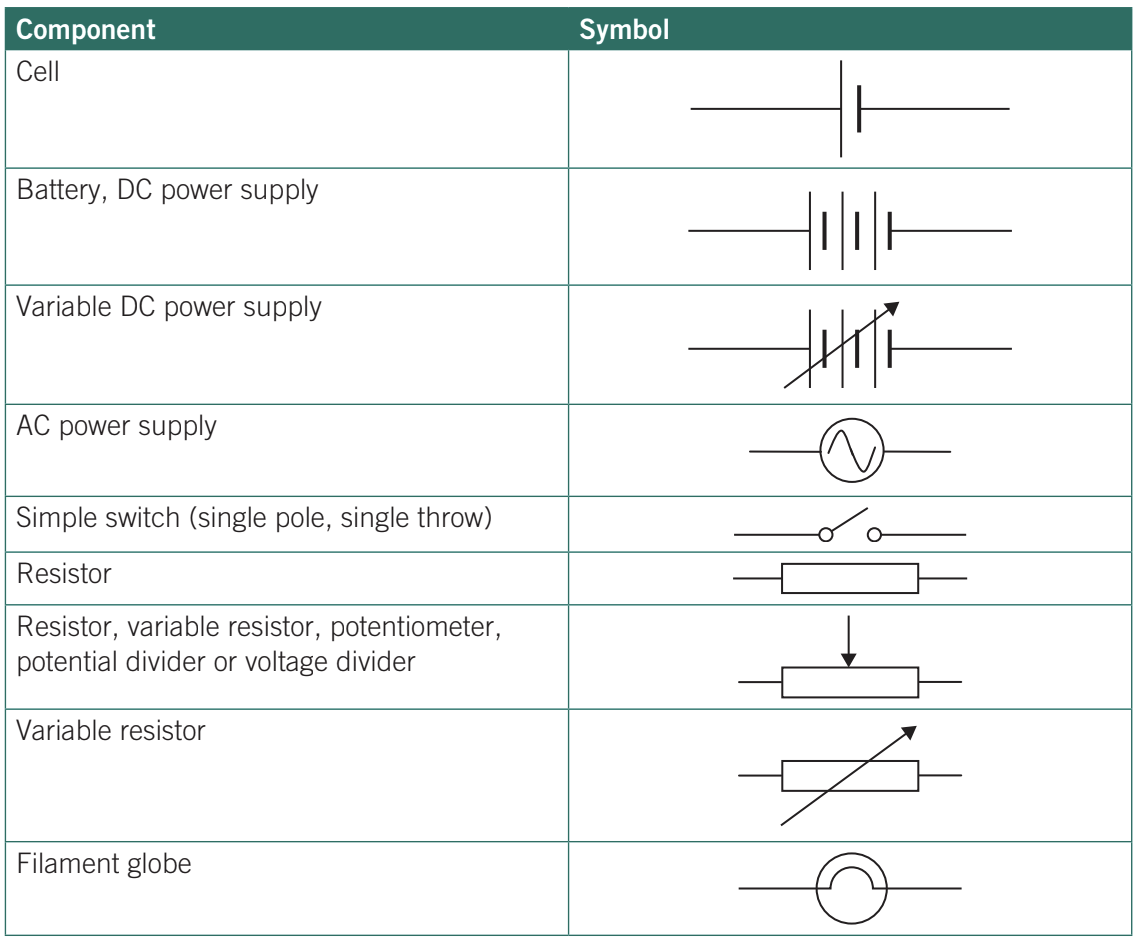
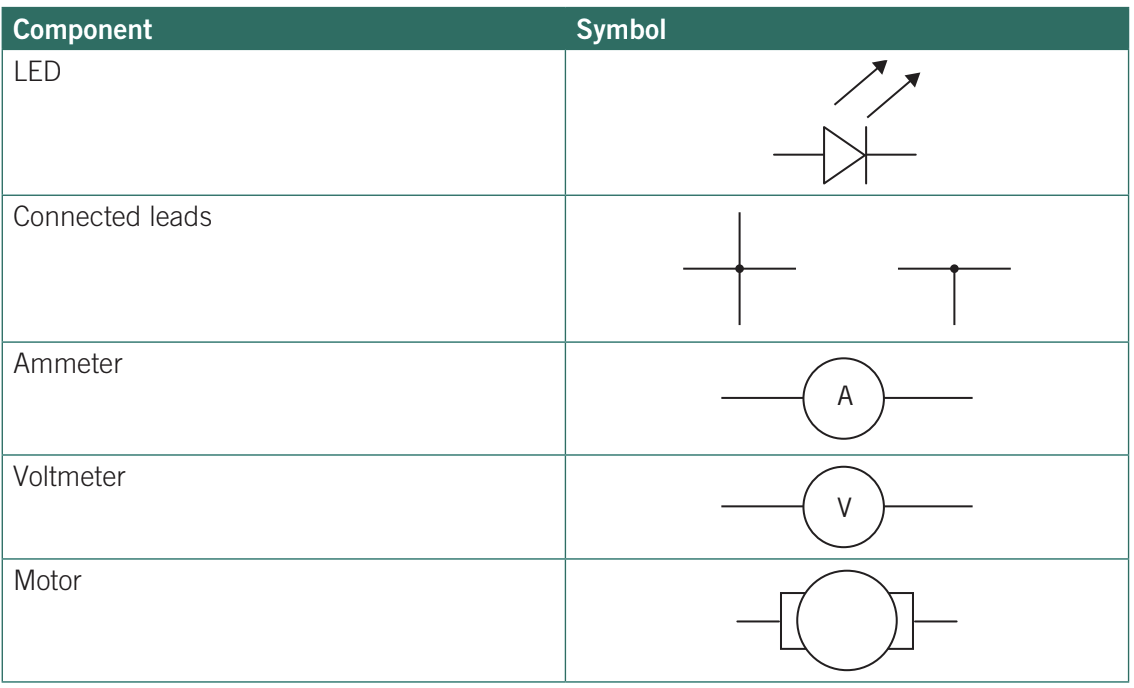
Drawing circuit diagrams
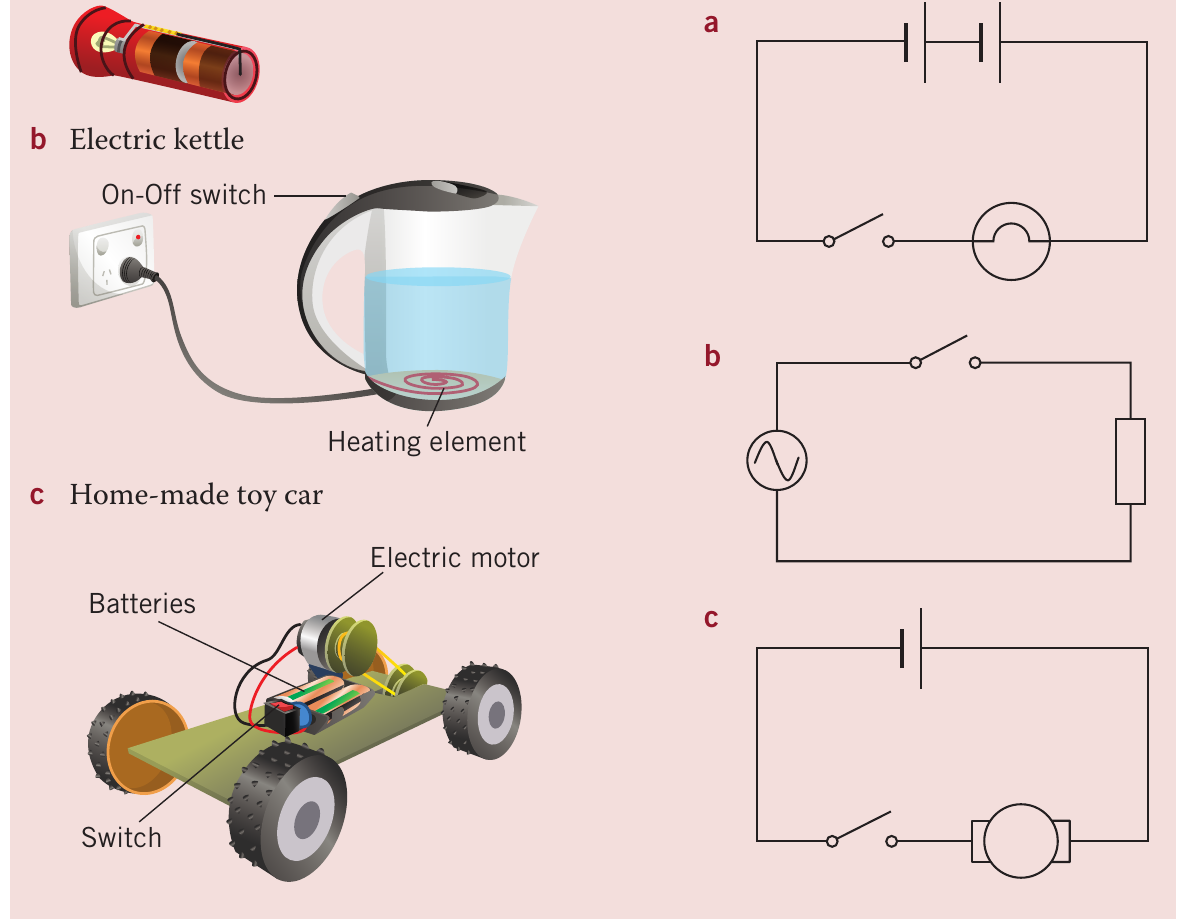
Circuit diagrams show:
- How components are connected
- The function of each component
- The path current takes through the circuit
Measuring current
The ammeter
An ammeter (from "ampere-meter") is an instrument used to measure electric current. The ammeter must be placed in series in the circuit, meaning the current being measured must flow through it.
Note
To remember "in series":
Think of a television series where one episode follows another. In a series circuit, components are connected one after another in a continuous loop.
Units of current
The unit of current is the ampere or amp (A).
- One amp () is quite large
- In laboratory work, milliamps are more common: (one-thousandth of an amp)
Important
Key observation about current in series circuits:
In a simple series circuit, wherever you place the ammeter, it measures the same current. This shows that electrons flow at the same rate all the way around the circuit.
This is an important principle - current is not "used up" as it flows through components. The same amount of charge flows through every part of a series circuit.
Calculating charge from current
The coulomb
The unit of charge is the coulomb (C). This is quite a large unit, so microcoulombs are often used:
- (one-millionth of a coulomb)
- There are 1 million μC in 1 C
Relationship between current and charge
Current is defined as the rate of flow of charge:
Where:
- = electric current (A)
- = charge (C) passing a point
- = time (s)
This can be rearranged to:
Important
Understanding the equation:
In words:
- (one coulomb per second)
- 1 coulomb = the amount of charge passing a point when 1 amp flows for 1 second
This equation tells us that current is simply the amount of charge flowing per unit time. A larger current means more charge flowing past a point each second.
The elementary charge
The charge on a single electron (or proton) is called the elementary charge:
This is incredibly small. To make up 1 coulomb of charge, you need:
That's over 6 billion billion electrons!
Worked example: calculating charge
Example
Worked Example: Calculating charge and number of electrons
Question: Calculate the charge that passes the positive terminal of a battery in 1 second when there is a current of in the circuit. How many electrons is this?
Solution:
Using with and :
To find the number of electrons:
This enormous number shows why we use coulombs rather than counting individual electrons!
Remember!
Summary
Key Points to Remember:
- Charge is a property of matter; like charges repel, opposite charges attract
- Current is the flow of electric charge, measured in amperes (A)
- Conventional current flows from positive to negative (opposite to electron flow)
- The relationship between charge, current, and time is: or
- One coulomb equals electrons
- An ammeter must be placed in series to measure current
- A complete circuit is needed for current to flow