Electric Power (VCE SSCE Physics): Revision Notes
📚Revision Notes
Electric Power
Introduction to electric power
Understanding electric power is essential when working with electrical devices and circuits. Some appliances, like calculators or emergency phones, can run on small batteries or solar panels, while others, like electric kettles, require connection to mains electricity. The key difference often isn't just the total amount of energy needed, but how quickly that energy must be delivered.
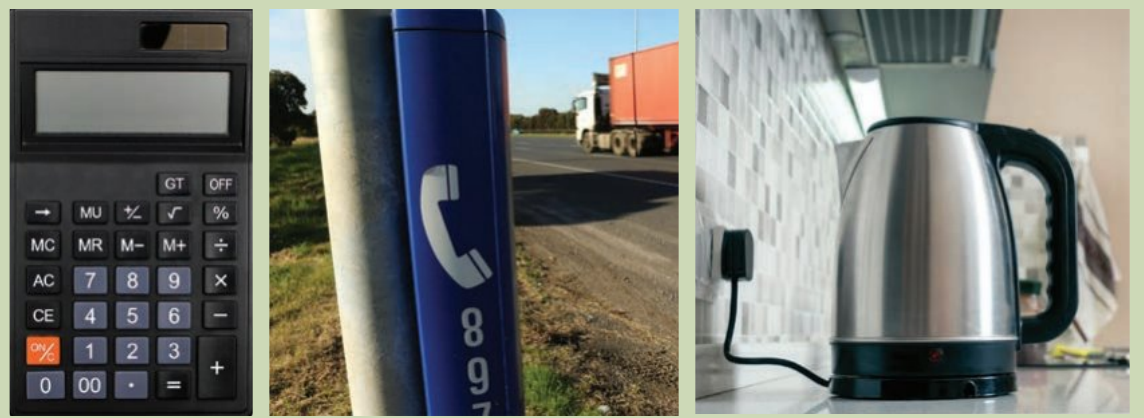
Think about charging your mobile phone - different chargers can recharge your phone at different speeds, even though they all achieve 100% charge eventually. You might see ratings like 5V 12W or 5V 18W on charger labels. The difference in power rating determines how quickly energy is transferred to your phone's battery.
Note
The rate at which energy is delivered - the electric power - determines how quickly a device operates or charges. This is why a 18W charger fills your phone's battery faster than a 5W charger, even though both eventually achieve a full charge.
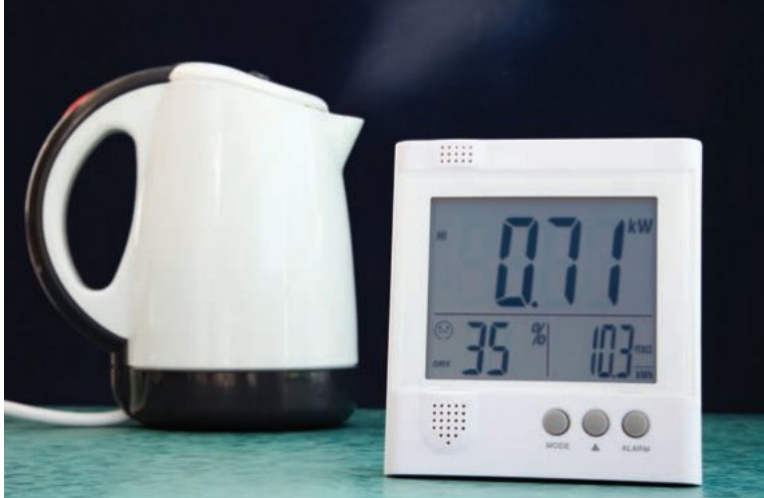
This concept becomes even more important with electric vehicles. EV charging can range from a slow "trickle-charge" of around 2 kW from a standard power point (taking all night) to a rapid 250 kW DC supercharger that can recharge from 20% to 80% in under 30 minutes. The rate at which energy is delivered - the electric power - is often more critical than the total energy required.
What is power?
In everyday conversation, people often use "power" and "energy" interchangeably. In physics, however, these terms have distinct and precise meanings that must be understood clearly.
Energy is the capacity to do work, measured in joules (J). It represents how much work can be done or how much change can be produced.
Power is the rate at which energy is transformed or the rate at which work is done. Power tells us how quickly energy is being used or transferred, not just how much energy is available.
Power is measured in watts (W), where:
This means one watt equals one joule per second. A device with a power rating of 100 W transforms 100 joules of energy every second, regardless of whether it operates for one millisecond or ten hours. The power rating remains constant - it describes the rate of energy transformation, not the total amount of energy used.
Important
Common Error to Avoid
A common mistake is to say "the power of this device is 100 watts per hour". This is incorrect because power is already a rate (energy per second). Adding "per hour" creates a meaningless unit.
You wouldn't say "I can run at 4 metres per second per hour" - similarly, don't add time units to power measurements. The watt already includes "per second" in its definition.
Calculating power as rate of energy transfer
The fundamental formula for power applies to all types of energy transformation, not just electrical systems. Understanding this general definition helps you apply power concepts across different physics contexts.
Formula:
Where:
- = power (W)
- = energy transferred (J)
- = time over which energy is transferred (s)
This formula tells us that power is the amount of energy transferred divided by the time taken for that transfer. The faster energy is transferred (smaller time), the greater the power. Conversely, transferring the same energy over a longer time period represents lower power.
Example
Worked Example: Power in a kettle
Let's examine a practical example using an electric kettle rated at 2 kW.
Part (a): Calculate the thermal energy delivered to water in 1 minute.
Given:
Rearranging to find energy:
The kettle delivers 120 kJ of energy to the water in one minute.
Part (b): How long would the kettle need to run to supply 4 kJ of energy?
Given:
Rearranging to find time:
The kettle takes only 2 seconds to deliver 4 kJ of energy.
Part (c): A different kettle supplies 3 kJ of energy per 30 seconds. Calculate its power.
Given:
Using the power formula:
This kettle has a power of only 100 W, making it much slower to boil water than the 2 kW kettle from parts (a) and (b).
Example
Worked Example: Power in an electric stove
An electric stove uses 1.8 MJ of energy to heat its hotplate every 10 minutes.
Part (a): Calculate the power of the stove in watts.
Given:
Using the power formula:
The stove has a power of 3000 W or 3 kW.
Part (b): Calculate how long the stove takes to use 1.7 kJ of energy.
Given:
Rearranging for time:
The stove uses 1.7 kJ in just 0.57 seconds.
Part (c): If the stove's power increases by 500 W, calculate the energy used in 40 seconds.
New power:
Given :
At the higher power, the stove uses 0.14 MJ in 40 seconds.
Calculating power in electric circuits
While the general formula applies to all energy transformations, we can derive a more specific formula for electric circuits that relates power directly to electrical quantities like current and voltage.
Starting with the general power formula and substituting the expression for electrical energy ():
The time cancels out, giving us:
This elegant result shows that electrical power equals the product of potential difference and current.
Formula for electrical power:
Where:
- = power in an electric circuit (W)
- = potential difference (V)
- = current (A)
Note
Understanding the Power Formula
This formula reveals an important insight: the power supplied or consumed in a circuit depends on two factors:
- Current (): How many coulombs of charge flow past per second
- Potential difference (): How much energy each coulomb carries
Higher current means more charge carriers moving through the circuit each second. Higher potential difference means each charge carrier transfers more energy. Together, they determine the rate of energy transfer - the power.
Example
Worked Example: Power in a light bulb
Consider a light bulb connected to a 12 V battery, carrying a current of 0.5 A.
Part (a): Calculate the power drawn by the light bulb.
Given:
Using :
The light bulb draws 6 W of power.
Part (b): If the bulb is switched on for 2 minutes, how much energy does it transform?
Given:
Rearranging :
The bulb transforms 720 J of electrical energy (into light and heat) over 2 minutes.
Example
Worked Example: Comparing power consumption
A kettle and an induction cooktop both connect to 230 V mains power. The kettle draws 10 A while the cooktop draws 32 A. Calculate the power used by each appliance.
For both appliances, .
For the kettle ():
For the cooktop ():
The cooktop uses more than three times the power of the kettle. If both were used to heat the same mass of water from 20°C, the induction cooktop would reach boiling point much faster due to its higher power delivery.
Alternative forms of the power formula
The formula is useful for general calculations, but sometimes you may not know both current and potential difference directly. Using Ohm's law (), we can derive alternative forms of the power equation that are more convenient in specific situations.
First alternative:
Starting with and substituting :
This form is particularly useful when you know the current and resistance but not the potential difference.
Note
When to use
This form is especially valuable when calculating power "lost" as thermal energy in wires or resistors. Notice that power increases with the square of the current - doubling the current increases power loss by a factor of four. This explains why high-current circuits experience significant heating effects.
Second alternative:
Starting again with and substituting :
This form is useful when you know the potential difference and resistance but not the current.
Note
When to use
This form is best for comparing power usage in circuits with different resistances. Note the inverse relationship - lower resistance means higher power. This helps explain why parallel circuits (which have lower equivalent resistance) consume more power than series circuits with the same components.
Summary
Summary of power formulas
For circuits with ohmic resistors:
Where:
- = power (W)
- = potential difference (V)
- = current (A)
- = resistance (Ω)
Choosing the right formula:
- Use for general calculations when you know both current and voltage
- Use when considering power lost in wires or when you know current and resistance
- Use when comparing circuits with different resistances but the same potential difference
Example
Worked Example: Power loss due to resistance
A caravan needs connecting to a 240 V AC power supply using a 10 m extension cable. Two cables are available with resistances of 1 Ω and 5 Ω. The caravan appliances draw 10 A. Find the power loss in each cable.
Since we're calculating power loss due to heating in the wire, and we know current and resistance, we should use .
For cable 1 (, ):
Cable 1 wastes 100 W as heat.
For cable 2 (, ):
Cable 2 wastes 500 W as heat.
The 5 Ω cable transforms 400 W more power than the 1 Ω cable due to its higher resistance. You should choose the cable with lower resistance to minimise energy waste and ensure maximum power reaches the caravan appliances.
Example
Worked Example: Resistance from power consumption
Calculate and compare the resistance of a 5 W LED bulb and a 9 W LED bulb when each is connected to 230 V mains supply.
Since we know power and voltage, we should use and rearrange to find resistance.
Rearranging:
For the 5 W LED bulb (, ):
For the 9 W LED bulb (, ):
The 5 W LED bulb has almost twice the resistance of the 9 W LED bulb. This makes sense because at the same voltage, higher resistance means lower current, which produces lower power according to .
Comparing power in series and parallel circuits
One of the most important applications of power calculations is understanding how series and parallel circuits differ in their power consumption. This has significant practical implications for household wiring and circuit design.
Example
Worked Example: Power loss in series and parallel
Consider two light globes with resistances of 1000 Ω and 3000 Ω connected to a 24 V battery.
Part (a): Calculate the power used when the globes are connected in parallel.
First, draw a circuit diagram and calculate the equivalent resistance:
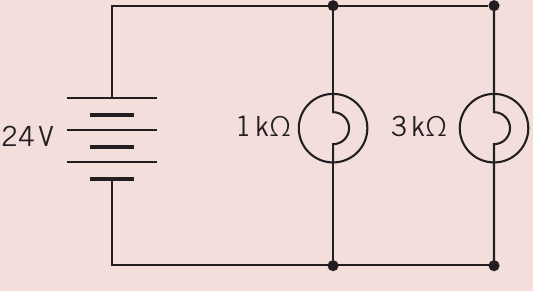
For resistors in parallel:
The potential difference across the parallel combination is 24 V. Using :
The parallel circuit uses 0.77 W of power.
Part (b): Calculate the power used if the same globes are connected in series.
For resistors in series:
The potential difference across the series combination is still 24 V. Using the same power formula:
The series circuit uses only 0.144 W of power.
Comparison: The parallel circuit uses significantly more power (0.77 W) than the series circuit (0.144 W). This occurs because the parallel combination has lower equivalent resistance, allowing more current to flow and thus transforming energy at a faster rate. The parallel globes will be brighter (transforming more energy per second) but will drain the battery more quickly.
Important
General Principle
Parallel circuits consume more power than series circuits with the same components at the same supply voltage. This is because parallel arrangements have lower equivalent resistance, allowing higher total current to flow.
Advantages of parallel circuits
Understanding power differences between series and parallel circuits helps explain why household electrical systems use parallel wiring. Beyond power considerations, parallel circuits offer several practical advantages.
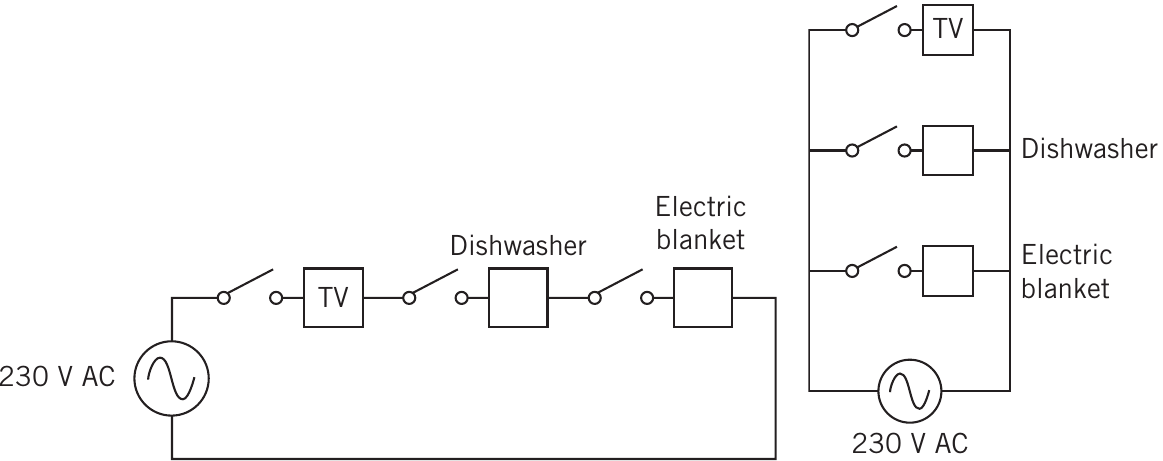
Consider two circuits with the same three appliances (TV, dishwasher, and electric blanket), each with its own switch, connected to 230 V AC mains power. The left diagram shows a series connection, while the right shows parallel connection.
Independent operation
In the series circuit (left), all three switches must be closed before any appliance will work, and they will all operate simultaneously. There is no way to run appliances independently. Additionally, each appliance receives only a portion of the 230 V supply, so none will function at its designed voltage or power rating.
In the parallel circuit (right), each appliance can be controlled by its own switch without affecting the others. Each component receives the full 230 V supply, allowing it to operate at its design specifications.
Note
Independent Control
Parallel circuits allow each device to be switched on or off independently, making them far more practical for household applications where different appliances need to operate at different times.
Reliability
In a series circuit, if one appliance fails or is removed, the circuit breaks and no other appliances will work. This single point of failure makes series circuits impractical for most applications.
In a parallel circuit, each appliance receives its own current path. If one fails, the others continue operating normally. This reliability is essential for household use.
Power distribution
Parallel circuits allow each appliance to draw the power it needs. However, this means the total current draw can be substantial. If a TV, dishwasher, and electric blanket all operate simultaneously, each draws current as if it were the only branch. Care must be taken not to overload the power supply - this is why homes have circuit breakers.
When series circuits are useful
Series circuits do have one advantage: a single switch can control multiple devices simultaneously. For example, when turning on a home entertainment system (TV, DVD player, and soundbar), using one power switch is more convenient than three separate switches. Typically, this is achieved by placing a master switch in series with the power supply, while the appliances themselves are wired in parallel branches.
Important
Why Household Circuits Use Parallel Wiring
Household electrical circuits are wired in parallel rather than series because parallel circuits:
- Allow independent operation of each appliance
- Ensure each appliance receives full voltage
- Maintain system reliability even if one component fails
Calculating power in complex circuits
For more complicated circuit arrangements, you can calculate power by first simplifying the circuit to find equivalent resistance and total current, then applying the power formula.
Example
Worked Example: Step-by-step approach
Consider this example circuit:
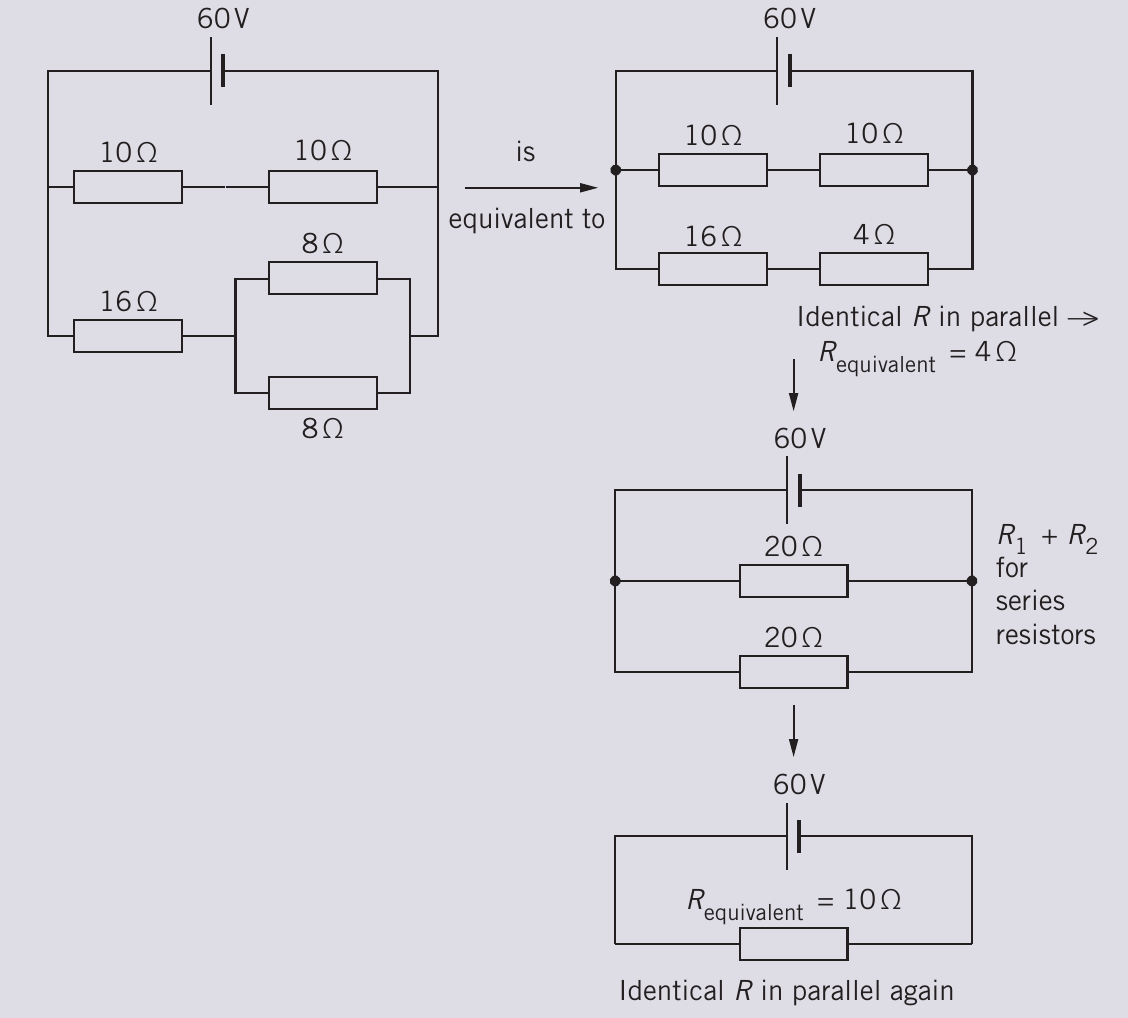
Step 1: Simplify the circuit to find equivalent resistance
The circuit can be reduced through several stages:
- Combine series resistors:
- Combine identical parallel resistors: (for two identical resistors)
- Continue until you reach a single equivalent resistance
Following the diagram, the complex circuit with multiple 10 Ω, 16 Ω, and 8 Ω resistors simplifies to a single equivalent resistance of 10 Ω.
Step 2: Calculate total current
Using Ohm's law with the battery voltage (60 V) and equivalent resistance (10 Ω):
Step 3: Calculate power supplied by the battery
Using :
This power (360 W) is dissipated among all the resistors in the circuit.
Summary
Key Points to Remember:
-
Power is the rate at which energy is transformed or work is done, measured in watts (W), where
-
Three key power formulas: , , and - choose based on which quantities you know
-
Parallel circuits use more power than series circuits with the same components at the same voltage because they have lower equivalent resistance
-
Household circuits are wired in parallel so appliances can operate independently, each receives full voltage, and one component failure doesn't affect others
-
Use when calculating power loss in wires or cables, as power loss increases with the square of the current