Peak and RMS Values of Sinusoidal AC Voltages (VCE SSCE Physics): Revision Notes
📚Revision Notes
Peak and RMS Values of Sinusoidal AC Voltages
Introduction to AC voltage measurements
When working with alternating current (AC) systems, we need different ways to describe the voltage and current. Unlike direct current (DC) where the voltage stays constant, AC voltage continuously changes, oscillating between positive and negative values. This means we need specific terminology to describe these varying quantities accurately.
In Australia, household electricity is described as 230 V AC with a frequency of 50 Hz. However, this 230 V value requires careful interpretation – it's not the maximum voltage that reaches your home, but rather a special type of average called the root-mean-square or RMS value.
Note
Understanding the difference between peak and RMS values is fundamental to working with AC systems safely and effectively. Throughout this topic, pay close attention to which type of value is being specified in any given situation.
Single-phase AC supply
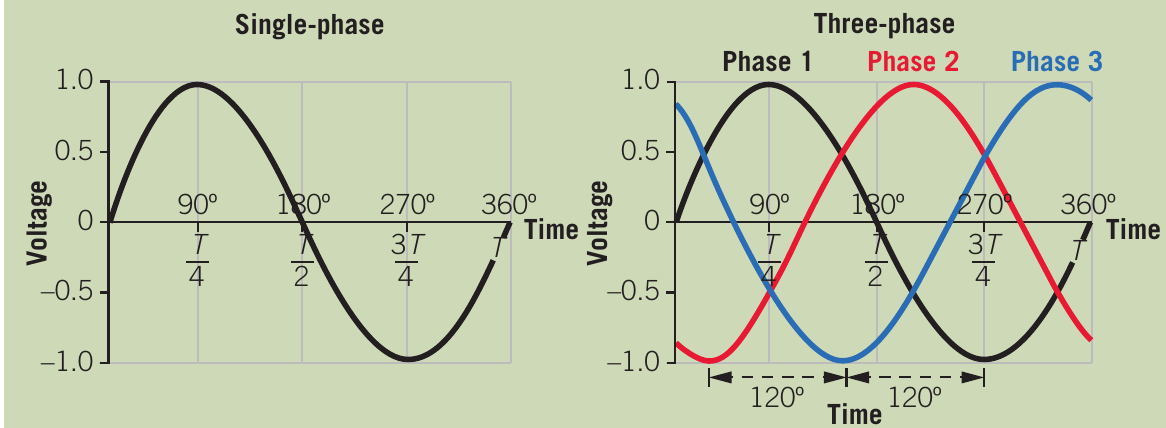
The type of alternating current used in Australian homes is called single-phase AC. This produces one sinusoidal waveform, with one active wire connecting electrical devices to the mains supply.
Note
Single-phase AC is sufficient for most household applications. Industrial and commercial settings often use three-phase AC, which provides three separate sinusoidal waveforms offset by 120°, allowing for more efficient power transmission and the operation of heavy machinery.
Understanding peak values
The peak value represents the maximum voltage (or current) reached during one complete cycle of the AC waveform. This is the amplitude of the sine wave.
For Australian mains electricity labelled as 230 V AC, the actual voltage swings between much higher extremes. The peak voltage is:
For 230 V AC:
Important
This means the voltage oscillates from +325 V to -325 V – a total swing of 650 V every half-cycle! This is nearly three times higher than the stated 230 V rating.
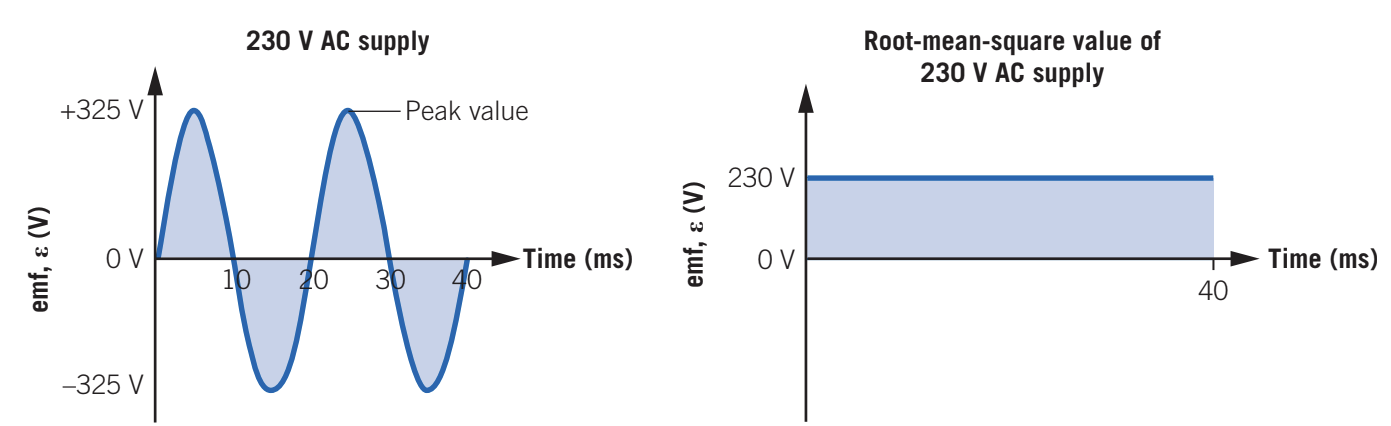
Why isn't peak value used? The peak value only occurs for an instant during each cycle. It doesn't accurately represent the voltage's ability to do useful work, such as running lights, heaters or motors. We need a better measure of the effective voltage.
The root-mean-square (RMS) value
The root-mean-square (RMS) value provides the effective value of an AC voltage or current. It represents the equivalent DC voltage that would deliver the same power to a resistive load.
Why RMS is necessary
A simple mathematical average of AC voltage would be zero, because the positive values cancel out the negative values over a complete cycle. The RMS value solves this problem using a mathematical technique that:
Note
The RMS Calculation Process:
- Squares all the voltage values (making them all positive)
- Finds the mean (average) of these squared values
- Takes the square root of this mean
The result gives us an effective value that properly represents the power-delivering capability of the AC supply.
Mathematical relationship
For sinusoidal AC, the RMS value relates to the peak value through:
Where:
- = root-mean-square voltage (V)
- = peak voltage (V)
This can be rearranged to find peak voltage from RMS:
Important
Critical Convention: When AC voltages are stated (like "230 V AC"), the RMS value is usually quoted, not the peak value. Always assume RMS unless explicitly stated otherwise.
RMS values for current
The same relationship applies to alternating current:
Where:
- = root-mean-square current (A)
- = peak current (A)
For a fixed resistive load, if you know the RMS voltage and resistance, you can calculate the RMS current using Ohm's law:
Peak-to-peak values
The peak-to-peak value measures the total amplitude from the top of the positive peak to the bottom of the negative trough. This equals double the peak value:
Note
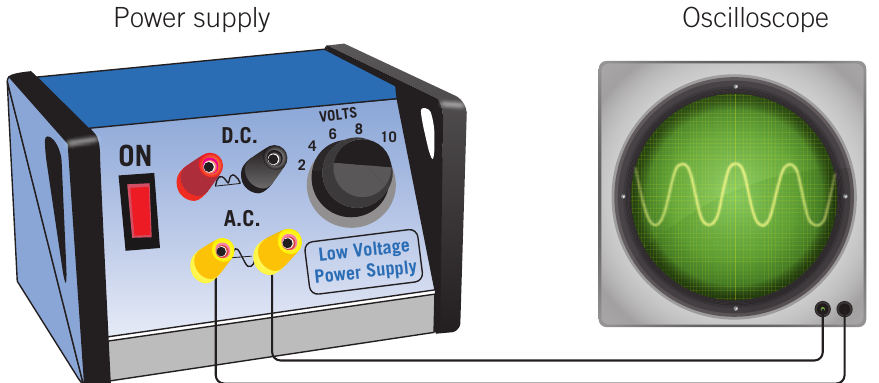
Peak-to-peak measurements are particularly useful when reading oscilloscope traces, as it's often more accurate to measure from one peak to the opposite trough rather than trying to centre the trace and measure just the peak.
Power in AC circuits
For AC circuits containing only resistive components, the effective power is calculated using RMS values:
We can derive an alternative formula using peak values. Substituting the RMS formulas:
This shows that:
Where:
- = effective power in an AC circuit (W)
- = root-mean-square voltage (V)
- = root-mean-square current (A)
- = peak voltage (V)
- = peak current (A)
Important
Key insight: The effective power in an AC circuit equals half the peak power. This is why we must use RMS values to accurately calculate power consumption in AC circuits.
Worked example: AC circuit calculations
Example
Worked Example: Calculating AC Circuit Values
Problem: A power supply labelled "50 Hz 20 " is connected to an oscilloscope.
(a) What is the peak voltage and peak-to-peak voltage? (b) With a 100 Ω load resistor connected, what is the peak current? (c) What effective (RMS) power is drawn from the supply with the 100 Ω resistor?
Solution:
(a) Finding peak and peak-to-peak voltages:
(b) Finding peak current:
Using Ohm's law with peak voltage:
(c) Finding effective power:
Using the formula for effective power:
Alternatively, using RMS values:
First find :
Then:
Notice how both methods give the same answer, demonstrating the consistency of the relationships between peak and RMS values.
Understanding the patterns and relationships
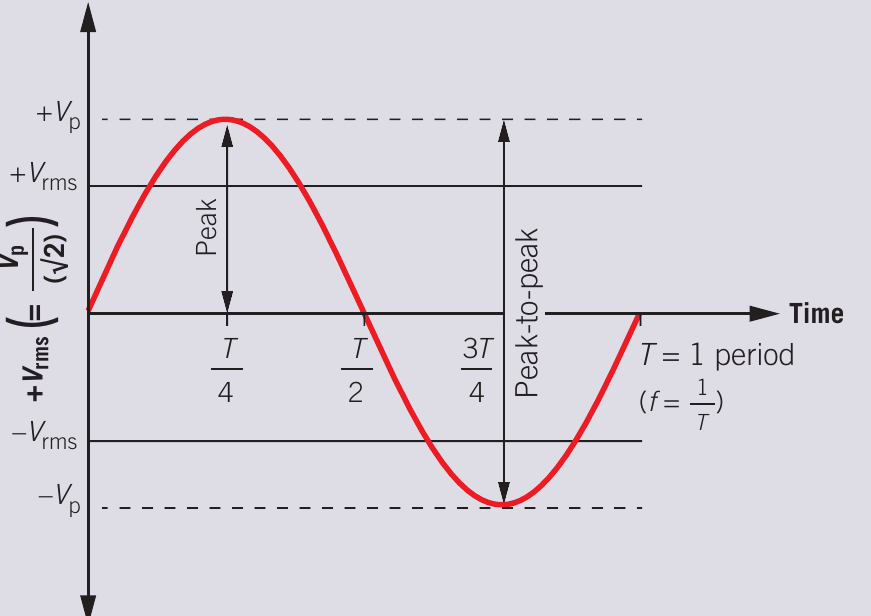
To avoid confusion between the different voltage, current and power measurements, it helps to visualise them on a single diagram:
Note
Key relationships to remember:
-
Peak-to-peak is double peak:
-
RMS is always less than peak: Because you divide by (approximately 1.414), dividing always gives a smaller number. Therefore:
-
RMS to peak conversion: (multiply by approximately 1.414)
-
Peak to RMS conversion: (divide by approximately 1.414)
Frequency and period for Australian AC
Remember the connection between frequency and period for AC in Australia:
For 50 Hz AC:
Note
One complete cycle takes 20 milliseconds, meaning the voltage swings from zero to positive peak, back through zero to negative peak, and returns to zero 50 times every second. This rapid oscillation is what distinguishes AC from DC.
Exam tips
Note
Examination Strategy:
- Always check whether a question gives you peak or RMS values before starting calculations
- When stating AC voltages, use RMS values unless specifically asked for peak values
- The factor √2 appears in both voltage and current formulas – this is not a coincidence but comes from the sinusoidal nature of AC
- Drawing a quick sketch of the waveform can help you visualize the relationship between peak, peak-to-peak, and RMS values
- For oscilloscope measurements, peak-to-peak is often easier to measure accurately than peak alone
Safety implications
Important
Critical Safety Consideration:
The difference between RMS and peak values has important safety implications. Circuit protection devices like fuses and circuit breakers must be designed to handle peak currents, not just RMS currents, even though they occur only briefly. Different types of fuses (fast-blow, slow-blow, circuit breakers) respond differently to brief peak currents versus sustained RMS currents.
Understanding these differences is essential for proper circuit design and electrical safety.
Remember!
Summary
Key Concepts Summary:
-
Peak value () is the maximum voltage reached during one cycle – the amplitude of the sine wave
-
RMS value () is the effective voltage that delivers the same power as an equivalent DC voltage:
-
Peak-to-peak value () measures from positive peak to negative trough:
-
Effective power in AC resistive circuits:
-
Australian mains electricity is 230 V RMS at 50 Hz, which corresponds to a peak voltage of 325 V and a period of 20 ms