Sleep Across the Life Span (VCE SSCE Psychology): Revision Notes
📚Revision Notes
Sleep Across the Life Span
Introduction to sleep functions
Sleep serves multiple essential purposes that cannot be explained by a single theory. Research has identified several key functions:
- Repair and restoration: Sleep enables the body and mind to repair tissues, replenish neurotransmitters, and remove waste products accumulated during waking hours.
- Adaptive function: Sleep provides time to conserve energy and remain safe during periods of potential danger, such as night-time for humans.
- Memory consolidation: During sleep, information acquired throughout the day is processed and consolidated, supporting memory formation and preparing the brain for the following day.
Note
These three functions work together to maintain overall health and wellbeing. While repair and restoration focuses on physical recovery, memory consolidation supports cognitive function, and the adaptive function ensures survival during vulnerable periods.
Tracking sleep through smart technology
Modern technology has made personal sleep monitoring accessible and affordable. Wearable devices such as bracelets, watches and headbands can record various physiological indicators during sleep, including:
- Sounds and movement
- Heart rate
- Breathing rate
These measurements help determine sleep patterns and estimate the proportions of different sleep stages. Smartphone applications provide immediate access to this data, allowing users to monitor their sleep without disruption.

One advantage of wearable technology is its ability to identify optimal wake times by detecting light sleep stages, rather than waking users during deep sleep. Research by Garmin found that actigraphy (a method of measuring rest and activity levels) combined with optical heart rate sensors can estimate sleep stages with approximately 70% accuracy when compared to gold-standard polysomnography.
Note
These devices help users develop better sleep hygiene practices, ultimately improving sleep quality and overall wellbeing. The combination of continuous monitoring and instant feedback makes it easier for individuals to identify patterns and make informed decisions about their sleep habits.
General changes in sleep across the lifespan
As individuals age, their sleep needs and patterns undergo several changes:
Important
Key Sleep Changes Across the Lifespan:
- Total sleep amount decreases progressively from birth to old age
- REM sleep proportion decreases significantly from birth until approximately 2 years old
- N3 (deep) sleep amount decreases, largely replaced by N2 sleep
- Circadian phase delay occurs during adolescence, causing a preference for later bedtimes
- Circadian phase advance occurs after adolescence, shifting sleep preferences earlier
- Sleep disruptions increase from adulthood to older age
- Sleep efficiency reduces, meaning the percentage of time in bed actually spent asleep decreases
Sleep patterns vary among individuals due to biological, psychological and social factors beyond age-related changes.
Circadian rhythm development across the lifespan
The circadian rhythm undergoes distinct changes at different life stages, affecting when individuals naturally feel sleepy and alert.
Newborn stage
Newborns lack an established circadian rhythm. Their sleep patterns are erratic and distributed across the full 24-hour day without a clear day-night distinction.
Infant stage
From approximately 4 months of age, infants develop more nocturnal sleep patterns. As they experience rapid physiological changes and continued development, they establish a fairly consistent circadian rhythm aligned with day-night cycles.
Adolescent stage
Adolescents experience a shift in their circadian rhythm, often not feeling tired until later in the evening. This biological change can result in delayed sleep phase syndrome, where their natural sleep-wake cycle is pushed back compared to other age groups.
Adult stage
Following adolescence, the circadian rhythm returns to more typical timing. Most healthy adults maintain a consistent circadian rhythm when following regular routines with relatively stable bedtimes and wake times.
Older adult stage
Older adults typically prefer an earlier bedtime and consequently wake earlier in the morning, representing a circadian phase advance.
Sleep recommendations and patterns by age group
Sleep requirements and the proportions of REM and NREM sleep change systematically throughout the lifespan. The Australian Government Department of Health has established 24-Hour Movement Guidelines specifying recommended sleep hours for different age groups.
Newborn (0–3 months)
Recommended total sleep: 14–17 hours per day
Sleep composition:
- REM sleep: 50%
- NREM sleep: 50%
Explanations for sleep patterns:
Newborns require the greatest amount of sleep to support rapid growth and development. The exceptionally high proportion of REM sleep (highest of any life stage) may support brain growth and development whilst helping consolidate learning and memory.
Note
During REM sleep, muscle twitches occur during periods of complete relaxation and immobility. These movements may help newborns develop their sensorimotor system, which coordinates sensory experiences (such as seeing and hearing) with motor actions (such as reaching and touching).
Infant (4–11 months)
Recommended total sleep: 12–16 hours per day
Sleep composition:
- REM sleep: 30–40%
- NREM sleep: 60–70%
Explanations for sleep patterns:
Infants begin sleeping for longer continuous periods as their circadian rhythm develops a more regular pattern following day-night cycles. This represents a significant shift from the erratic newborn sleep pattern.
Toddler (1–2 years)
Recommended total sleep: 11–14 hours per day
Sleep composition:
- REM sleep: 25–30%
- NREM sleep: 70–75%
Explanations for sleep patterns:
Important
By the toddler stage, REM sleep proportion has undergone its greatest decline from birth. Following this stage, REM sleep only decreases by small amounts throughout the remaining lifespan.
Preschooler (3–5 years)
Recommended total sleep: 10–13 hours per day
Sleep composition:
- REM sleep: 25%
- NREM sleep: 75%
Explanations for sleep patterns:
During the preschool years, the circadian rhythm timing may advance, causing sleep to shift earlier in the evening as children begin dropping their daytime naps.
School-age children (6–13 years)
Recommended total sleep: 9–11 hours per day
Sleep composition:
- REM sleep: 20%
- NREM sleep: 80%
Explanations for sleep patterns:
From early to late childhood, the circadian rhythm timing gradually delays, shifting sleep to later in the evening. This represents the opposite pattern to preschool years.
Adolescent (14–17 years)
Recommended total sleep: 8–10 hours per day
Sleep composition:
- REM sleep: 20%
- NREM sleep: 80%
Explanations for sleep patterns:
Adolescents experience a delay in circadian rhythm caused by a hormonally determined shift in melatonin release, occurring 1–2 hours later than other age groups. This biological change creates a preference for later bedtimes, often resulting in fewer hours of sleep than needed due to early school start times.
Important
Additional factors contributing to delayed bedtime include increasing school-related requirements, growing independence, and easy access to constant entertainment and social networks. This combination of biological and social factors can significantly impact adolescent sleep quality and duration.
Young adult (18–25 years)
Recommended total sleep: 7–9 hours per day
Sleep composition:
- REM sleep: 20%
- NREM sleep: 80%
Explanations for sleep patterns:
Young adult sleep patterns can be altered by psychosocial factors including tertiary study, work requirements, social schedules and increased independence.
A circadian phase advance begins towards the end of this stage, resulting in a preference for earlier sleep times. Melatonin concentrations also begin declining after puberty.
Adult (26–64 years)
Recommended total sleep: 7–9 hours per day
Sleep composition:
- REM sleep: 20%
- NREM sleep: 80%
Explanations for sleep patterns:
Adult sleep patterns can be affected by lifestyle changes such as caring for infants and children, changing work and social requirements, development of health problems, and changing family dynamics including balancing work with parenthood.
Note
Later in this stage, N3 sleep begins declining and is replaced by N2 sleep. Melatonin concentrations continue declining throughout adulthood, which can impact sleep quality and the ability to fall asleep quickly.
Older adult (≥65 years)
Recommended total sleep: 7–8 hours per day
Sleep composition:
- REM sleep: 18–20%
- NREM sleep: 80–82%
Explanations for sleep patterns:
Older adult sleep patterns can be altered by lifestyle changes including retirement, increased health issues (including sleep disorders), physical inactivity, decreased social interactions, increased medication use, change of living arrangements, and bereavement.
A circadian phase advance occurs, and less sleep may be achieved if individuals resist their body's preference for earlier bedtime and awakening. N3 sleep continues declining and may not occur at all, replaced entirely by N2 sleep.
Important
During older adulthood, sleep latency (the time taken to fall asleep) increases and multiple awakenings become more frequent. Melatonin concentrations continue declining.
The shorter total sleep in this stage may result from impaired ability to obtain sleep rather than a reduced need for sleep.
Visual summary of sleep recommendations
The following diagram illustrates how recommended sleep hours decrease across the lifespan, whilst also showing the changing proportions of REM sleep:
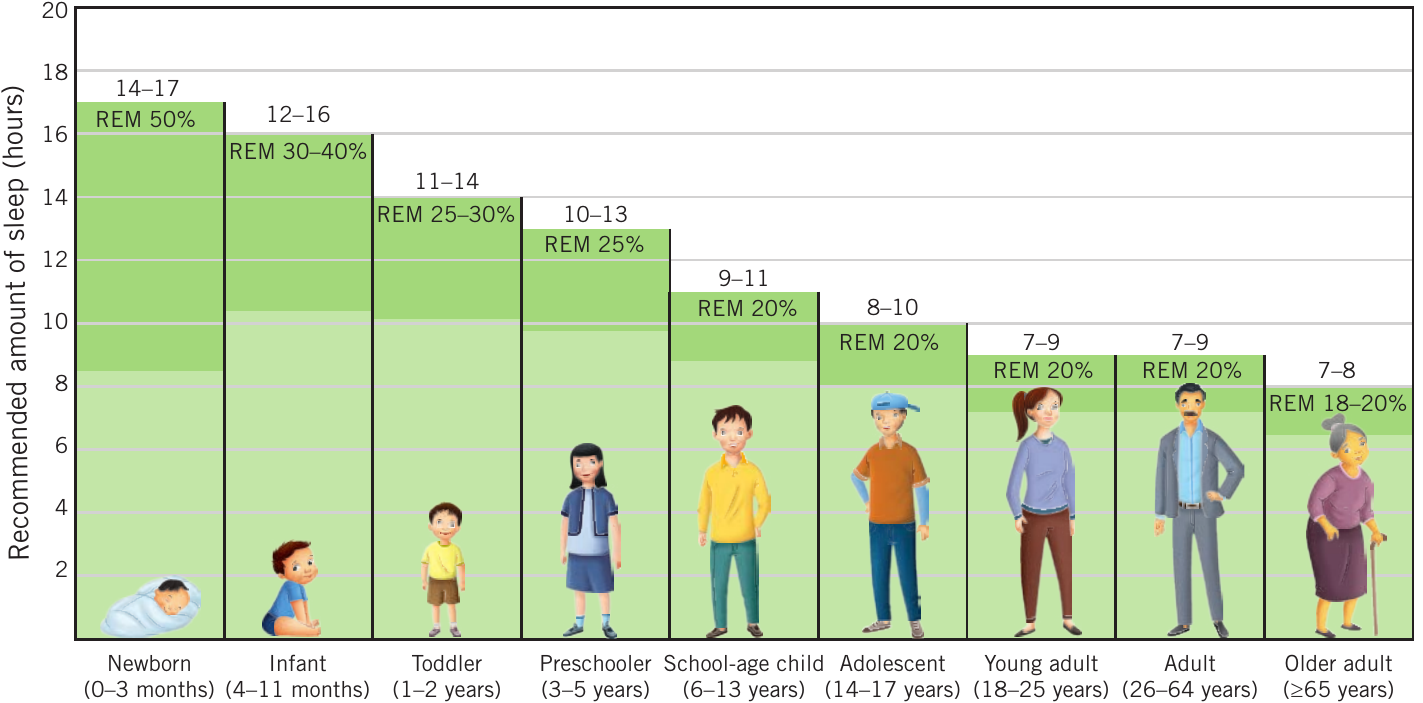
This visual representation clearly demonstrates:
- The progressive decrease in total sleep requirements from newborn (14-17 hours) to older adult (7-8 hours)
- The dramatic decline in REM sleep proportion from newborn (50%) to a stable 20% in adulthood
- The relatively consistent REM sleep proportion (around 20%) maintained from adolescence through older adulthood
International comparison of sleep duration
Research comparing sleep duration across different countries reveals interesting patterns:
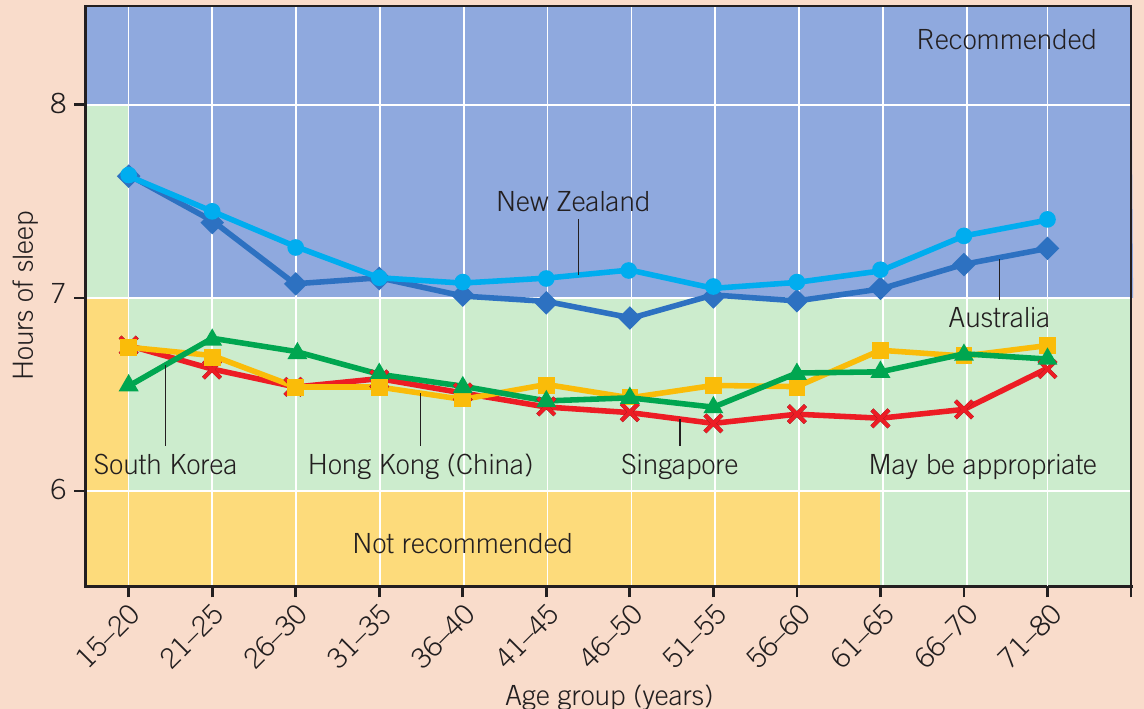
This graph shows average hours of sleep across age groups in five Asia-Pacific territories: New Zealand, Australia, South Korea, Hong Kong (China), and Singapore. Key observations include:
Note
Key International Sleep Patterns:
- New Zealand consistently shows the highest sleep duration (around 7-7.5 hours)
- Asian countries (South Korea, Hong Kong, Singapore) cluster in the 6.5-7 hour range
- All countries show relatively stable sleep durations across most age groups
- Most data falls within the "may be appropriate" or "recommended" zones
- Some age groups in Asian countries fall into the "not recommended" zone (below 6 hours)
Comparing sleep patterns: examination skills
When comparing sleep patterns between different life stages, you must select one key point and describe how it differs between the two stages.
Example
Worked Example: Comparing Sleep Patterns
Question: Provide one difference between the sleep patterns of a newborn and an older adult. (2 marks)
Incomplete answer (1/2 marks): "A newborn experiences 50% of their total sleep in REM sleep. An older adult sleeps about 7 hours each night."
Why this is incomplete: This answer identifies features correctly but fails to make a direct comparison.
Complete answer (2/2 marks): "A newborn experiences 50% of their total sleep in REM sleep, whereas an older adult experiences 20% of their total sleep in REM sleep."
Why this is complete: This answer uses a contrast conjunction ("whereas") to directly compare the same factor (REM sleep proportion) between the two life stages.
Effective comparison strategy:
- Select one key difference point (e.g., REM sleep proportion, total sleep amount, circadian rhythm timing)
- Describe this factor for each life stage
- Use contrast conjunctions such as "whereas", "although", "while", "in comparison to", or "however" to connect the descriptions
Analysing sleep data quality
When evaluating sleep research, several quality factors must be considered:
Accuracy
Accuracy refers to how close measurements are to the true value. In sleep research, wearable fitness trackers showed 96-97% accuracy for sleep detection when compared to gold-standard polysomnography measures.
External validity
External validity concerns whether research results can be applied to other individuals in different settings. A limitation of wearable device studies is that users typically fall into medium to high socio-economic ranges and are generally health-conscious, potentially limiting generalisability to the wider population.
Internal validity
Internal validity assesses whether a study investigates what it claims to investigate. If devices cannot automatically detect sleep periods less than one hour (such as naps), but the study claims to measure total sleep, internal validity may be compromised.
Precision
Precision measures how closely a set of measurements agree with each other. Devices that poorly detect wake periods during sleep may produce less precise measurements across multiple recordings.
Repeatability
Repeatability considers how close successive measurements are under identical conditions. Using the same specific brand of fitness tracker ensures repeatability in follow-up studies.
Reproducibility
Reproducibility examines how close measurements are when conditions change. If a study using movement-based trackers produces similar results to one using brain wave measurements, the findings are considered reproducible and credible.
Systematic errors
Systematic errors cause measurements to consistently differ from the true value. If fitness trackers consistently overestimate total sleep time by 8-9 minutes compared to polysomnography, a systematic error exists.
Important
Common Research Quality Concern:
Systematic errors are particularly problematic in sleep research because they can lead to consistent overestimation or underestimation of sleep parameters. Unlike random errors, systematic errors cannot be reduced by taking multiple measurements.
Outliers and incomplete data
Outliers are values that lie far from other results. Researchers may exclude incomplete data, such as participants who did not record the minimum required number of nights, to maintain data quality.
Remember!
Summary
Key Points to Remember:
-
Sleep needs and patterns change systematically throughout the lifespan, with total sleep decreasing from approximately 14-17 hours in newborns to 7-8 hours in older adults.
-
REM sleep proportion experiences its most dramatic decrease from birth (50%) to toddlerhood (25-30%), then stabilises at approximately 20% from adolescence onwards.
-
Circadian rhythm shifts occur at specific life stages: adolescents experience a phase delay (preferring later sleep), whilst older adults experience a phase advance (preferring earlier sleep).
-
Multiple factors influence sleep patterns beyond age, including biological changes (melatonin levels, brain development), psychological factors (stress, mental health), and social factors (work schedules, family responsibilities, technology use).
-
When comparing sleep patterns across life stages, always select one specific factor and describe how it differs between the stages using appropriate contrast conjunctions.