Sleep as a Naturally Occurring Altered State of Consciousness (VCE SSCE Psychology): Revision Notes
📚Revision Notes
Sleep as a Naturally Occurring Altered State of Consciousness
Understanding consciousness
Consciousness refers to your awareness of both your internal mental processes and the external world around you. Your internal awareness includes thoughts, feelings, sensations and perceptions, whilst your external awareness encompasses everything happening in your environment. This awareness is unique to each individual, subjective in nature, and constantly shifting from moment to moment.
Consider how your conscious experience changes throughout a single minute: you might be reading these words, then notice you're thinking about dinner, then become aware of a friend asking you a question. Each shift represents a change in what occupies your conscious mind.
Consciousness in the brain
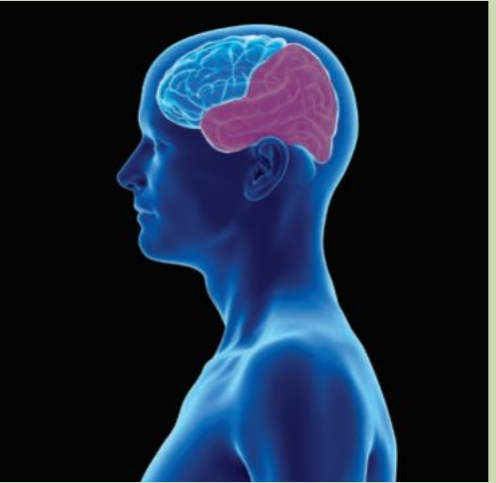
Research has revealed that consciousness does not reside in a single brain structure. Instead, it involves multiple neural pathways distributed across various brain regions, depending on the type of activity occurring. Conscious awareness appears to be particularly associated with the cerebral cortex, with a 'posterior hot zone' at the back of the brain showing heightened activity during conscious experiences. This zone consists of the parietal, temporal and occipital lobes.
Note
Understanding consciousness has practical applications in medicine and psychology, including developing treatments for anxiety disorders such as phobias, supporting recovery from coma, and better understanding hallucinations and psychosis.
Consciousness as a psychological construct
When you encounter a stranger, you cannot directly observe their personality, intelligence or conscious experience. You know your own feelings, thoughts and perceptions – your subjective experience – but cannot precisely know another person's conscious experience. You cannot peer inside their mind to discover their internal world.
Important
This limitation exists because consciousness is a psychological construct. A psychological construct is a concept that cannot be directly observed or measured through objective data collection, yet is widely accepted to exist. Whilst no single brain structure houses consciousness and the complete physiological mechanisms remain unclear, we acknowledge its existence. Researchers can only measure consciousness indirectly through observable indicators such as physiological changes, behaviours, or self-report methods.
States of consciousness
Your consciousness does not simply switch on or off. Instead, it continuously shifts through different levels of awareness throughout each day. You might experience a caffeine-influenced state after morning coffee, focused attention during an examination, lethargy at day's end, a daydreaming state during your commute, and finally sleep with periods of dreaming.
These various states fall into two broad categories: normal waking consciousness and altered states of consciousness.
Normal waking consciousness
Normal waking consciousness describes a state in which you are aware of your internal and external environments. You experience this state during everyday activities when awake with a regular level of awareness. During normal waking consciousness, you can manage your attention and behaviour, and your thoughts and perceptions remain organised and clear. Examples include reading a book, conversing with a friend, or sharing dinner with family.

Altered states of consciousness
An altered state of consciousness is any state where awareness differs from normal waking consciousness. During altered states, your awareness levels may be either lower or higher than in normal waking consciousness. Additionally, mental processing changes, potentially altering perceptions or thinking patterns. Both a child daydreaming during a long car journey and an elite tennis player serving a winning point exist in altered states of consciousness.
Important
Understanding the Distinction Between Types of Altered States
Altered states divide into two categories based on their origin:
Naturally occurring altered states of consciousness arise without external influence. Examples include sleep, fatigue, or the focused concentration experienced during intense physical activity.
Induced altered states of consciousness are deliberately brought about through external means. Examples include alcohol-induced states, anaesthetised states during surgery, or meditative states achieved through practice.

Sleep as a naturally occurring altered state
Sleep represents a naturally occurring and reversible altered state of consciousness. It is characterised by reduced awareness and responsiveness to external surroundings. During sleep, distinctive brain wave activity occurs alongside other identifiable physiological changes. These characteristics help differentiate sleep from other altered states that might result from brain injury or substance use.
Note
As part of the broader construct of consciousness, sleep can also be considered a psychological construct. Sleep remains fundamentally private to each individual, meaning researchers can only infer its presence through observations and measurements of associated physiological responses.
The architecture of sleep: NREM and REM
During a typical night, you experience two distinct types of sleep: rapid eye movement (REM) sleep and non-rapid eye movement (NREM) sleep. An eight-hour sleep episode typically includes approximately five sleep cycles, each lasting around 90 minutes and featuring distinguishable, repetitive patterns of REM and NREM sleep.
For adults, a typical sleep episode consists of approximately 55% light sleep, 20% deep sleep, 20% REM sleep, and 5% brief periods of wakefulness.
NREM sleep: Stages of progressive decline
Non-rapid eye movement (NREM) sleep is characterised by a progressive decline in physiological activity. NREM sleep consists of three distinct stages and comprises approximately 80% of a sleep episode in people of school age and older. NREM sleep is thought to facilitate bodily repair.
Note
NREM Stage 1 (N1) represents the transitional phase between wakefulness and sleep. This light sleep stage involves the beginning of physiological slowing, including decreases in brain activity, heart rate and body temperature. N1 occurs when a person 'dozes off', making them easily awakened. As sleep progresses, relatively little time is spent in N1. Without disturbance, a person typically moves from N1 into N2 within a few minutes.
NREM Stage 2 (N2) also constitutes light sleep, during which physiological responses continue their decline. Whilst a person remains relatively easy to wake during N2, bursts of brain activity help resist arousal from environmental stimuli such as noises. N2 represents the stage experienced most throughout a complete sleep episode.
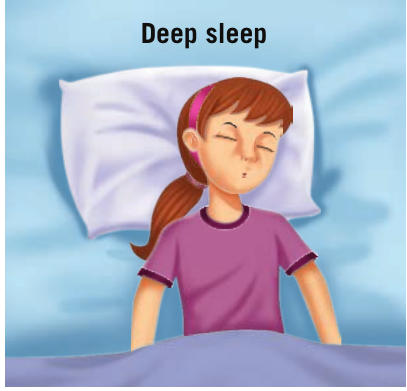
NREM Stage 3 (N3) constitutes deep sleep, during which physiological responses reach their slowest rates and arousal becomes most difficult. N3 is termed 'slow-wave sleep' because brain activity reaches its minimum speed. During a sleep episode, N3 predominantly occurs in the first half of the night. As sleep progresses, less time is spent in N3, potentially disappearing entirely during the final one or two sleep cycles of a typical night.
REM sleep: The dreaming stage
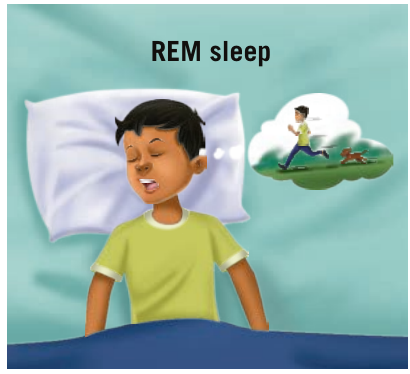
During rapid eye movement (REM) sleep, your eyes make quick darting movements behind closed eyelids whilst physiological activity increases. Brain activity during REM sleep resembles wakefulness, and both heart rate and breathing rate increase. Voluntary muscles appear paralysed, twitching only intermittently. The most vivid and memorable dreams occur during REM sleep. REM sleep is thought to facilitate mental repair.
A period of REM sleep occurs at the end of each sleep cycle. These REM periods become progressively longer and more frequent as sleep continues, meaning more REM sleep occurs in the second half of the night than the first. REM sleep typically comprises 20% of a sleep episode in people aged around five years and older. If sleep deprivation occurs, the subsequent sleep episode may feature increased REM sleep.
Sleep cycles and hypnograms
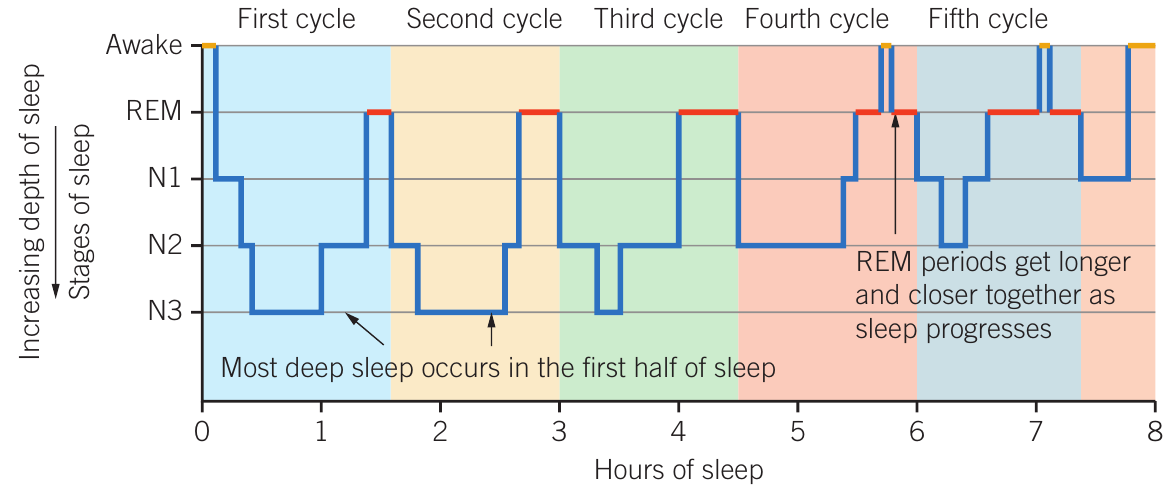
A sleep cycle progresses through distinct stages in a recognisable pattern. Beginning with N1, sleep deepens through N2 to N3 (deep sleep), then reverses back through N2 before concluding with a REM period. This complete cycle lasts approximately 90 minutes, with five cycles typically occurring during an eight-hour sleep episode.
Important
Key Patterns in Sleep Architecture
Two key patterns characterise normal sleep architecture:
-
Deep sleep concentration: Most N3 (deep sleep) occurs during the first half of sleep. Later cycles may contain little or no N3 sleep.
-
REM sleep progression: REM periods become longer and occur more frequently as sleep progresses, resulting in more REM sleep during the second half of the night.
Understanding hypnograms
A hypnogram is a line graph displaying sleep stages plotted against time, revealing the sleep architecture or pattern of a complete sleep episode. Time appears on the horizontal x-axis (either as clock time or hours since attempting sleep), whilst sleep types and stages appear on the vertical y-axis, with wakefulness at the top and deepest sleep (N3) at the bottom.
The hypnogram shows how sleep progresses through multiple cycles of REM and NREM stages throughout the night. Each U-shaped pattern in the line represents one sleep cycle, showing the descent from light sleep (N1) through deeper stages (N2, N3) and the return upward through lighter stages before REM sleep.
Note
Interpreting Hypnograms
When interpreting hypnograms, several features provide information about sleep patterns:
- Sleep cycle number: The quantity of complete cycles experienced
- REM sleep timing and duration: When REM periods occur and their length
- Total sleep duration: The complete hours of sleep achieved
- Sleep onset and offset: When sleep begins and ends
- Awakenings: Frequency and duration of waking periods
- Deep sleep proportion: Time spent in N3 compared to lighter stages (N1, N2)
These features can indicate a person's age or reveal potential sleep disorders. For example, reduced N3 sleep, inconsistent cycle patterns, or unusual REM distribution might suggest sleep disruption.
Remember!
Summary
Key Points to Remember:
-
Consciousness is your awareness of internal mental processes and the external environment; it cannot be directly measured but is understood to exist as a psychological construct.
-
Normal waking consciousness involves regular awareness during everyday activities, whilst altered states feature different levels of awareness and may be naturally occurring (like sleep) or induced (like meditation).
-
Sleep is a naturally occurring, reversible altered state characterised by reduced awareness and unique physiological changes, including distinctive brain wave patterns.
-
NREM sleep (80% of sleep) has three stages showing progressive physiological decline, particularly N3 deep sleep, whilst REM sleep (20%) features increased activity, rapid eye movements, and vivid dreaming.
-
Sleep cycles last approximately 90 minutes, with about five cycles per eight-hour sleep episode; deep sleep concentrates in the first half of the night, whilst REM sleep becomes longer and more frequent in the second half.