B-lymphocytes & Humoral Immunity (AQA A-Level Biology): Revision Notes
📚Revision Notes
B-lymphocytes & Humoral Immunity
What is humoral immunity?
Humoral immunity represents one of the body's key defence mechanisms against pathogens. The term "humoral" comes from an old-fashioned word for body fluids called "humour". This type of immunity involves antibodies - proteins that circulate freely in the blood plasma and tissue fluids throughout the body.
Note
The term "humoral" has historical significance in medicine, dating back to ancient theories about body fluids or "humours" that were thought to control health and disease. Today, we use this term specifically to describe immunity mediated by substances dissolved in body fluids.
The process begins when specific T helper cells recognise foreign antigens and stimulate B-lymphocytes (B cells) to divide and multiply. These B cells then become the central players in producing the antibodies needed to combat specific threats.
How B cells recognise and respond to antigens
When a pathogen enters the body, it carries multiple antigens on its surface - these are proteins that the immune system recognises as foreign. Each B cell in your body has the ability to produce one specific type of antibody that matches perfectly with one particular antigen, like a lock and key mechanism.
Note
This lock and key mechanism is fundamental to immune system specificity. Just as a key must have the exact shape to fit a particular lock, each antibody has a unique three-dimensional structure that can only bind to its corresponding antigen.
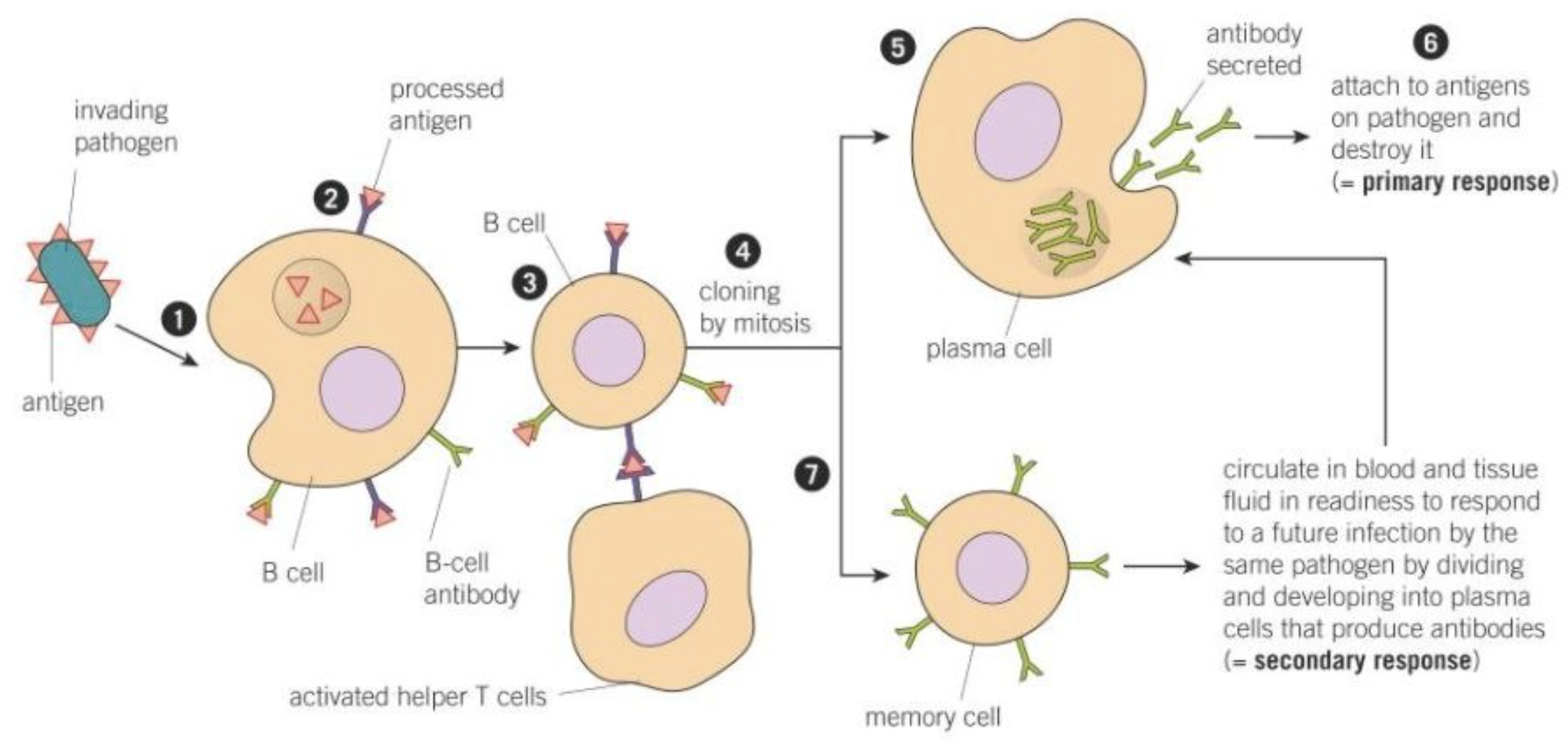
The process works through complementary binding - the antibody on the B cell surface has a shape that exactly fits the antigen. When this binding occurs, the antigen enters the B cell through endocytosis and gets processed internally. The B cell then displays these processed antigens on its surface, where activated helper T cells can recognise and bind to them.
Clonal selection and antibody production
Once a B cell has been activated by helper T cells, it undergoes rapid division through mitosis. This process is called clonal selection because it creates a clone of identical B cells, all capable of producing the same specific antibody against the original antigen.
These cloned cells develop into two distinct types, each with different roles in immunity:
Plasma cells - the immediate response team
Plasma cells are the workhorses of antibody production. These cells have several important characteristics:
Note
Key Plasma Cell Features:
Plasma cells are highly specialised factories for antibody production. Their internal structure is optimised for protein synthesis, with enlarged rough endoplasmic reticulum and Golgi apparatus to handle the massive antibody production demands.
- They secrete antibodies directly into blood plasma and tissue fluids
- Each plasma cell can produce approximately 2000 antibodies every second
- They have a relatively short lifespan, surviving only a few days
- They are responsible for the primary immune response - the body's first encounter with a pathogen
The antibodies produced by plasma cells circulate throughout the body, binding to antigens on pathogens and marking them for destruction by other immune cells. This immediate response helps contain the initial infection.
Memory cells - the long-term protection force
Memory cells provide the foundation for long-lasting immunity. These specialised cells:
Note
Memory Cell Longevity:
Memory cells are remarkable for their longevity - some can survive for the entire lifetime of an individual. This is why people who survived certain diseases like measles or chickenpox typically never get them again, and why vaccines can provide decades of protection.
- Live considerably longer than plasma cells, often surviving for decades
- Do not actively produce antibodies during their resting state
- Circulate in blood and tissue fluid, constantly monitoring for their specific antigen
- Are responsible for the secondary immune response when the same pathogen is encountered again
When memory cells detect their specific antigen during a subsequent infection, they rapidly divide and develop into both plasma cells and additional memory cells. This creates a much faster and more powerful immune response compared to the initial encounter.
Primary vs secondary immune responses
Important
Critical Difference Between Immune Responses:
The contrast between primary and secondary immune responses is one of the most important concepts in immunology. Understanding this difference explains why vaccination works and why some diseases typically only affect people once.
The difference between primary and secondary immune responses is dramatic:
Primary response occurs during the first exposure to an antigen:
- Takes longer to develop (several days to weeks)
- Produces lower quantities of antibodies initially
- Antibody levels peak later and decline relatively quickly
- The individual may experience symptoms as the immune system learns to combat the pathogen
Secondary response occurs during subsequent exposures:
- Develops much more rapidly (within days)
- Produces significantly higher quantities of antibodies
- Antibody levels peak sooner and remain elevated longer
- Often prevents symptoms entirely, as the pathogen is eliminated before it can establish infection
This enhanced secondary response explains why vaccination is so effective - it creates memory cells without causing disease, providing protection against future encounters with the pathogen.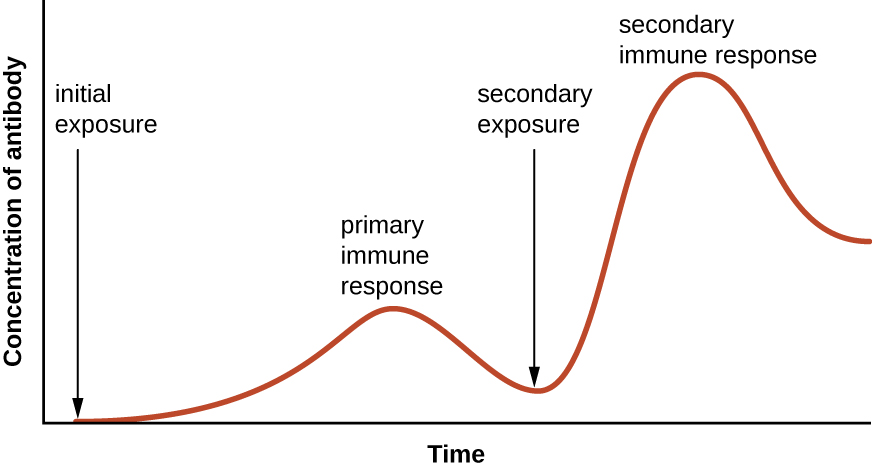
The complete B cell response process
Example
Worked Example: The Complete Humoral Immune Response
Following a pathogen invasion, the humoral immune response proceeds through these steps:
Step 1: Antigen recognition - Surface antigens from an invading pathogen are recognised by a B cell with the complementary antibody
Step 2: Antigen processing - The B cell engulfs the antigen through endocytosis and processes it internally
Step 3: Antigen presentation - Processed antigens are displayed on the B cell surface
Step 4: T cell activation - Helper T cells (previously activated) bind to the presented antigens and activate the B cell
Step 5: Clonal expansion - The activated B cell divides rapidly by mitosis, creating a clone of identical cells
Step 6: Cell differentiation - The cloned cells develop into plasma cells and memory cells
Step 7: Antibody production - Plasma cells secrete specific antibodies that bind to antigens on the pathogen, leading to its destruction
Step 8: Memory formation - Memory cells remain in circulation, ready to respond quickly to future infections by the same pathogen
This coordinated response ensures both immediate protection through antibody production and long-term immunity through memory cell formation.
Summary
Key Points to Remember:
- Humoral immunity uses antibodies dissolved in body fluids to fight pathogens, with B cells producing these specific defensive proteins
- Clonal selection creates identical copies of B cells that can all produce the same antibody against a specific antigen
- Plasma cells provide immediate defence by producing thousands of antibodies per second but only live for a few days
- Memory cells live for decades and enable rapid, powerful responses to repeat infections by the same pathogen
- The secondary immune response is faster, stronger, and more effective than the primary response, forming the basis of vaccination and long-term immunity