Co-transport (AQA A-Level Biology): Revision Notes
📚Revision Notes
Co-transport
What is co-transport?
Co-transport is a specialised membrane transport mechanism where two different substances are moved across a cell membrane simultaneously using the same carrier protein. This process occurs when one substance moves down its concentration gradient, providing the energy to transport a second substance against its concentration gradient.
In biological systems, co-transport typically involves the movement of sodium ions alongside nutrients such as glucose or amino acids. The process is also known as secondary active transport because it relies indirectly on energy from ATP, rather than using ATP directly.
Note
Secondary active transport is called "secondary" because it doesn't use ATP directly like primary active transport. Instead, it harnesses the energy stored in concentration gradients that were created by primary active transport processes.
The mechanism of co-transport
The co-transport process works through a carefully coordinated series of steps involving sodium-potassium pumps and specialised co-transport proteins.
Step 1: Creating the sodium gradient
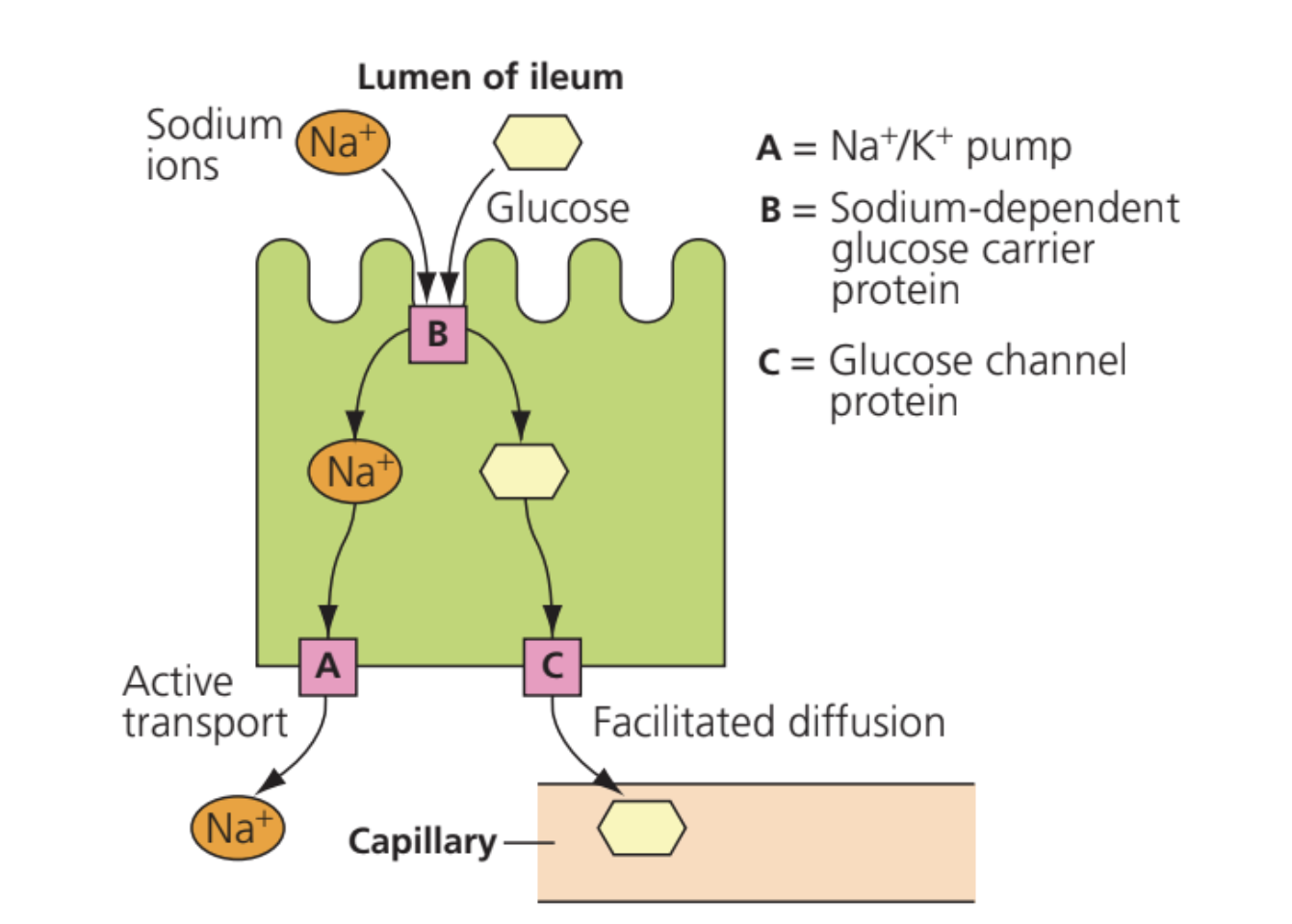
The sodium-potassium pump actively transports sodium ions out of epithelial cells into the blood. This process requires ATP and creates a concentration gradient with high sodium concentration in the intestinal lumen and low sodium concentration inside the epithelial cells.
Step 2: Co-transport protein binding
Co-transport proteins embedded in the cell surface membrane have binding sites for both sodium ions and the target nutrient (glucose or amino acids). When both substances bind to the protein simultaneously, it undergoes a conformational change.
Step 3: Coupled transport
As sodium ions move down their concentration gradient into the epithelial cell, they carry the glucose or amino acid molecules with them through the same transport protein. This occurs even though the nutrients are moving against their own concentration gradient.
Step 4: Release and exit
Once inside the cell, both substances are released. The glucose or amino acids then move into the bloodstream via facilitated diffusion using different carrier proteins on the basolateral membrane.
Important
The key to understanding co-transport is recognising that it's the sodium gradient (created by ATP-powered pumps) that provides the energy to move nutrients against their concentration gradients. Without this gradient, co-transport cannot occur.
Co-transport in glucose absorption
The small intestine provides an excellent example of co-transport in action. Epithelial cells lining the ileum possess microvilli - finger-like projections approximately 0.6 μm in length that form the brush border. These structures dramatically increase the surface area available for absorption.
Note
Microvilli are incredibly small but numerous. Each epithelial cell can have thousands of microvilli, collectively increasing the absorptive surface area by approximately 20-fold compared to a smooth surface.
During digestion, carbohydrates are broken down into simple sugars like glucose, creating high concentrations of these nutrients in the intestinal lumen. However, glucose cannot be absorbed efficiently by diffusion alone because:
- The concentration gradient may not always favour movement into cells
- Simple diffusion would be too slow to meet the body's energy demands
- Some glucose might be lost if absorption relied only on passive processes
Co-transport solves these problems by using the sodium gradient as a driving force. The process ensures that virtually all available glucose is absorbed into the bloodstream, even when glucose concentrations in the intestine become relatively low.
Link to other transport processes
Co-transport works alongside other membrane transport mechanisms to maximise absorption efficiency:
- Active transport maintains the sodium gradient that powers co-transport. The sodium-potassium pump continuously removes sodium from epithelial cells, ensuring the concentration difference persists.
- Facilitated diffusion allows the absorbed nutrients to move from epithelial cells into the bloodstream. This occurs down a concentration gradient and uses different carrier proteins from those involved in co-transport.
- Simple diffusion also contributes to absorption, particularly when concentration gradients favour movement from the intestine into epithelial cells.
The combination of these processes ensures that carbohydrate digestion products are absorbed efficiently, maintaining steady glucose levels in the bloodstream for cellular respiration throughout the body.
Summary
Key Points to Remember:
- Co-transport uses the energy from one substance moving down its gradient to transport another substance against its gradient
- Sodium-potassium pumps create the sodium gradient that powers glucose and amino acid co-transport
- Co-transport proteins have binding sites for both sodium ions and nutrients, allowing coupled movement
- This mechanism ensures efficient absorption of glucose and amino acids in the small intestine
- Co-transport is an example of secondary active transport as it relies indirectly on ATP energy