Osmosis (AQA A-Level Biology): Revision Notes
📚Revision Notes
Osmosis
What is osmosis?
Osmosis is a specialised type of diffusion that involves only the movement of water molecules. It can be defined as the movement of water from an area of higher water potential to an area of lower water potential through a selectively permeable membrane.
Note
Selectively permeable membranes, such as cell surface membranes and plasma membranes around organelles, allow water molecules and some small molecules to pass through, but prevent larger molecules from crossing. This selective nature is crucial for maintaining cellular control over what enters and exits the cell.
Understanding water potential
Water potential is represented by the Greek letter psi (ψ) and measured in units of pressure, typically kilopascals (kPa). It describes the pressure exerted by water molecules and indicates their tendency to move from one area to another.
Under standard conditions (25°C and 100 kPa pressure), pure water has a water potential of zero ( kPa). This serves as the reference point for all water potential measurements.
Important
Key Principles of Water Potential:
- Adding any solute to pure water will lower its water potential, making it negative
- The water potential of any solution (water + solute) is always less than zero
- The more concentrated a solution becomes, the more negative its water potential becomes
- Water moves by osmosis from regions of higher (less negative) water potential to regions of lower (more negative) water potential
The mechanism of osmosis
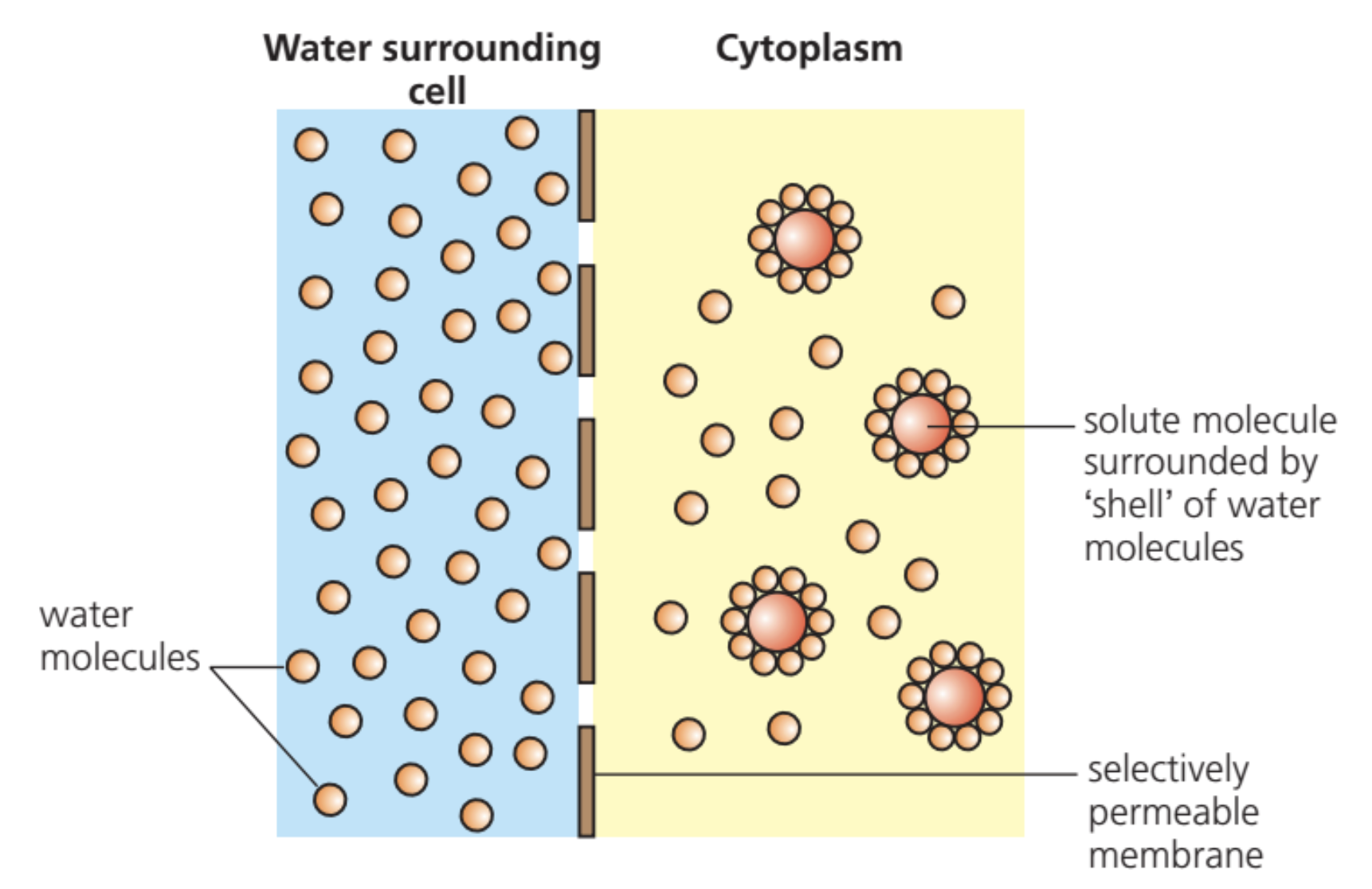
Osmosis occurs when a selectively permeable membrane separates two solutions with different concentrations of solute molecules. The process works as follows:
- Both solute and water molecules move randomly due to their kinetic energy
- The selectively permeable membrane allows only water molecules to pass through, blocking solute molecules
- Water molecules diffuse from the side with higher water potential to the side with lower water potential
- This continues until dynamic equilibrium is established, where water potentials are equal on both sides and there is no net movement of water
Note
Think of osmosis as water molecules "seeking balance" - they will continue to move across the membrane until the concentration of water molecules is equal on both sides, even though the total solute concentrations may remain different.
Osmosis in animal cells
Animal cells, such as red blood cells, contain various solutes dissolved in their watery cytoplasm. When placed in solutions of different water potentials, they respond in three possible ways:
Higher external water potential (hypotonic solution):
- Water enters the cell by osmosis
- The cell swells and may eventually burst
- In red blood cells, this bursting is called haemolysis
- Cell surface membranes are thin (7 nm) and flexible, offering little resistance to expansion
Equal water potential (isotonic solution):
- No net movement of water occurs
- The cell maintains its normal size and shape
- This represents dynamic equilibrium
Lower external water potential (hypertonic solution):
- Water leaves the cell by osmosis
- The cell shrinks and becomes shrivelled
- The cytoplasm becomes more concentrated
Example
Worked Example: Red Blood Cell in Different Solutions
Consider a red blood cell with internal water potential of -900 kPa:
Step 1: In distilled water (ψ = 0 kPa)
- External water potential > internal water potential
- Water enters cell → cell swells → haemolysis occurs
Step 2: In isotonic saline (ψ = -900 kPa)
- External = internal water potential
- No net water movement → cell maintains normal shape
Step 3: In concentrated salt solution (ψ = -1500 kPa)
- External water potential < internal water potential
- Water leaves cell → cell shrinks and shrivels
In nature, animal cells typically exist in fluids that match their internal water potential. For example, red blood cells are surrounded by blood plasma, which has the same water potential as the cells themselves.
Osmosis in plant cells
Plant cells have a more complex structure that affects their response to osmosis. Each plant cell contains three main components:
- The central vacuole - contains a solution of salts, sugars and organic acids in water
- The protoplast - includes the cell surface membrane, nucleus, cytoplasm and inner vacuole membrane
- The cellulose cell wall - a tough, inelastic covering permeable to large molecules
When plant cells are placed in solutions of different water potentials:
Higher external water potential:
- Water enters the cell by osmosis
- The protoplast swells and presses against the cell wall
- The cell becomes turgid
- The rigid cell wall prevents the cell from bursting
Equal water potential:
- No net water movement occurs
- The cell shows incipient plasmolysis - the protoplast just begins to pull away from the cell wall
Lower external water potential:
- Water leaves the cell by osmosis
- The protoplast shrinks and pulls completely away from the cell wall
- The cell becomes plasmolysed
Example
Worked Example: Plant Cell Responses
Consider a plant cell in different solutions:
Step 1: In distilled water
- Water potential gradient favours water entry
- Cell becomes turgid - protoplast pushes against cell wall
- Cell wall prevents bursting (unlike animal cells)
Step 2: At incipient plasmolysis point
- Water potentials are equal
- Protoplast just begins to separate from cell wall
- This represents the transition point
Step 3: In concentrated sugar solution
- Water leaves the cell
- Protoplast shrinks away from cell wall
- Cell becomes plasmolysed but cell wall remains intact
Important
Key Difference from Animal Cells:
Plant cells normally exist in conditions where they absorb water and become turgid. This creates pressure that helps support the plant structure. Unlike animal cells, plant cells can safely absorb large amounts of water due to the protective cell wall that resists further expansion.
Links to required practicals
Understanding osmosis is essential for Required Practical 3, which involves producing dilution series to create calibration curves for determining the water potential of plant tissues.
Summary
Key Points to Remember:
- Osmosis is the movement of water molecules only, from higher to lower water potential through a selectively permeable membrane
- Pure water has a water potential of zero; all solutions have negative water potential values
- Animal cells can burst (haemolysis) or shrink when placed in solutions of different water potentials
- Plant cells are protected by their cell walls and become turgid or plasmolysed rather than bursting
- Dynamic equilibrium is reached when water potentials become equal on both sides of the membrane
- Water always moves from less negative to more negative water potential values