Structure of the Cell Membrane (AQA A-Level Biology): Revision Notes
📚Revision Notes
Structure of the Cell Membrane
Basic membrane structure
All cellular membranes share the same fundamental architecture, whether they surround entire cells or form boundaries around internal organelles. These structures are collectively termed plasma membranes. The cell-surface membrane refers specifically to the plasma membrane that encases the cell, creating a selective barrier between the internal cytoplasm and the external environment.
This boundary serves multiple essential roles: it maintains distinct internal conditions, regulates the passage of materials, and enables cells to interact with their surroundings. Understanding the molecular components that create this sophisticated barrier is essential for explaining how cells maintain homeostasis and communicate.
Note
The terms "plasma membrane" and "cell-surface membrane" are often used interchangeably, but remember that plasma membranes can also refer to membranes around organelles like mitochondria and chloroplasts, while cell-surface membrane specifically refers to the outer boundary of the cell.
Phospholipids
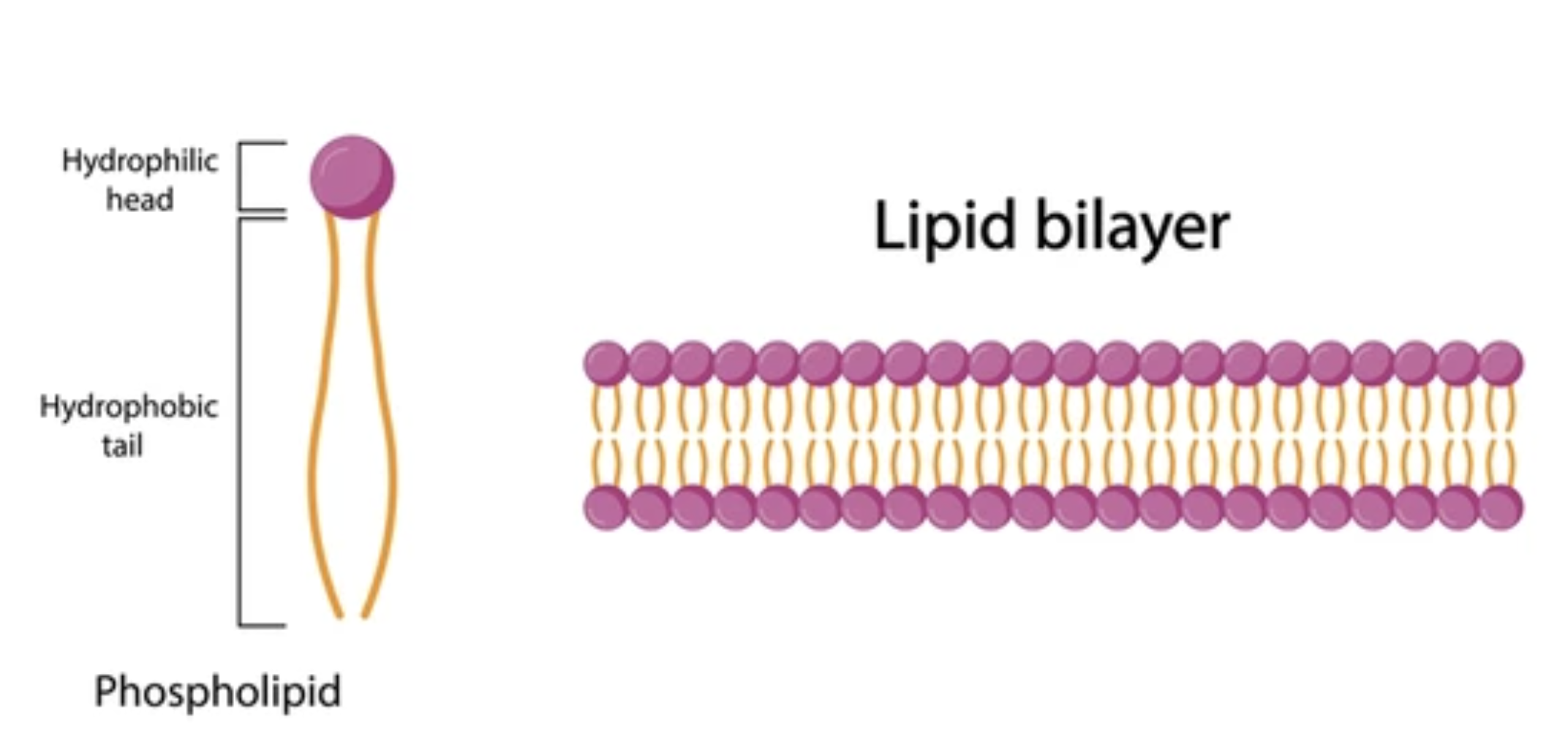
Phospholipids form the structural foundation of all cell membranes. Each phospholipid molecule contains a hydrophilic (water-attracting) phosphate head group attached to two hydrophobic (water-repelling) fatty acid tails. This dual nature drives their spontaneous arrangement into a phospholipid bilayer.
In this bilayer arrangement, the hydrophilic heads orient towards the aqueous environments on both sides of the membrane, whilst the hydrophobic tails cluster together in the membrane interior, away from water. This creates a continuous double layer that effectively separates the cell's interior from its external environment.
Important
The amphipathic nature of phospholipids (having both water-loving and water-hating parts) is crucial for understanding why they automatically form bilayers in aqueous environments. This is not a process that requires energy - it happens spontaneously due to the chemical properties of the molecules.
The phospholipid bilayer performs several vital functions:
- Permits lipid-soluble substances to pass through the membrane by dissolving in the fatty acid region
- Blocks water-soluble substances from crossing freely, maintaining distinct internal and external compositions
- Provides membrane flexibility and enables self-sealing properties, allowing the membrane to maintain integrity even when stretched or compressed
Membrane proteins
- Proteins embedded within the phospholipid bilayer dramatically expand the membrane's functional capabilities. These proteins integrate with the bilayer in two distinct patterns.
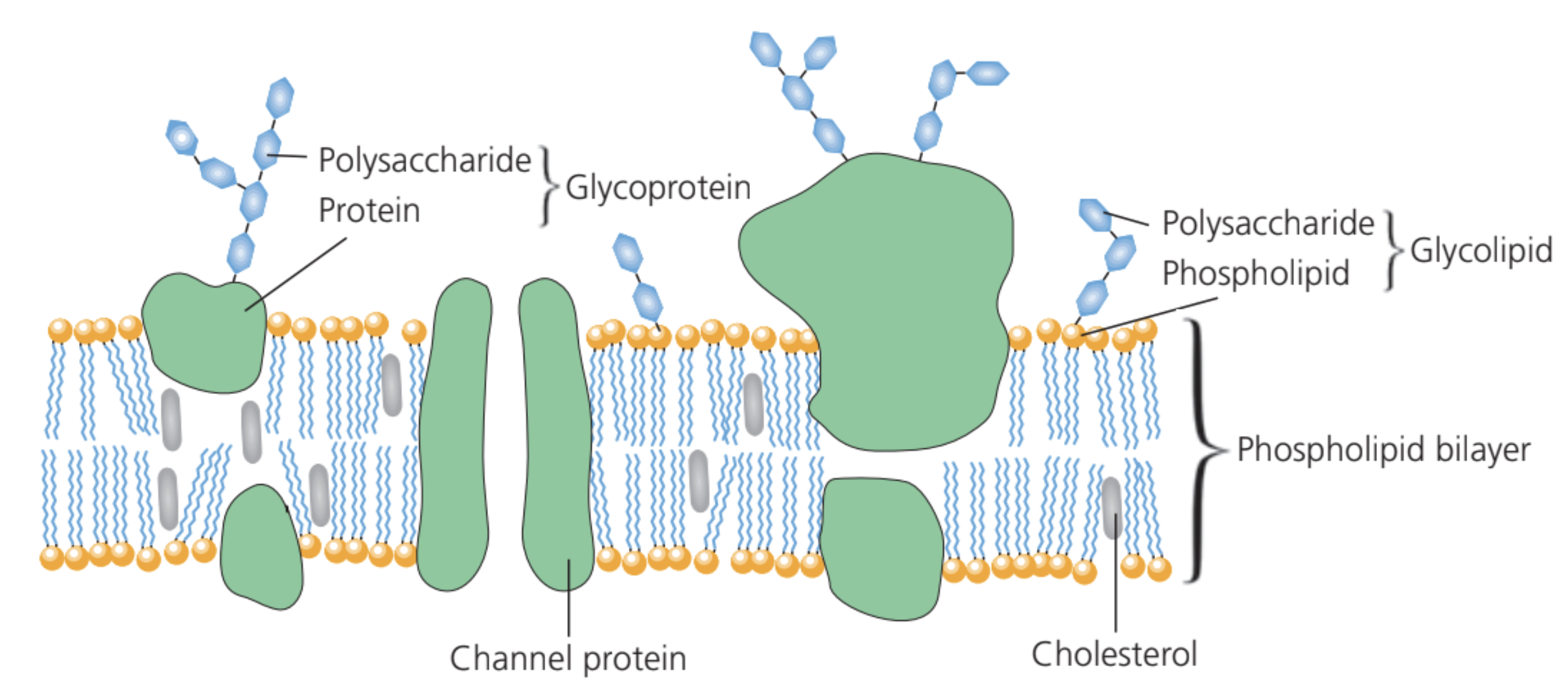
- Surface proteins associate with one side of the bilayer without spanning its entire width. These proteins typically provide structural support to the membrane or function as receptors for signalling molecules such as hormones and neurotransmitters.
- Transmembrane proteins extend completely across the bilayer from one surface to the other. This group includes protein channels that form water-filled passages, allowing specific water-soluble ions to traverse the membrane. Carrier proteins represent another crucial type - these bind to particular molecules like glucose or amino acids, then undergo conformational changes to transport these substances across the membrane.
Note
The distinction between surface proteins and transmembrane proteins is important for understanding their different functions. Surface proteins are like decorations on one side of a wall, while transmembrane proteins are like doorways that go all the way through the wall.
Membrane proteins collectively serve six major functions:
- Provide structural reinforcement to the membrane
- Create channels for water-soluble substance transport
- Enable active transport through carrier protein mechanisms
- Form cell-surface receptors for cell identification and signalling
- Facilitate cell adhesion by helping adjacent cells bind together
- Act as hormone receptors for cellular communication
Cholesterol
Cholesterol molecules nestle within the phospholipid bilayer, adding mechanical strength and regulating membrane properties. These highly hydrophobic molecules play a stabilising role by interacting with phospholipid fatty acid chains, which affects membrane fluidity and integrity.
Note
Cholesterol is found primarily in animal cell membranes. Plant cells use different molecules like sterols to achieve similar membrane-stabilising effects. This is why plant cell membranes can function effectively without cholesterol.
Cholesterol molecules position themselves between phospholipid molecules, where they serve three important functions:
- Reduce lateral movement of phospholipids and other membrane components, providing structural stability
- Decrease membrane fluidity at elevated temperatures, preventing excessive molecular motion
- Prevent water and ion leakage by filling gaps between phospholipid molecules and maintaining membrane integrity
This regulation ensures the membrane maintains optimal fluidity across varying temperature conditions whilst preventing unwanted permeability.
Glycolipids
Glycolipids consist of carbohydrate groups covalently attached to lipid molecules. The carbohydrate portion projects from the phospholipid bilayer into the surrounding aqueous environment, where it serves as a recognition element for specific chemical interactions.
These molecules demonstrate particular importance in biological recognition systems. For example, the human ABO blood group system relies on specific glycolipids present on red blood cell surfaces to determine blood compatibility.
Note
The carbohydrate chains of glycolipids always face outward from the cell (towards the extracellular environment), never inward towards the cytoplasm. This asymmetry is crucial for their function as recognition molecules.
Glycolipids contribute to membrane function through three key roles:
- Act as recognition sites for specific molecules or cells
- Help maintain membrane stability under varying conditions
- Facilitate cell-to-cell attachment and tissue formation
Glycoproteins
Glycoproteins form when carbohydrate chains attach to extrinsic proteins located on the membrane's outer surface. These hybrid molecules function primarily as highly specific cell-surface receptors, particularly for hormone and neurotransmitter recognition.
The carbohydrate portions of glycoproteins extend into the extracellular environment, creating unique molecular signatures that enable precise cellular communication and recognition.
Glycoproteins perform three essential functions:
- Serve as recognition sites for intercellular communication
- Enable cell attachment and tissue organisation
- Allow cellular recognition, such as enabling immune cells to distinguish between the body's own cells and foreign organisms
Membrane permeability
The cell-surface membrane acts as a selectively permeable barrier, controlling which substances can enter or exit the cell. Most molecules cannot freely cross this barrier due to several physical and chemical constraints.
Important
Selective permeability is one of the most important properties of cell membranes. Without this property, cells would not be able to maintain different internal conditions from their external environment, and life as we know it would not be possible.
Many substances face barriers because they are:
- Not lipid-soluble, preventing passage through the phospholipid layer
- Too large to fit through existing protein channels
- Electrically charged in ways that prevent passage through available channels
- Polar molecules that cannot traverse the non-polar hydrophobic interior of the phospholipid bilayer
This selective permeability enables cells to maintain distinct internal compositions whilst allowing essential nutrients to enter and waste products to exit through specific transport mechanisms.
Fluid-mosaic model
The fluid-mosaic model describes how membrane components combine to create a dynamic, functional structure. This model explains the membrane's architecture using two key characteristics.
Important
The fluid-mosaic model is the currently accepted explanation for membrane structure. Understanding both the "fluid" and "mosaic" aspects is essential for explaining how membranes can be both stable and flexible at the same time.
The fluid aspect refers to the ability of individual phospholipid molecules to move relative to each other within their layer. This molecular motion gives the membrane a flexible structure that constantly changes shape whilst maintaining its integrity.
The mosaic characteristic describes how various proteins embed within the phospholipid bilayer in different shapes, sizes, and positions, resembling tiles arranged in a mosaic pattern.
This model successfully explains the membrane's ability to maintain structural integrity whilst accommodating the diverse proteins necessary for cellular functions. The fluid nature allows proteins to move within the membrane when needed, whilst the mosaic arrangement provides the variety of functions required for cellular processes.
Summary
Key Points to Remember:
- Cell membranes consist of a phospholipid bilayer with hydrophilic heads facing outwards and hydrophobic tails facing inwards
- Membrane proteins enable transport and communication functions that the phospholipid bilayer alone cannot provide
- Cholesterol regulates membrane fluidity and prevents unwanted leakage of water and ions
- Glycolipids and glycoproteins serve as recognition sites and enable cell-to-cell interactions
- The fluid-mosaic model explains how membranes maintain flexibility whilst incorporating diverse functional proteins