Transcription (AQA A-Level Biology): Revision Notes
📚Revision Notes
Transcription
Introduction to protein synthesis
Proteins are essential to all aspects of life, and every organism needs to create its own unique proteins. Cells have the remarkable ability to manufacture every protein from just 20 amino acids. The specific proteins produced depend entirely on the instructions provided by DNA in the cell's nucleus at any given time.
Note
The ability of cells to create thousands of different proteins from just 20 amino acids is one of the most remarkable aspects of cellular biology. This process demonstrates the incredible efficiency and versatility of biological systems.
The process begins when DNA provides instructions through a long sequence of bases. This information must be converted into a usable form that can direct protein synthesis.
What is transcription?
Transcription is the process where part of a DNA sequence is used as a template to create a complementary molecule called pre-mRNA (pre-messenger RNA). This represents the first major step in converting genetic information into proteins.
The process occurs in the nucleus and involves the enzyme RNA polymerase, which reads the DNA template and assembles the corresponding RNA molecule.
The transcription process
Initial setup
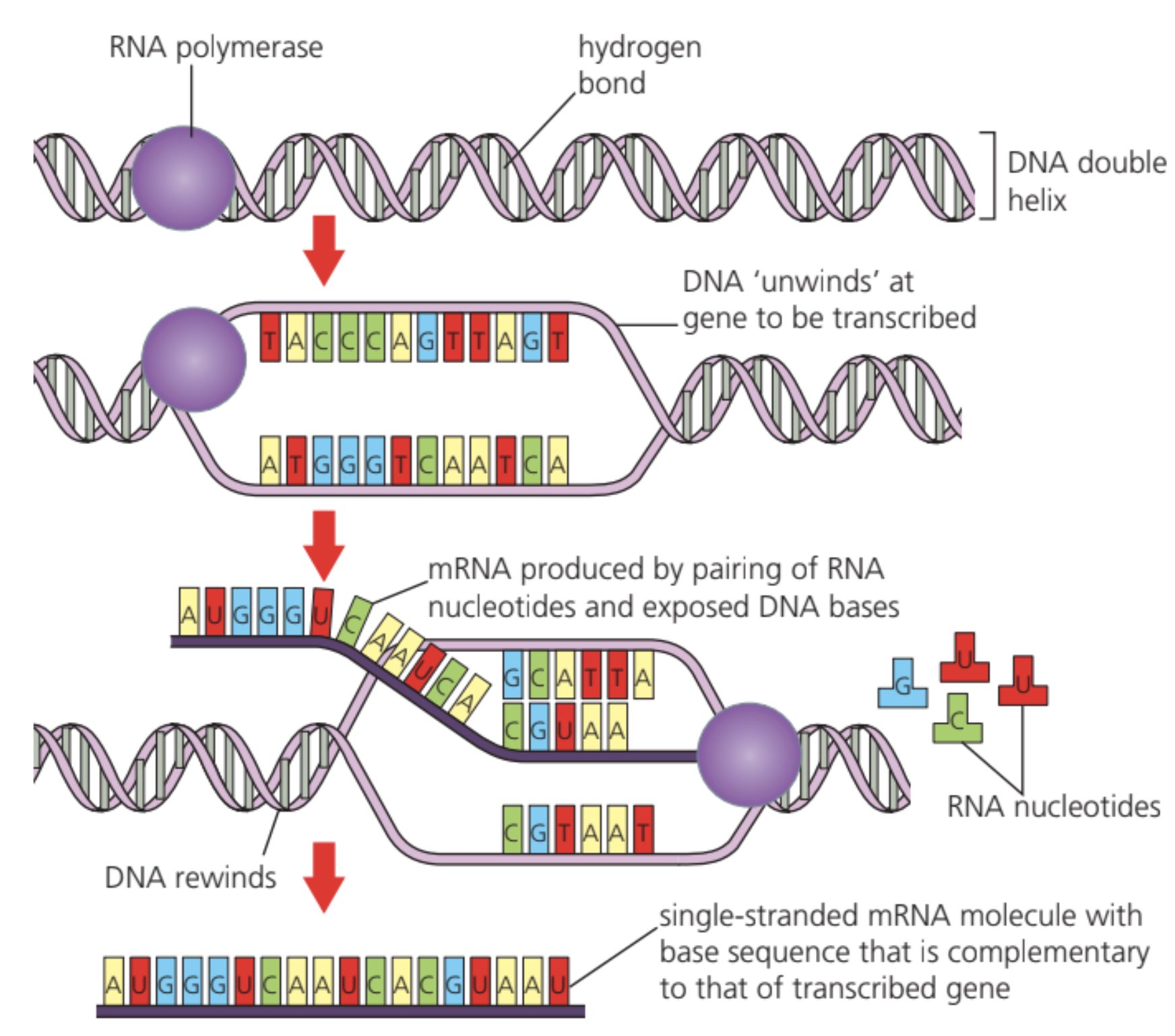
An enzyme acts on a specific region of DNA, causing the two strands to separate and expose the nucleotide bases in that region. This creates an accessible template for RNA synthesis.
Template strand recognition
The nucleotide bases on one DNA strand, known as the template strand, pair with their complementary nucleotides from the pool present in the nucleus. The enzyme RNA polymerase moves along this strand and joins the nucleotides together to form a pre-mRNA molecule.
Base pairing rules
During transcription, specific base pairing occurs according to established rules:
Example
Base Pairing During Transcription - Complementary Base Pairings:
- Guanine on DNA binds to cytosine in the RNA
- Cytosine on DNA links to guanine in the RNA
- Thymine on DNA joins to adenine in the RNA
- Adenine on DNA pairs with uracil in the RNA (not thymine)
Note: The key difference from DNA replication is that uracil replaces thymine in RNA.
Process completion
As RNA polymerase adds nucleotides one at a time to build the pre-mRNA strand, the DNA strands rejoin behind it. Only about 12 base pairs remain exposed at any time. When RNA polymerase reaches a specific sequence that it recognises as a 'stop' signal (stop codon), it detaches and pre-mRNA production is complete.
Splicing of pre-mRNA
Why is splicing necessary?
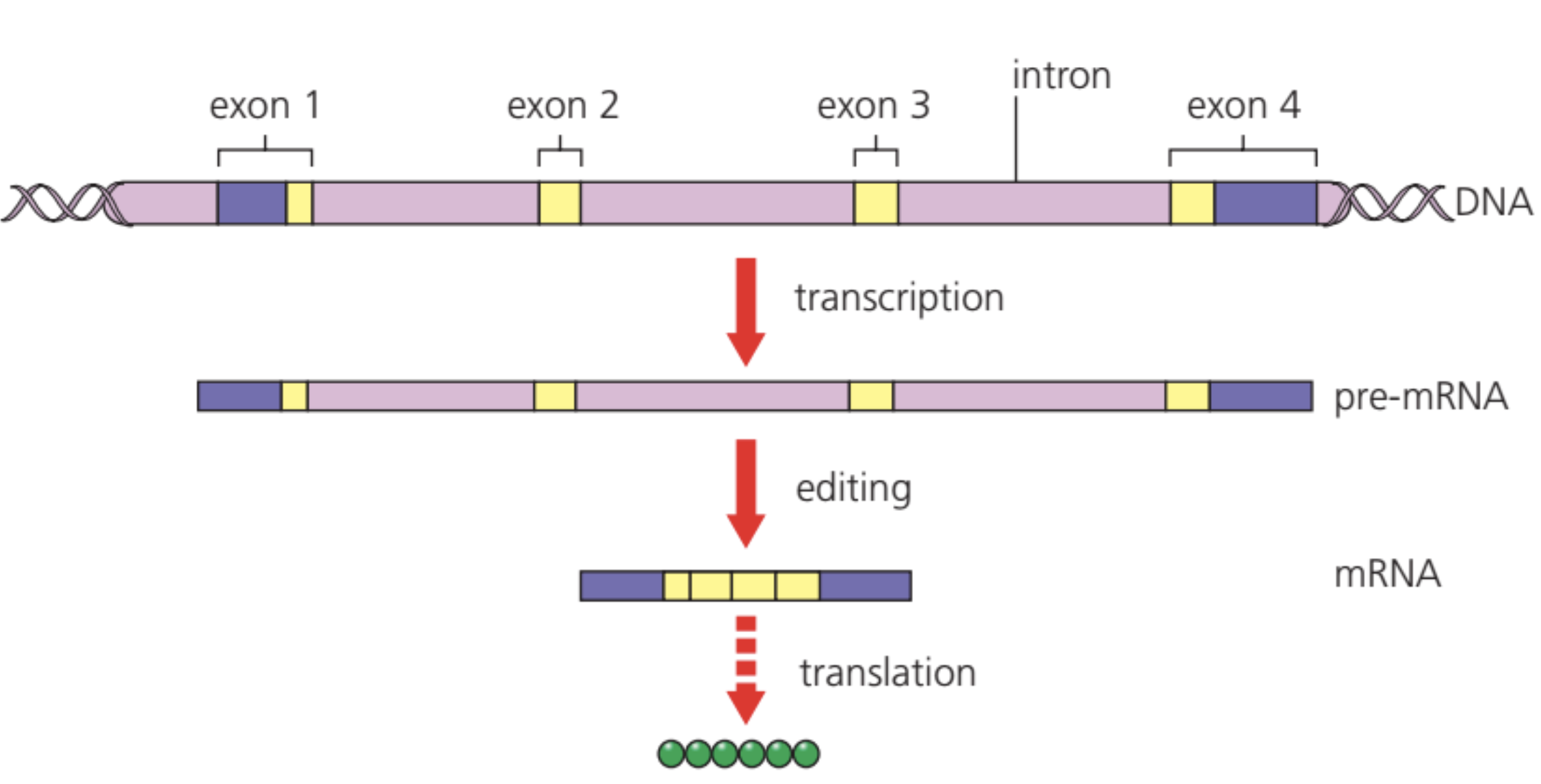
In eukaryotic cells, the DNA of genes contains sections called exons that code for proteins and sections called introns that do not code for proteins. These intervening introns would prevent successful protein synthesis if left in the RNA.
Important
Introns must be removed from pre-mRNA before it can function properly. If introns remained in the final mRNA, they would disrupt the protein-coding sequence and prevent the synthesis of functional proteins.
The splicing process
Splicing is the process where introns are removed from pre-mRNA and the functional exons are joined together. This creates mature mRNA that contains only the protein-coding sequences.
The splicing process transforms pre-mRNA (which contains both exons and introns) into mRNA (which contains only exons in the correct sequence).
Movement to ribosomes
Once splicing is complete, the mRNA molecules are too large to simply diffuse out of the nucleus. Instead, they exit through nuclear pores and travel to the ribosomes in the cytoplasm, where they become attached and ready for the next stage of protein synthesis - translation.
Summary
Key Points to Remember:
- Transcription creates pre-mRNA from a DNA template using RNA polymerase
- The template strand of DNA provides the sequence information for RNA synthesis
- Base pairing rules ensure accurate copying, with uracil replacing thymine in RNA
- Splicing removes introns and joins exons to create functional mRNA in eukaryotes
- mRNA exits the nucleus through nuclear pores to reach ribosomes for translation