Meiosis (AQA A-Level Biology): Revision Notes
📚Revision Notes
Meiosis
Why meiosis is necessary
Meiosis is essential for sexual reproduction because it solves a fundamental problem with chromosome numbers. When two gametes (sex cells) fuse during fertilisation, they combine their genetic material. If each gamete contained the full diploid number of chromosomes, the offspring would have double the chromosome number of the parents.
Important
The Chromosome Doubling Problem
Without meiosis, sexual reproduction would be impossible due to chromosome accumulation. In humans, body cells contain 46 chromosomes (the diploid number). If gametes also contained 46 chromosomes, offspring would have 92 chromosomes. This doubling would continue each generation, rapidly making reproduction impossible.
Meiosis prevents this by producing gametes with the haploid number of chromosomes - exactly half the diploid number. In humans, this means each gamete contains 23 chromosomes. When fertilisation occurs, the diploid number (46) is restored in the offspring.
Note
This elegant solution ensures that chromosome numbers remain constant across generations while still allowing the genetic mixing that makes sexual reproduction advantageous for species survival.
The process of meiosis
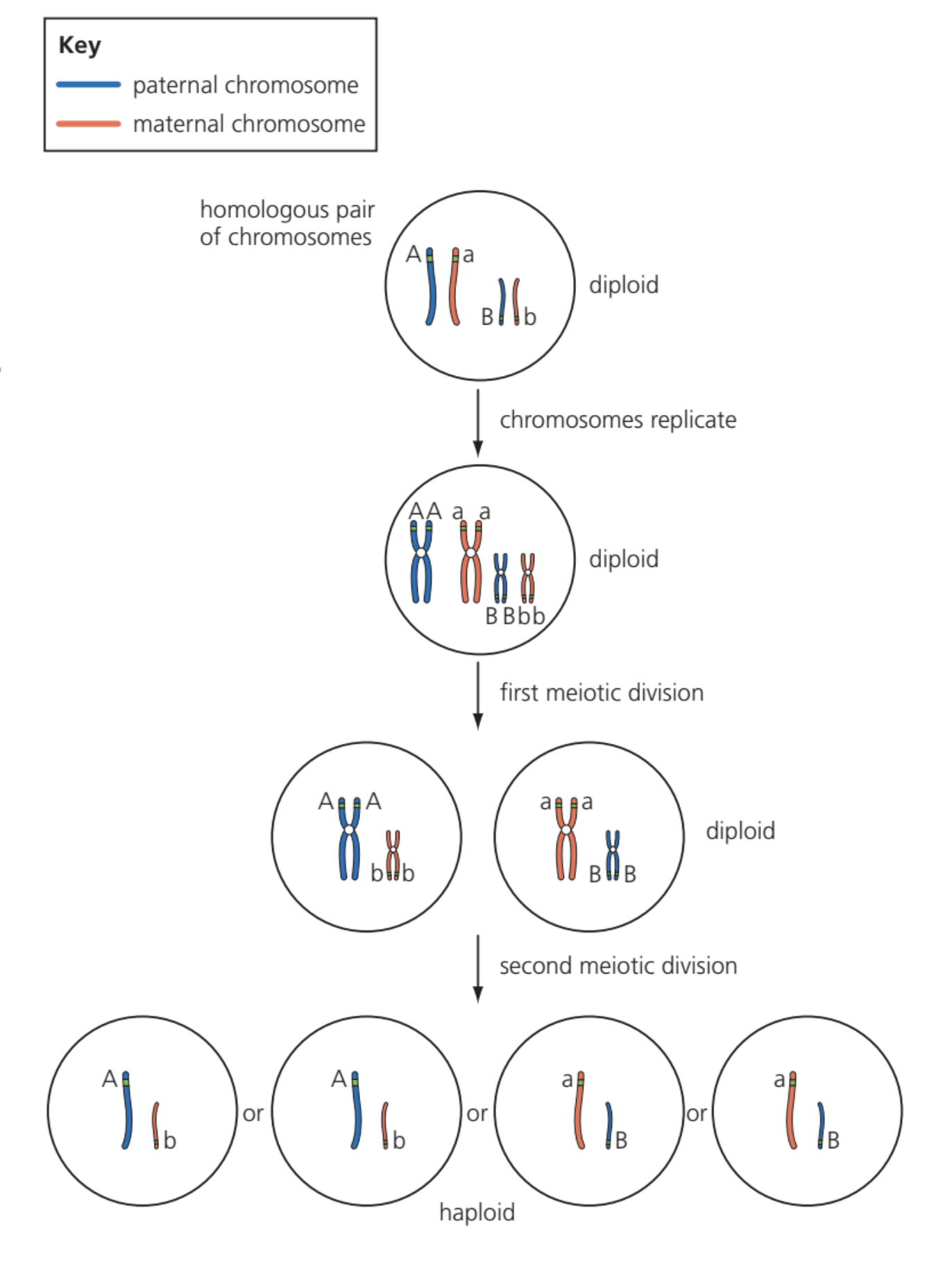
Meiosis involves two consecutive nuclear divisions that occur immediately one after the other, producing four daughter cells from a single parent cell.
Meiosis I - the first division
During the first meiotic division, homologous chromosomes pair up and their chromatids wrap around each other. This pairing allows equivalent portions of chromatids to be exchanged in a process called crossing over.
By the end of meiosis I, homologous pairs have separated, with one chromosome from each pair going into each daughter cell. This division reduces the chromosome number from diploid to haploid.
Meiosis II - the second division
The second meiotic division resembles mitosis. The chromatids of each chromosome separate and move to opposite poles of the cell. At the end of meiosis II, four cells have been produced, each containing the haploid number of chromosomes (23 in humans).
Each of these four gametes contains a single chromatid from what were originally chromosome pairs in the parent cell.
Key terminology
- Gene - a length of DNA that codes for a polypeptide
- Locus - the position of a gene on a chromosome or DNA molecule
- Allele - one of the different forms of a particular gene
- Homologous chromosomes - a pair of chromosomes (one maternal, one paternal) that have the same gene loci
- Diploid - cells containing two complete sets of chromosomes (46 in humans)
- Haploid - cells containing one complete set of chromosomes (23 in humans)
Summary
Key Points to Remember:
- Meiosis produces four haploid gametes from one diploid parent cell through two consecutive divisions
- The process halves chromosome number, preventing chromosome doubling in sexual reproduction
- Genetic variation arises through independent segregation of chromosome pairs and crossing over between homologous chromosomes
- In humans, independent segregation alone can produce over 8 million different chromosome combinations
- Crossing over creates entirely new genetic combinations by exchanging portions of homologous chromatids