Digestive Enzymes (AQA A-Level Biology): Revision Notes
📚Revision Notes
Digestive Enzymes
Digestion occurs through two distinct processes that work together to break down food molecules.
Physical breakdown involves mechanically reducing food into smaller pieces using structures like teeth. This process increases the surface area available for enzyme action and makes food easier to swallow. The stomach muscles also contribute by churning food to physically break it apart.
Note
Increasing surface area is crucial for efficient digestion because it provides more sites where enzymes can bind to their substrate molecules, dramatically speeding up the chemical breakdown process.
Chemical digestion uses enzymes to break down large, complex molecules into smaller, soluble ones through hydrolysis. Hydrolysis involves splitting molecules by adding water to the chemical bonds holding them together. This process is essential because only small molecules can cross cell membranes and enter the bloodstream.
Important
Only small, soluble molecules can be absorbed across cell membranes. This is why large food molecules must be completely broken down into their monomers before they can enter the bloodstream and be transported to cells throughout the body.
Types of digestive enzymes
Three main groups of digestive enzymes work to break down different macromolecules:
- Carbohydrases break down carbohydrates into simple sugars (monosaccharides)
- Lipases break down fats and oils into glycerol and fatty acids
- Proteases break down proteins into amino acids
Each enzyme group is specific to its substrate and typically requires multiple enzymes working in sequence to completely break down large molecules into their monomers.
Note
Enzyme specificity means that each enzyme can only break down one particular type of substrate. This is due to the precise shape of the enzyme's active site, which only fits specific substrate molecules - much like a lock and key mechanism.
Carbohydrate digestion
Starch breakdown
Starch digestion involves a coordinated process beginning in the mouth and continuing in the small intestine.
Amylase is the primary starch-digesting enzyme, produced in two locations:
- Salivary amylase begins working in the mouth, mixed with food during chewing
- Pancreatic amylase continues the process in the small intestine
Amylase breaks the bonds between glucose units in starch, converting it into maltose (a disaccharide). However, this process is temporarily halted in the stomach where acidic conditions denature the amylase enzyme.
Note
The stomach's acidic environment (pH ~1.5-2) denatures most enzymes, which is why salivary amylase stops working once food reaches the stomach. The alkaline pancreatic juice (pH ~8.5) in the small intestine provides optimal conditions for renewed enzyme activity.
When food reaches the small intestine, pancreatic juice containing fresh amylase continues breaking down any remaining starch. The alkaline conditions in the small intestine provide the optimal pH for enzyme function.
Maltase, a membrane-bound disaccharidase, completes starch digestion by breaking maltose into two glucose molecules. This enzyme is embedded in the cell-surface membrane of intestinal epithelial cells rather than being released into the intestinal contents.
Example
Worked Example: Complete Starch Digestion
Step 1: Starch (polysaccharide) enters the mouth
- Salivary amylase breaks some starch → maltose + remaining starch
Step 2: Food reaches the small intestine
- Pancreatic amylase breaks remaining starch → maltose
Step 3: Final breakdown at intestinal membrane
- Maltase breaks maltose → glucose + glucose
Result: Large starch molecules are completely broken down into absorbable glucose units.
Other disaccharide digestion
Two additional disaccharides commonly found in food require specific enzymes:
- Sucrase breaks down sucrose (found in fruits) into glucose and fructose
- Lactase breaks down lactose (found in milk) into glucose and galactose
Both enzymes are membrane-bound disaccharidases located on the intestinal epithelial cells.
Lipid digestion
Lipid digestion presents unique challenges because fats and oils are hydrophobic and tend to form large droplets in the aqueous environment of the digestive system.
Lipases, produced by the pancreas, break down triglycerides by cleaving the ester bonds to produce fatty acids and monoglycerides (glycerol with one fatty acid attached).
Important
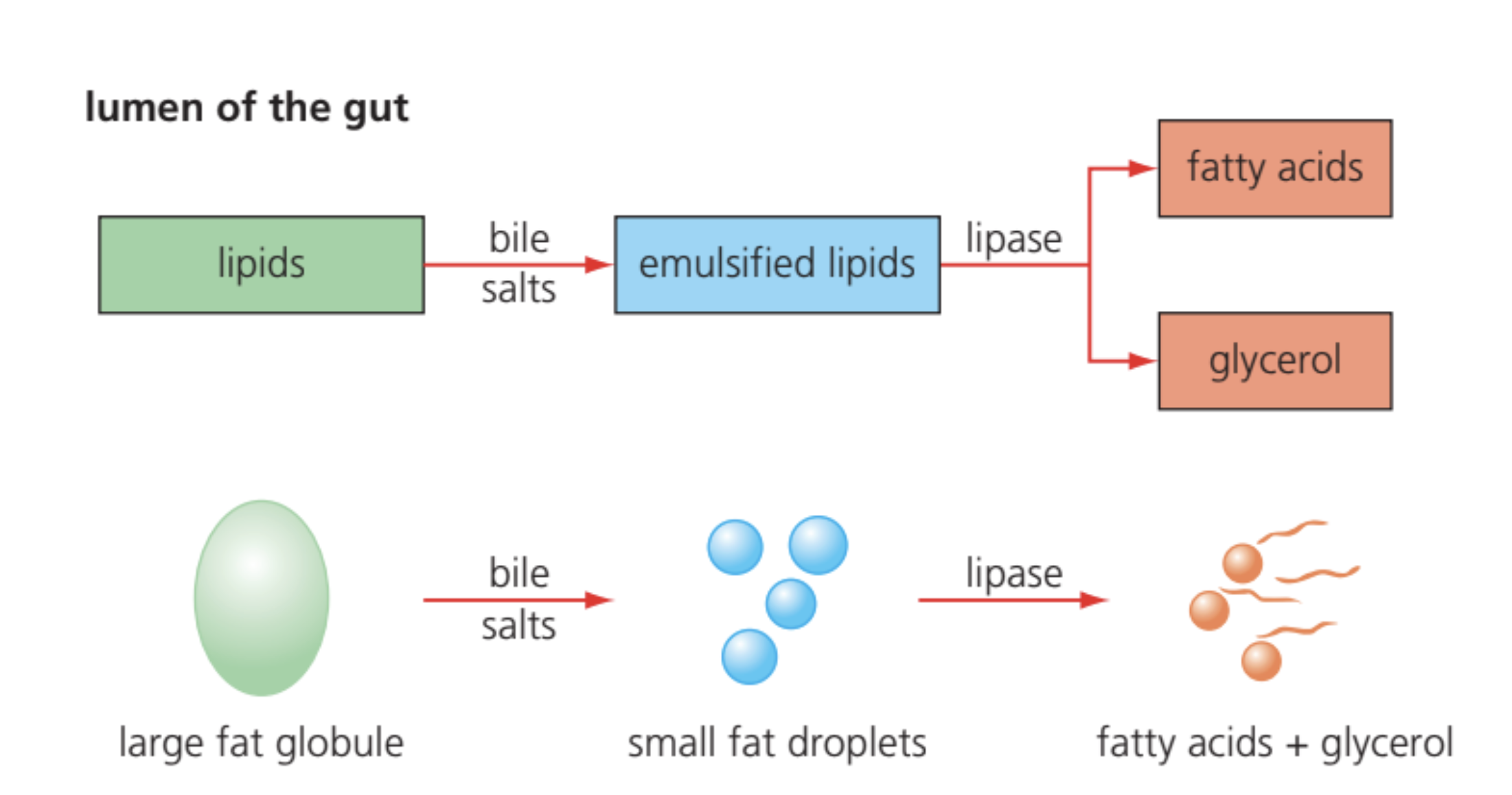
Emulsification is crucial for effective lipid digestion. Without this process, lipids would remain in large droplets with minimal surface area exposed to lipase enzymes, making digestion extremely slow and inefficient.
Emulsification is crucial for effective lipid digestion. Bile salts, produced by the liver, break large lipid droplets into tiny droplets called micelles. This dramatically increases the surface area available for lipase action, speeding up the digestion process.
Example
Worked Example: Lipid Digestion Process
Step 1: Large fat droplets enter the small intestine
- Surface area is limited, lipase action is slow
Step 2: Bile salts emulsify the fats
- Large droplets → thousands of tiny micelles
- Surface area increases dramatically
Step 3: Lipase breaks down triglycerides
- Triglyceride → fatty acids + monoglyceride
- Process is now much faster due to increased surface area
Result: Efficient breakdown of dietary fats into absorbable molecules.
The combination of emulsification and lipase action ensures efficient breakdown of dietary fats into molecules small enough for absorption.
Protein digestion
Protein digestion requires multiple enzymes working together because proteins are large, complex molecules with many peptide bonds.
Peptidases (also called proteases) are the enzyme group responsible for protein breakdown. Three types work in sequence:
- Endopeptidases break peptide bonds within the central regions of protein molecules, creating shorter peptide chains. This provides more terminal ends for other enzymes to act upon.
- Exopeptidases work on the terminal amino acids of peptide chains created by endopeptidases, progressively releasing individual amino acids and dipeptides.
- Dipeptidases complete the process by breaking the remaining dipeptides into individual amino acids. Like the disaccharidases, dipeptidases are membrane-bound enzymes on the intestinal epithelial cells.
Example
Worked Example: Protein Digestion Sequence
Step 1: Large protein molecule enters the digestive system
- Endopeptidases break internal peptide bonds
- Result: Protein → shorter peptide chains
Step 2: Peptide chains are further broken down
- Exopeptidases remove amino acids from the ends
- Result: Shorter chains → amino acids + dipeptides
Step 3: Final breakdown at intestinal membrane
- Dipeptidases break remaining dipeptides
- Result: Dipeptides → individual amino acids
Final result: Complete protein converted to absorbable amino acids.
This coordinated approach ensures complete breakdown of proteins into amino acids that can be absorbed into the bloodstream.
Note
The sequential action of different peptidases is essential because no single enzyme could efficiently break down the complex structure of proteins. Each enzyme type has a specific role that contributes to the complete digestion process.
Lactose intolerance
An important application of digestive enzyme knowledge is understanding lactose intolerance. Humans produce high levels of lactase during infancy when milk forms the primary food source. However, lactase production typically decreases significantly as children mature and milk becomes less important in the diet.
In adults with reduced lactase production, undigested lactose reaches the large intestine where bacteria ferment it, producing gas and other byproducts. The presence of undigested lactose also lowers the water potential in the colon, leading to water retention and diarrhoea.
Important
Lactose intolerance demonstrates how enzyme production can change throughout life stages. This evolutionary adaptation made sense when milk was only consumed during infancy, but modern dairy consumption can cause digestive issues in adults with reduced lactase production.
This condition illustrates how enzyme production can change throughout life and highlights the importance of specific enzymes for proper digestion.
Summary
Key Points to Remember:
- Digestion involves both physical breakdown (increasing surface area) and chemical breakdown (using enzymes and hydrolysis)
- Three main enzyme groups digest the major macromolecules: carbohydrases for carbohydrates, lipases for fats, and proteases for proteins
- Starch digestion requires both amylase (to produce maltose) and maltase (to produce glucose) working in sequence
- Lipid digestion requires emulsification by bile salts to increase surface area for lipase action
- Protein digestion uses multiple peptidases (endopeptidases, exopeptidases, and dipeptidases) working together to completely break down complex proteins
- Enzyme production can change throughout life, as seen with lactase and lactose intolerance