Haemoglobin (AQA A-Level Biology): Revision Notes
📚Revision Notes
Haemoglobin
Introduction
Haemoglobin is a group of chemically similar protein molecules found in many organisms, specialised for transporting oxygen. These molecules have evolved a highly efficient quaternary structure that allows them to load oxygen under certain conditions and unload it under different conditions.
Note
The remarkable efficiency of haemoglobin lies in its ability to respond to environmental conditions, making it one of nature's most sophisticated transport molecules.
Structure of haemoglobin molecules
Haemoglobin molecules demonstrate all four levels of protein structure, each contributing to their oxygen-carrying function:
- Primary structure refers to the sequence of amino acids within the four polypeptide chains that make up each haemoglobin molecule.
- Secondary structure occurs when each polypeptide chain coils into a helix formation, providing the basic three-dimensional shape for each chain.
- Tertiary structure involves each polypeptide chain folding into a precise, complex shape. This specific folding pattern is essential for the molecule's ability to bind with oxygen effectively.
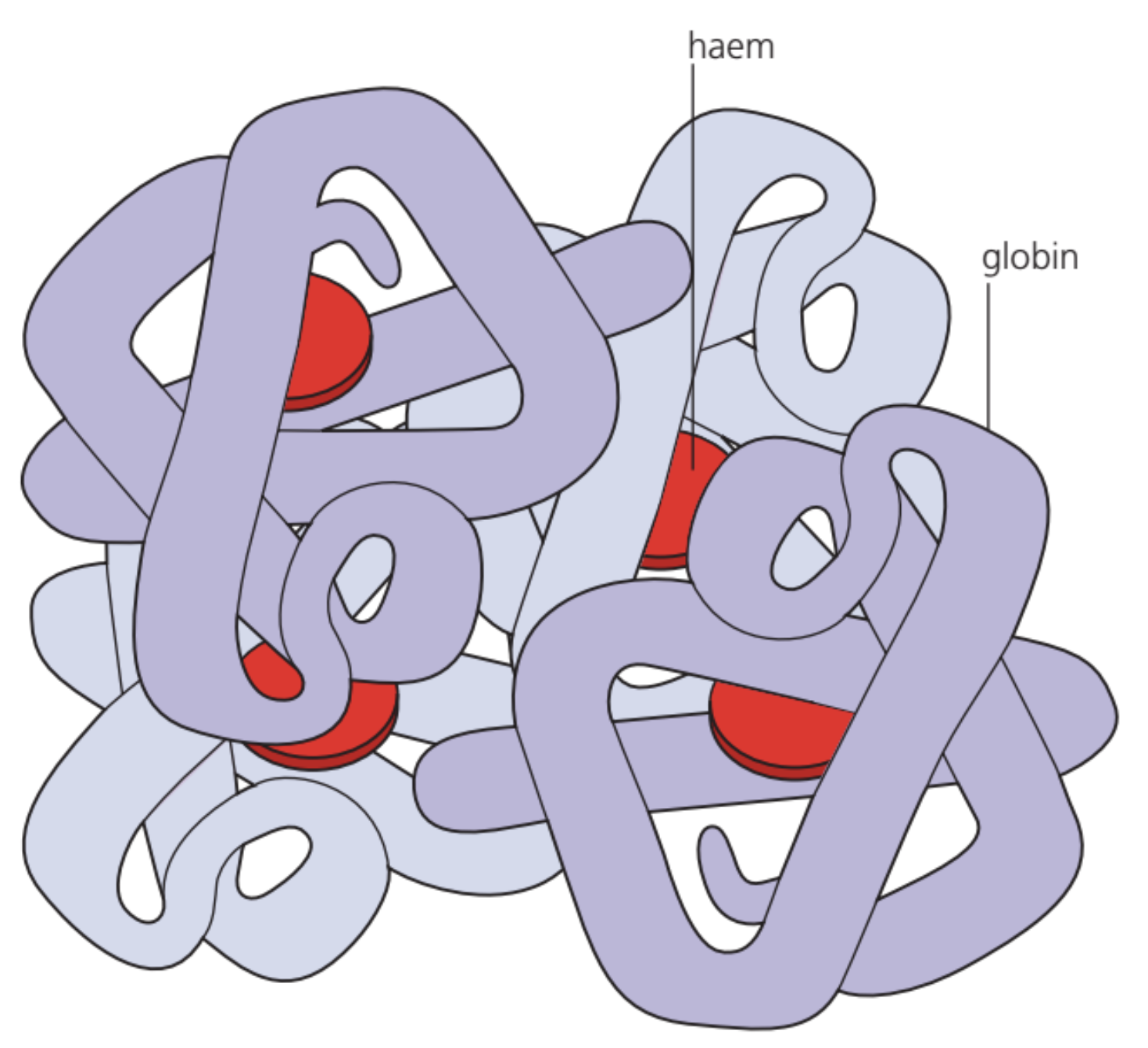
- Quaternary structure represents the final level, where all four polypeptide chains link together to form an almost spherical molecule. Each polypeptide chain associates with a haem group containing a ion. Since each ion can combine with one oxygen molecule (), a single haemoglobin molecule can transport four molecules in humans.
Important
The relationship between structure and function is critical in haemoglobin - each level of protein structure directly contributes to the molecule's oxygen-carrying capability. Any disruption to this structure can significantly impact oxygen transport efficiency.
Loading and unloading oxygen
The transport of oxygen by haemoglobin involves two complementary processes:
- Loading (or associating) describes when haemoglobin binds with oxygen. In humans, this process occurs primarily in the lungs where oxygen concentration is high.
- Unloading (or dissociating) describes when haemoglobin releases its oxygen. This happens in body tissues where oxygen is needed for cellular respiration.
The efficiency of these processes depends on haemoglobin's affinity for oxygen. Molecules with high affinity readily take up oxygen but release it less easily, while those with low affinity take up oxygen less readily but release it more easily.
Note
These two processes work in perfect harmony - the same molecule that eagerly picks up oxygen in the lungs must be equally willing to release it in the tissues. This apparent contradiction is resolved through haemoglobin's sensitivity to environmental conditions.
Environmental effects on oxygen transport
Haemoglobin exhibits a remarkable property where its oxygen affinity changes based on environmental conditions. The presence of carbon dioxide causes shape changes in the haemoglobin molecule, which affects how tightly it binds to oxygen.
| Location | Oxygen concentration | Carbon dioxide concentration | Haemoglobin affinity | Result |
|---|---|---|---|---|
| Gas exchange surface | High | Low | High | Oxygen associates |
| Respiring tissues | Low | High | Low | Oxygen dissociates |
At gas exchange surfaces (such as lungs), high oxygen and low carbon dioxide concentrations result in high affinity, promoting oxygen loading. In respiring tissues, low oxygen and high carbon dioxide concentrations reduce affinity, encouraging oxygen unloading exactly where it's needed.
Important
Carbon dioxide acts as a molecular signal that tells haemoglobin when and where to release oxygen. This ensures oxygen delivery is precisely matched to tissue demand - areas producing more carbon dioxide (through respiration) receive more oxygen.
Role of haemoglobin in oxygen transport
For haemoglobin to function effectively as an oxygen transporter, it must fulfil two key requirements:
- Readily associate with oxygen at surfaces where gas exchange occurs
- Readily dissociate from oxygen in tissues that require it for respiration
Important
The Haemoglobin Paradox
These requirements might seem contradictory - how can the same molecule both readily pick up AND readily release oxygen? Haemoglobin solves this paradox through its ability to change affinity based on local conditions, particularly the presence of carbon dioxide. This environmental responsiveness makes it perfectly suited for oxygen transport.
Although these requirements might seem contradictory, haemoglobin achieves both through its ability to change affinity based on local conditions, particularly the presence of carbon dioxide.
Variation in haemoglobin types
Different organisms possess haemoglobin molecules with varying oxygen affinities. This variation exists because each species has evolved a slightly different amino acid sequence in their haemoglobin. These sequence differences result in distinct tertiary and quaternary structures, leading to different oxygen-binding properties.
The range extends from haemoglobins with very high oxygen affinity to those with relatively low affinity. This diversity allows different species to optimise their oxygen transport according to their specific environmental conditions and metabolic requirements.
Note
Evolution and Adaptation
The structural differences between haemoglobin types arise from genetic variations that produce different amino acid sequences. Since protein structure determines function, these sequence variations directly influence how effectively each type of haemoglobin can bind and release oxygen under specific conditions. This is a perfect example of how evolution fine-tunes molecular machinery to match environmental demands.
Key Points to Remember
Summary
Essential Haemoglobin Concepts:
- Haemoglobin has a quaternary structure with four polypeptide chains, each containing a haem group that can carry one oxygen molecule
- Loading occurs in high oxygen, low carbon dioxide environments (like lungs), while unloading happens in low oxygen, high carbon dioxide environments (like tissues)
- Carbon dioxide causes haemoglobin to change shape, reducing its affinity for oxygen and promoting oxygen release where it's needed
- Different species have evolved haemoglobin variants with different oxygen affinities to suit their specific environmental and metabolic needs
- The molecule's ability to change its oxygen affinity based on local conditions makes it highly efficient for oxygen transport throughout the body