Measuring Water Uptake Using a Potometer (AQA A-Level Biology): Revision Notes
📚Revision Notes
Measuring Water Uptake Using a Potometer
What is a potometer and why use it?
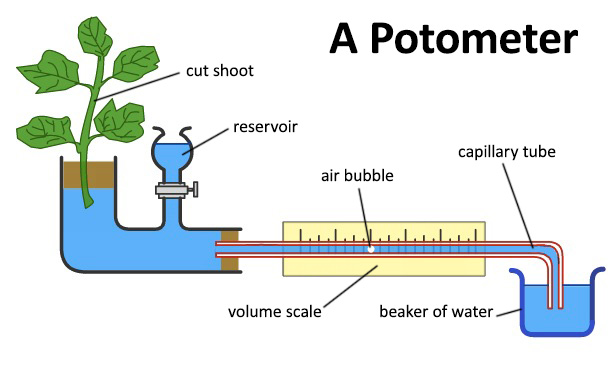
A potometer is a piece of apparatus used to measure the rate of water uptake by plant shoots. While it's nearly impossible to directly measure transpiration (water loss from leaves), potometers provide an accurate alternative method.
Note
The key principle behind potometer use is that approximately 99% of water absorbed by a plant is lost through transpiration. This means the rate of water uptake closely matches the transpiration rate, making potometer measurements a reliable indicator of water loss under different environmental conditions.
Equipment and setup
The potometer consists of several key components that work together to create a sealed system for measuring water uptake:
- Reservoir filled with water
- Capillary tube with measurement scale
- Rubber tubing connecting components
- Tap to control water flow
- Syringe for introducing air bubbles
- Waterproof jelly for sealing joints
Each component plays a crucial role in maintaining the integrity of the water column and ensuring accurate measurements.
Experimental method
Setting up and using a potometer requires careful attention to detail to ensure accurate results:
Example
Worked Example: Setting Up a Potometer
Step 1: Preparation A leafy shoot is cut underwater to prevent air entering the xylem vessels. The cut must be made underwater to maintain the water column.
Step 2: Assembly The potometer is completely filled with water, ensuring no air bubbles remain in the system. The shoot is fitted using rubber tubing, with all joints sealed using waterproof jelly.
Step 3: Sealing The apparatus is removed from water and all connections are sealed with waterproof jelly to prevent air leaks.
Step 4: Air bubble introduction A small air bubble is introduced into the capillary tube using a syringe.
Step 5: Measurement The distance travelled by the air bubble over specific time intervals is measured and recorded multiple times to calculate a mean value.
Important
The shoot must be cut underwater to prevent air bubbles from entering the xylem vessels, which would break the water column and make measurements inaccurate.
Data collection and calculations
The volume of water absorbed can be calculated using the mathematical relationship between the bubble movement and tube dimensions.
Example
Worked Example: Calculating Water Volume
The volume of water absorbed is calculated using the formula:
Where:
- = radius of the capillary tube
- = distance moved by the air bubble
Sample calculation: If the capillary tube has a radius of 0.5 mm and the bubble moves 25 mm:
Measurements are typically repeated several times and averaged to improve accuracy. Results can be plotted as a graph showing volume of water uptake against time.
Experimental variables
Potometers are particularly valuable because they allow investigation of various factors affecting transpiration rates under controlled conditions:
- Temperature - higher temperatures increase transpiration due to increased evaporation rates
- Humidity - lower humidity increases transpiration as the water potential gradient becomes steeper
- Light intensity - bright light increases transpiration by opening stomata for photosynthesis
- Air movement - wind increases transpiration by removing water vapour from leaf surfaces
- Species differences - different plants have varying transpiration rates based on leaf structure and adaptations
Note
By changing one variable at a time while keeping others constant, students can investigate cause-and-effect relationships and gather quantitative data about plant responses to environmental conditions.
Resetting the apparatus
When the air bubble approaches the reservoir junction, the experiment can be continued without dismantling the entire setup:
Example
Resetting Procedure:
- Opening the tap on the reservoir
- Pushing the syringe to force the bubble back to the start of the scale
- Closing the tap and continuing measurements
This allows for continuous data collection over extended periods.
Limitations and considerations
While potometers are valuable scientific instruments, several factors limit the accuracy of measurements and must be considered when interpreting results:
Important
Key Limitations:
- The apparatus measures water uptake, not directly transpiration
- Laboratory conditions may not represent natural environmental conditions
- Air leaks can significantly affect accuracy
- The cutting process may damage some xylem vessels
- Temperature changes can affect air bubble movement through thermal expansion
Despite these limitations, potometers remain valuable tools for comparing transpiration rates under controlled conditions and investigating the effects of environmental variables. They provide students with hands-on experience in quantitative plant physiology experiments.
Summary
Key Points to Remember:
- Potometers measure water uptake as a proxy for transpiration rate
- 99% of plant water uptake is lost through transpiration
- All joints must be sealed with waterproof jelly to prevent air leaks
- The shoot must be cut underwater to maintain the water column
- Use the formula to calculate water volume from bubble movement
- Results should be repeated and averaged for greater accuracy