Transport of Water in the Xylem (AQA A-Level Biology): Revision Notes
📚Revision Notes
Transport of Water in the Xylem
Plants absorb water through their root hair cells, which are extensions of root cells that increase surface area for absorption. This water must travel from the roots all the way up to the leaves, sometimes over 100 metres in tall trees. The transport system that carries water upwards consists of xylem vessels - hollow, thick-walled tubes that form continuous pathways from roots to leaves.
The driving force for water movement through plants is transpiration - the evaporation of water from leaf surfaces. This process is powered by solar energy and operates passively, meaning the plant doesn't need to spend metabolic energy to move water upwards.
Note
Transpiration is the evaporation of water from leaf surfaces, primarily through stomata. This process creates the driving force that pulls water from roots to leaves throughout the entire plant.
Water movement out through stomata
Water exits the plant through small pores called stomata, located mainly on the undersides of leaves. The process works because:
- Atmospheric humidity is typically lower than the humidity in the air spaces inside leaves
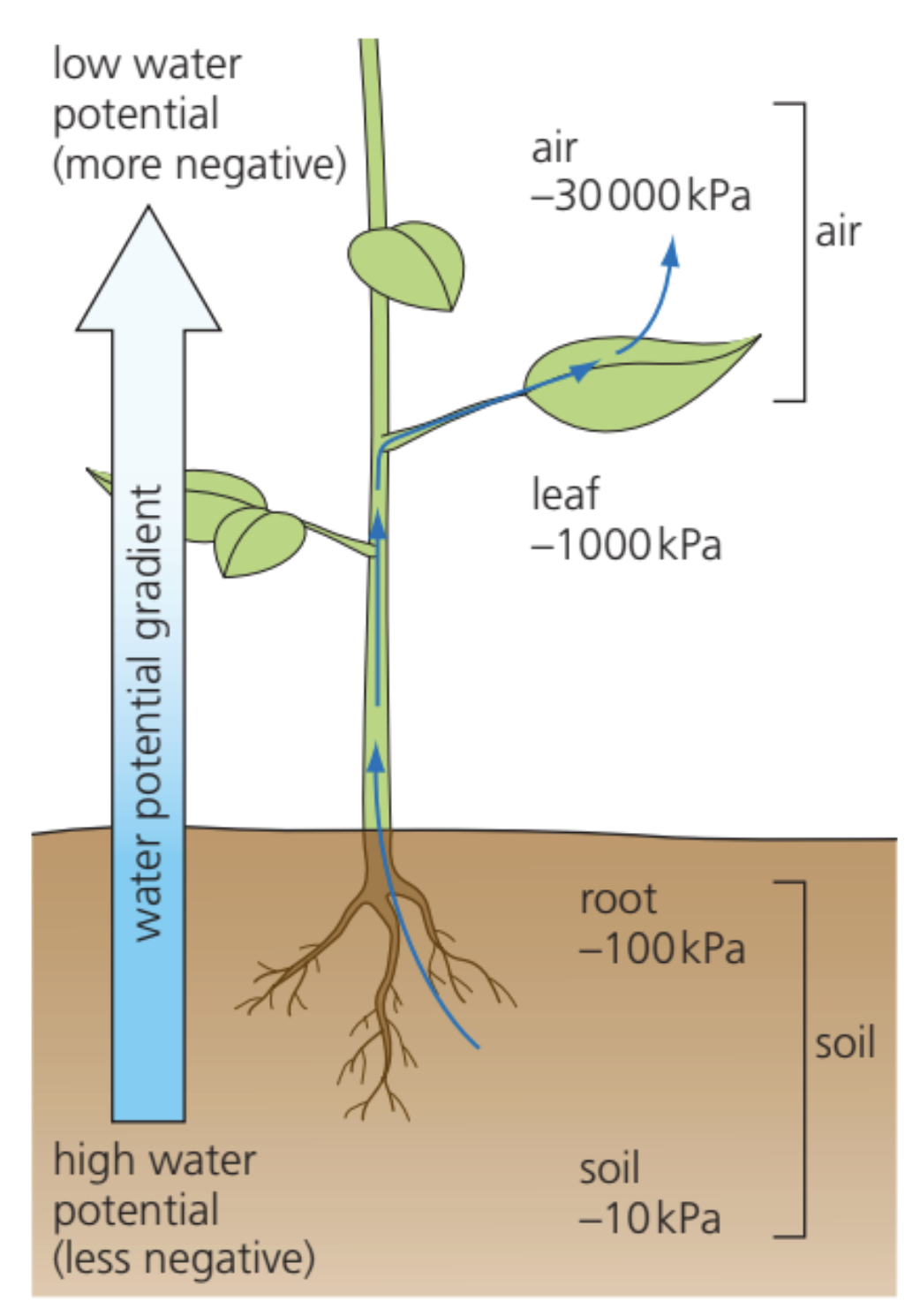
- This creates a water potential gradient from inside the leaf to the external environment
- When stomata are open, water vapour molecules diffuse from the humid air spaces to the drier atmosphere
- As water is lost through diffusion, it's replaced by water evaporating from the cell walls of surrounding mesophyll cells
Plants can control their rate of transpiration by adjusting the size of their stomatal openings, allowing them to balance water loss with gas exchange needs.
Water movement across leaf cells
When mesophyll cells lose water through evaporation into air spaces, a chain reaction begins that draws water from the xylem vessels. This happens through the following sequence:
Mesophyll cells lose water to air spaces by evaporation due to heat from the sun. As these cells lose water, their water potential decreases (becomes more negative). Water then moves by osmosis from neighbouring cells with higher water potential into the mesophyll cells.
This water loss from neighbouring cells lowers their water potential in turn, causing them to draw water from their neighbours by osmosis. This process continues cell by cell, creating a water potential gradient that extends all the way back to the xylem vessels.
Note
Two Pathways for Water Movement
Water can move between cells via two main routes:
- Cell wall pathway: water moves through cell walls and spaces between cells
- Cytoplasmic pathway: water moves through cell membranes and cytoplasm
Both pathways work together to ensure efficient water transport across leaf tissues.
This water potential gradient effectively pulls water from the xylem, across the leaf mesophyll, and finally into the atmosphere.
Movement of water up the xylem stem
The upward movement of water through xylem vessels is explained by the cohesion-tension theory. This theory describes how water moves from roots to leaves through the following mechanism:
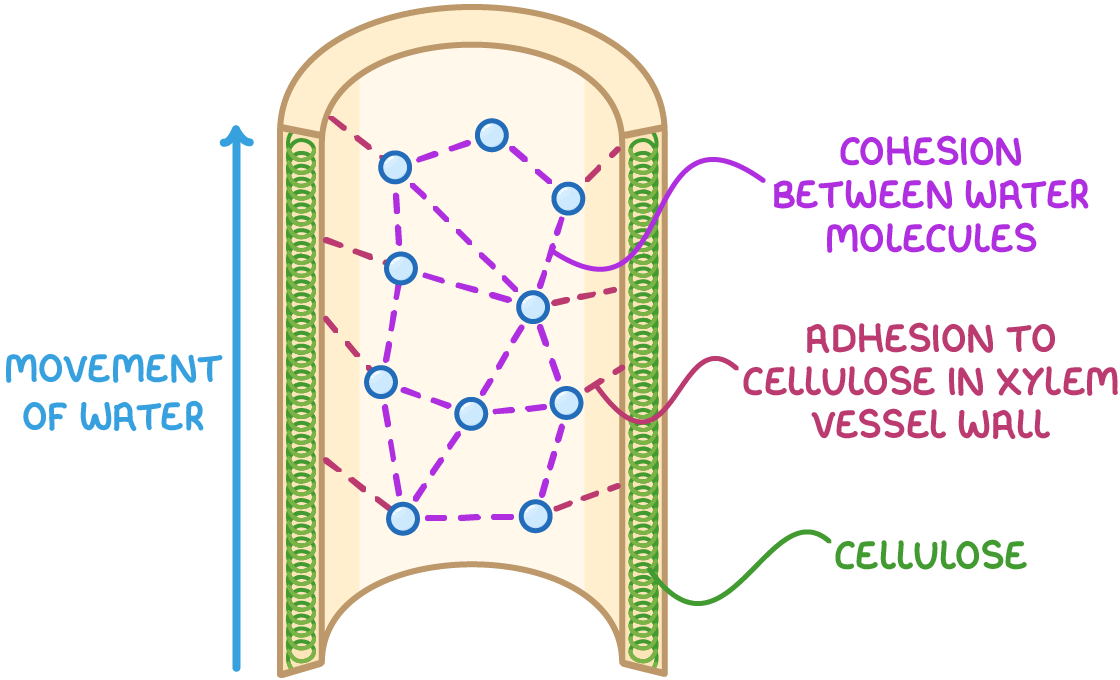
Water evaporates from mesophyll cells, creating the transpiration pull described above. Water molecules form hydrogen bonds with each other, a property called cohesion. Due to cohesion, water molecules stick together and form a continuous, unbroken column throughout the xylem vessels.
When transpiration creates a pull at the top of this water column (in the leaves), the entire column moves upward due to cohesive forces between molecules. This creates tension within the xylem vessels - essentially a negative pressure that pulls the water column upward.
The transpiration pull puts the entire xylem under tension, which is why this mechanism is called the cohesion-tension theory.
Important
Key Concept: The cohesion-tension theory explains that water moves up xylem vessels under negative pressure (tension), not positive pressure. This is a crucial distinction - the water is being pulled up, not pushed up.
Evidence supporting cohesion-tension theory
Several pieces of evidence support the cohesion-tension theory:
Important
Tree Trunk Diameter Changes
During the day when transpiration rates are highest, increased tension in xylem vessels causes them to contract slightly, making tree trunks measurably thinner. At night when transpiration decreases, tension reduces and trunk diameter increases.
This provides direct evidence that xylem vessels are under tension during active transpiration.
Important
Air Bubble Experiments
If a xylem vessel is broken and air enters, trees cannot draw up water effectively. This occurs because air breaks the continuous water column, preventing cohesive forces from operating.
Importantly, when vessels are broken, air is drawn in rather than water leaking out, confirming that the xylem is under tension (negative pressure) rather than positive pressure.
Vessel continuity: Xylem vessels have no end walls, forming continuous tubes from roots to leaves. This structure is essential for maintaining unbroken water columns required by the cohesion-tension theory.
Complete water transport pathway
Example
Complete Water Transport Process
The complete pathway of water transport involves these sequential steps:
Step 1: Water absorption by root hair cells from soil
Step 2: Radial movement across root tissues to reach xylem vessels
Step 3: Upward transport through xylem vessels via cohesion-tension
Step 4: Lateral movement from xylem vessels across leaf tissues
Step 5: Evaporation from mesophyll cell walls into air spaces
Step 6: Diffusion of water vapour through stomata to the atmosphere
This entire process is passive, requiring no metabolic energy from the plant. The energy driving the system comes from solar radiation, which provides the heat for evaporation. Xylem vessels themselves are dead cells, consisting only of cell walls with no cytoplasm, which creates the hollow tubes necessary for efficient water transport.
Summary
Key Points to Remember:
- Transpiration is the evaporation of water from leaves that drives the entire water transport system
- Cohesion between water molecules allows them to form continuous columns in xylem vessels that can be pulled upward
- Water potential gradients created by evaporation drive water movement from cell to cell across leaf tissues
- The cohesion-tension theory explains how water moves up xylem vessels under negative pressure (tension)
- Evidence for this theory includes trunk diameter changes and the behaviour of broken xylem vessels