Exchange Rate Systems and Economic Growth and Development (AQA A-Level Economics): Revision Notes
📚Revision Notes
Economic Growth and Development
The difference between growth and development
Understanding the distinction between economic growth and economic development is fundamental to studying development economics.
Economic growth refers to the increase in the volume of goods and services that an economy produces over time. It tracks changes in the physical quantity of output, either actual production or potential production capacity. Growth is typically measured by changes in real gross domestic product (GDP) or real GDP per capita.
Economic development is a broader concept. While it includes economic growth, it extends well beyond simple increases in output quantity. Development encompasses improvements in the quality of goods and services produced, and more importantly, improvements in human welfare and quality of life.
Important
Economic growth does not automatically lead to economic development. A country's ruling elite might use the benefits of growth to purchase military equipment and maintain political control through oppression. Although economic growth has occurred (more goods produced), economic development has not taken place because the wider population has not benefited.
According to economists, economic development can be measured through several key indicators:
- General improvements in living standards that reduce poverty and alleviate human suffering
- Access to essential resources such as food, clean water, and adequate housing that satisfy basic human needs
- Opportunities for human development through education and skills training
- Sustainability and environmental regeneration, reducing resource depletion and degradation
- Access to quality healthcare services
Note
Understanding Sustainable versus Sustained Growth
Students should avoid confusing these two terms:
-
Sustained growth simply means achieving a consistent rate of economic growth over several years. For instance, the UK experienced sustained annual growth of approximately 2.75% from the end of the 1992 recession until 2008.
-
Sustainable growth requires that growth today does not compromise future generations' ability to meet their needs. Sustained growth over a long period may actually be unsustainable if it causes environmental damage, depletes finite resources, or degrades ecosystems.
Components of economic welfare
To better understand development, economists break down total economic welfare into three components:
The first component includes welfare derived from goods and services purchased through market transactions. The second component covers public goods and merit goods provided collectively by the state, such as healthcare, education, and public infrastructure. The third component includes quality of life factors, external benefits minus external costs, and intangible elements.
National income measures like GDP capture the first two components reasonably well, as they relate to the consumption of material goods and services. However, they fail to adequately reflect how externalities and other quality of life factors affect overall economic welfare.
Limitations of national income measures
Several important factors are ignored or inadequately captured by national income statistics:
Intangible factors make up a significant part of people's living standards but are largely overlooked. These include the value people place on leisure time, living close to work, and various externalities. For example, pollution and traffic congestion generated from production and consumption of goods reduce people's welfare and quality of life, yet GDP does not account for these negative impacts.
Resource depletion and environmental degradation pose another serious limitation. National income measures fail to reflect how current production affects future productive capacity. When countries produce current income by depleting natural resources or damaging the environment, they reduce humankind's ability to generate future income. GDP statistics do not address sustainability issues.
Note
While national income includes merit goods like health and education, unless data is broken down by category, it becomes impossible to determine how much of a nation's resources are devoted to these vital services for economic development. Supplementary indicators such as life expectancy, infant mortality rates, and literacy rates help provide a more complete picture of people's quality of life and level of development.
The main characteristics of less developed economies
The term 'less developed economies' covers a wide spectrum, ranging from extremely poor nations to what the United Nations classifies as higher middle-income economies. Various frameworks exist for identifying characteristics of less developed economies.
Rostow's stages of economic growth
Nearly 70 years ago, economist and political theorist W.W. Rostow developed an influential model describing how economies progress through stages of development. While this model has faced considerable criticism, it provides a useful starting point for understanding key features of less developed economies and the transformation process.
Traditional societies represent the first stage. Rostow used this term to describe economies completely lacking in economic development. These societies have very limited production capacity because of restricted available production methods. Their output is largely agricultural. Traditional societies experience little change from generation to generation, with generally accepted customs and persistent relationship patterns governing economic life. A low ceiling on total production keeps these societies primarily focused on survival. Today, traditional societies often exist as tribal communities in remote areas of countries like Brazil, India, and parts of Africa.
Preconditions for take-off characterise the next stage. These are economies becoming more productive, where various conditions necessary for successful industrial growth begin to emerge. Commerce and trade opportunities appear, along with banks and financial institutions that can mobilize savings into productive investment. Infrastructure starts developing.
Take-off into self-sustaining growth marks a critical transition. Economies shift from largely agricultural to industrialized or manufacturing-based systems. Output increases substantially, though only a small portion of society benefits significantly from improved living standards. At this stage, economic growth takes priority over economic development.
Drive to maturity represents the stage where higher-income developing economies reach the final phase of continued self-sustained growth. Countries at this level of development can choose to allocate their increasing output toward social welfare and other aspects of economic development that improve quality of life for broader populations.
High mass consumption is the ultimate stage in Rostow's model, where mature developed economies achieve high levels of consumption across their populations.
Note
Criticisms of Rostow's Model
Rostow's framework has attracted substantial criticism. Critics argue it is historically inaccurate, factually flawed, and overly simplistic. Nevertheless, it serves as a helpful framework for understanding some key characteristics of less developed economies and the stages through which they progress toward prosperous, high-consumption societies.
Indicators of development
Economists typically use gross domestic product per head (GDP per capita) or gross national income per capita (GNI per capita) as their primary indicator of economic development. Unfortunately, for most developing economies, GDP tends to be higher than GNI. This occurs because profit outflows and interest payments flow from developing economies to more developed ones, and to banks within developing economies. When using development indicators, GDP per capita or GNI per capita (calculated on a per head of population basis) should be used rather than total GDP or GNI figures.
Are national income measures adequate indicators of development?
While national income and output measures provide useful information, they are not the best measures of living standards, economic welfare, and economic development. To answer this question properly, we need to revisit the three components of economic welfare outlined earlier:
When used carefully, national income figures can provide reasonable estimates of economic welfare derived from the first two elements - both relating to direct consumption of material goods and services. However, national income fails to satisfactorily indicate how externalities and other quality of life factors affect overall economic welfare and living standards.
Important
Key Limitations of National Income Measures
Intangible factors, which constitute the third element in people's living standards, are largely ignored by GDP and GNI statistics. These intangible factors include:
- The value people place on leisure time and proximity to work
- Externalities such as pollution and congestion generated from production and consumption activities
- Resource depletion and environmental degradation impacts
- The extent of resources devoted to merit goods like healthcare and education
These factors significantly affect people's welfare and quality of life but are not captured by standard national income measures.
National income measures also fail to reflect the impact of resource depletion and environmental degradation. Current production may reduce humankind's ability to produce future income, but national income and GDP statistics do not address sustainability concerns.
Furthermore, while national income accounts include the value of merit goods like healthcare and education, without detailed breakdowns, we cannot determine the extent to which national resources are devoted to these services vital for economic development. Additional indicators such as life expectancy, infant mortality rates, and literacy rates can supplement national income per head to provide better indicators of people's quality of life.
The United Nations Human Development Index (HDI)
Environmental pressure groups like Friends of the Earth have argued that national income measures such as GDP were never intended to be indicators of a country's economic welfare or development stage. In response to this recognition, alternative development indicators that are less dependent on 'raw' GNI or GDP have become increasingly used to assess economic and social progress.
One of the earliest alternative measures was the Measure of Economic Welfare (MEW) developed by Nordhaus and Tobin in 1972. More recent attempts to adjust conventional national income figures include the United Nations Human Development Index (HDI) and the Index of Sustainable Economic Welfare (ISEW).
How the HDI is constructed
The HDI is constructed by measuring three key dimensions:
- Life expectancy at birth - reflecting health and longevity
- Mean years of schooling and expected years of schooling - reflecting access to knowledge and education
- Gross national income (GNI) per head of population - calculated using purchasing power parity (PPP) in US dollars to reflect living standards
Note
The maximum value of the HDI is 1 (or unity). The closer a country's HDI approaches 1, the greater its level of human development, as measured by these three indicators.
HDI rankings: comparing developed and developing nations
Table 15.2 presents the 15 highest-ranked and 15 lowest-ranked countries in the 2022 HDI report (based on 2021 data).
| HDI rank | Country | Human Development Index value 2021 | Life expectancy at birth (years) 2021 | Expected years of schooling (years) 2021 | Mean years of schooling (years) 2021 | Gross national income (GNI) per capita (2017 PPP $) 2021 | GNI per capita rank minus HDI rank 2021 | HDI rank 2020 |
|---|---|---|---|---|---|---|---|---|
| Very high human development | ||||||||
| 1 | Switzerland | 0.962 | 84.0 | 16.5 | 13.9 | 66,933 | 5 | 3 |
| 2 | Norway | 0.961 | 83.2 | 18.2 | 13.0 | 64,660 | 6 | 1 |
| 2 | Iceland | 0.959 | 82.7 | 19.2 | 13.8 | 55,782 | 11 | 2 |
| 4 | Hong Kong, China (SAR) | 0.952 | 85.5 | 17.3 | 12.2 | 62,607 | 6 | 4 |
| 5 | Australia | 0.951 | 84.5 | 21.1 | 12.7 | 49,238 | 18 | 5 |
| 6 | Denmark | 0.948 | 81.4 | 18.7 | 13.0 | 60,365 | 6 | 5 |
| 7 | Sweden | 0.947 | 83.0 | 19.4 | 12.6 | 54,489 | 9 | 9 |
| 8 | Ireland | 0.945 | 82.0 | 18.9 | 11.6 | 76,169 | -3 | 8 |
| 9 | Germany | 0.942 | 80.6 | 17.0 | 14.1 | 54,534 | 6 | 7 |
| 10 | Netherlands | 0.941 | 81.7 | 18.7 | 12.6 | 55,979 | 3 | 10 |
| 11 | Finland | 0.940 | 82.0 | 19.1 | 12.9 | 49,452 | 11 | 12 |
| 12 | Singapore | 0.939 | 82.8 | 16.5 | 11.9 | 90,919 | -10 | 10 |
| 13 | Belgium | 0.937 | 81.9 | 19.6 | 12.4 | 52,293 | 7 | 16 |
| 13 | New Zealand | 0.937 | 82.5 | 20.3 | 12.9 | 44,057 | 16 | 13 |
| 15 | Canada | 0.936 | 82.7 | 16.4 | 13.8 | 46,808 | 9 | 15 |
| Low human development | ||||||||
| 177 | Guinea-Bissau | 0.483 | 59.7 | 10.6 | 3.6 | 1,908 | 0 | 177 |
| 178 | Liberia | 0.481 | 60.7 | 10.4 | 5.1 | 1,289 | 7 | 179 |
| 179 | Congo (Democratic Republic of the) | 0.479 | 59.2 | 9.8 | 7.0 | 1,076 | 9 | 180 |
| 180 | Afghanistan | 0.478 | 62.0 | 10.3 | 3.0 | 1,824 | -2 | 177 |
| 181 | Sierra Leone | 0.477 | 60.1 | 9.6 | 4.6 | 1,622 | -1 | 181 |
| 182 | Guinea | 0.465 | 58.9 | 9.8 | 2.2 | 2,481 | -13 | 182 |
| 183 | Yemen | 0.455 | 63.8 | 9.1 | 3.2 | 1,314 | 1 | 183 |
| 184 | Burkina Faso | 0.449 | 59.3 | 9.1 | 2.1 | 2,118 | -8 | 185 |
| 185 | Mozambique | 0.446 | 59.3 | 10.2 | 3.2 | 1,198 | 2 | 184 |
| 186 | Mali | 0.428 | 58.9 | 7.4 | 2.3 | 2,133 | -11 | 186 |
| 187 | Burundi | 0.426 | 61.7 | 10.7 | 3.1 | 732 | 4 | 187 |
| 188 | Central African Republic | 0.404 | 53.9 | 8.0 | 4.3 | 966 | 1 | 188 |
| 189 | Niger | 0.400 | 61.6 | 7.0 | 2.1 | 1,240 | -3 | 189 |
| 190 | Chad | 0.394 | 52.5 | 8.0 | 2.6 | 1,364 | -7 | 190 |
| 191 | South Sudan | 0.385 | 55.0 | 5.5 | 5.7 | 768 | -1 | 191 |
Example
Worked Example: Comparing HDI Rankings
Let's examine the stark contrast between the highest and lowest ranked countries:
Switzerland (Rank 1):
- HDI value: 0.962 (very close to the maximum of 1)
- Life expectancy: 84.0 years
- Expected years of schooling: 16.5 years
- GNI per capita: $66,933
South Sudan (Rank 191):
- HDI value: 0.385 (less than half of Switzerland's)
- Life expectancy: 55.0 years (29 years less than Switzerland)
- Expected years of schooling: 5.5 years (11 years less)
- GNI per capita: $768 (less than 1.2% of Switzerland's income)
This comparison illustrates the enormous disparities in human development between the world's most and least developed nations.
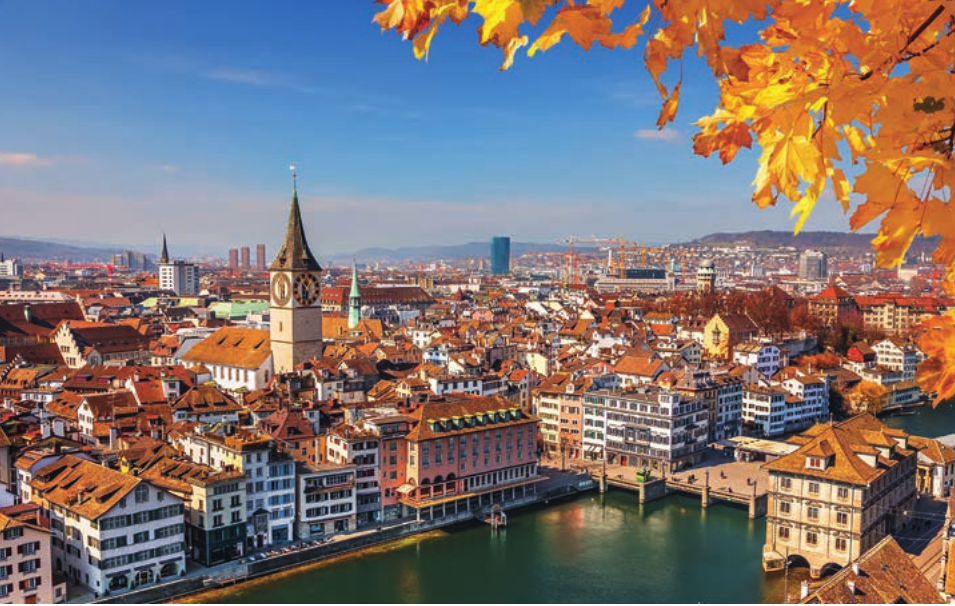
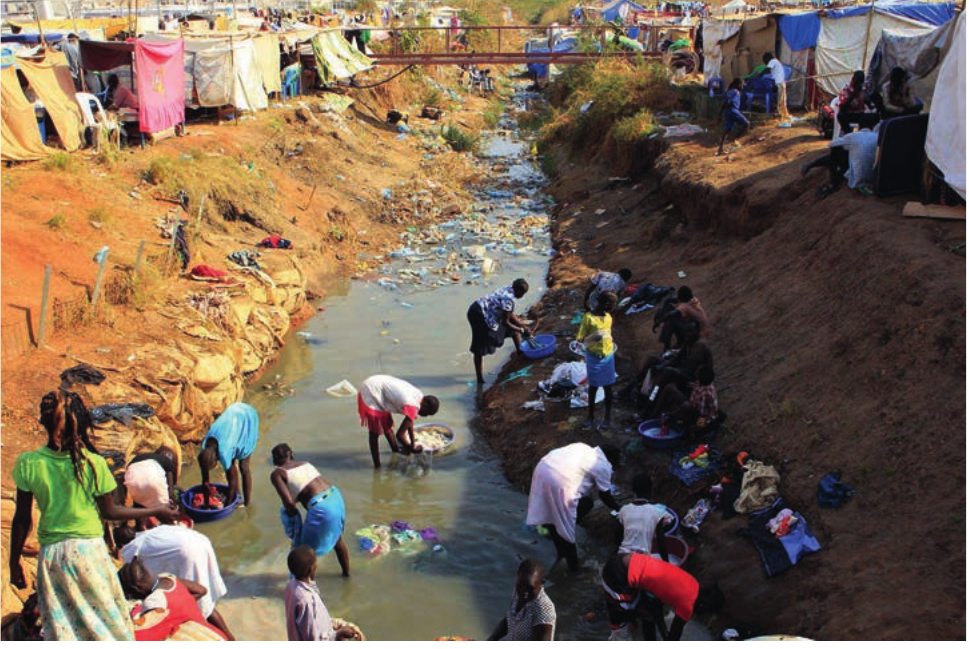
In 2022, Switzerland led the HDI 'top 15', with the UK and USA ranking eighteenth and twenty-first respectively. At the opposite end of the spectrum, almost all countries in the 'bottom 15' were located in sub-Saharan Africa.
Limitations of the HDI
The unadjusted HDI is not a perfect index of human development, primarily because it ignores inequalities in income distribution. In 2010, the UN's Human Development Report developed the HDI further by introducing the Inequality-adjusted Human Development Index (IHDI). The IHDI estimates the actual level of human development (accounting for inequality) in each of the 191 countries included in the HDI. The greater the degree of inequality within a country, the greater the difference between that country's HDI and IHDI scores.
Note
The HDI was created to focus on people and their capabilities rather than solely on economic growth. It represents an important alternative to GDP as a measure of a nation's development and well-being.
Factors that affect growth and development
Numerous factors influence both economic growth and development. One factor covered extensively in earlier chapters is investment. Investment in new capital goods and technical progress represents two of the main factors leading to long-term economic growth, and they are equally necessary for economic development.
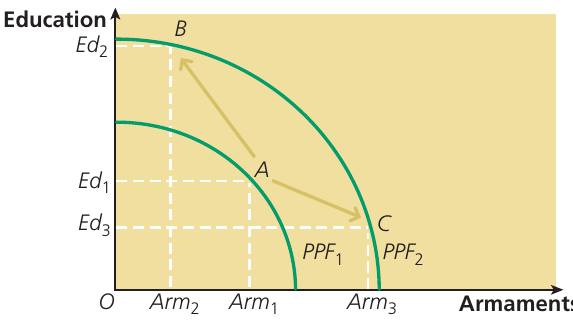
Consider Figure 15.6, which shows a simplified economy producing just two goods: education and armaments. The outward movement of the economy's production possibility frontier from PPF₁ to PPF₂ illustrates economic growth.
However, comparing different points on these frontiers reveals important insights. The movement from point A on PPF₁ to point B on PPF₂ shows that this society is now devoting more of its available resources to educating its children and actually allocating fewer resources than before to arms production. Resources devoted to education increase from Ed₁ to Ed₃, whereas resources devoted to armaments fall from Arm₁ to Arm₂. This increased investment in the economy has led to both economic development and economic growth.
Important
Growth Without Development
A movement from point A to point C illustrates economic growth, but almost certainly not economic development. Resources have shifted from education to armaments. Although new investment has moved the production possibility frontier outward from PPF₁ to PPF₂, resources have simultaneously shifted away from education into arms production. Armament production increases from Arm₁ to Arm₃, but at the expense of education, the output of which falls from Ed₁ to Ed₂.
The message here is clear: economic growth can occur without economic development, and indeed may occur at the expense of economic development.
The crucial role of education and training
Figure 15.6 highlights that investment in education and training usually represents an important component of both growth and economic development. Though often considered synonymous, education and training are actually slightly different concepts.
Education develops individual knowledge and intellect, furthering understanding and intellectual capacity. While a highly educated person is often more employable, education is not primarily about securing employment.
Training, by contrast, focuses on obtaining employment or improving and diversifying skills when already in a job. Training is undertaken to gain specific work skills, making a person more employable either in their existing line of work or through promotion or redeployment into different types of work.
Note
Both education and training are necessary for sustained economic growth and successful economic development.
Barriers to growth and development
Many barriers exist which prevent or significantly reduce economic growth, and with it the opportunity for further economic development. Five major barriers warrant particular attention: corruption, institutional factors, poor infrastructure, inadequate human capital, and lack of property rights.
Corruption
Corruption, defined as dishonest or illegal behaviour, often involving bribery and payments to powerful individuals such as government officials, prevents normal economic activity from functioning properly. Corruption and bribery divert scarce resources away from more productive uses to protect less efficient resource deployment. This raises production costs and consumer prices.
Bribes paid by customers to corrupt officials and to employees of firms wishing to conduct business increase the costs faced by businesses. These higher costs must either be absorbed, reducing profitability, or passed on to consumers through higher prices.
Important
Corruption creates an environment of mistrust that makes it extremely difficult for firms to raise capital for investment. Potential lenders and investors hesitate to provide funds when they believe corruption will result in financial losses. Trust and transparency in financial markets are essential for firms seeking to raise finance from banks or capital markets.
Institutional factors
Institutional factors differ greatly between less developed and more developed economies. These factors encompass a country's rules, laws, constitutions, financial system, and defined property rights. They also include:
- Legal and judicial structures
- Public administration systems
- Availability of and access to financial institutions such as banks and capital markets
- The role (if any) of civil service organisations
- Attitudes toward work and education
- Training systems
The 'law of contract' forms an important part of legal and judicial systems in more developed economies, but contract law remains much less well established in many less developed economies and even in parts of Eastern Europe. An efficient, policed, and enforced 'law of contract' should be viewed as a necessary precondition for businesses and consumers to confidently engage in commercial transactions. Without enforceable contract law, firms may fail to supply goods or services to consumers and other firms, even when payment has been received. In such environments, business transactions may simply not occur, stifling economic activity.
Note
Appropriate regulation of institutions and markets is necessary for a functioning economy. Well-designed competition policy, regulatory frameworks, and financial system regulation all contribute to creating an environment conducive to economic growth and development.
Poor infrastructure
Infrastructure primarily consists of past investment in buildings, roads, bridges, power supplies, fast broadband, and other fixed capital goods necessary for the economy to operate efficiently. Rich economies have built extensive infrastructure over decades (sometimes centuries), including roads, railways, telephone and communication networks, and other key elements of a modern economy.
Developing economies often lack such infrastructure, which represents an important factor constraining their development. Poor infrastructure raises firms' costs and makes it difficult or impossible to access raw materials and markets. Without adequate roads, businesses cannot efficiently transport goods, and people struggle to reach jobs or services.
Note
Technology Bypassing Infrastructure Gaps
Developing economies can offset infrastructure disadvantages by using technological progress to bypass outdated systems. Mobile phones provide an excellent example - their widespread use in many developing economies has eliminated the need to invest in traditional land-line telephone infrastructure. Future possibilities include drone technology for deliveries, bypassing the need to build traditional roads, as freight deliveries could be made via drones rather than road vehicles.
Investment in infrastructure is often undertaken by the public sector rather than private companies. This occurs because infrastructure projects are very expensive to build, may only generate returns after many years, and create significant external economies for the private sector. It may prove difficult or impossible for infrastructure providers to charge prices to private-sector firms that yield sufficient profit to justify the investment, and even when charging is possible, high prices might deter economic development.
Lack of human capital
Human capital refers to the skills, knowledge, and experience possessed by the working population. The term 'human capital' describes people at work and their collective knowledge, skills, abilities, and capacity to develop and innovate. It embodies the accumulated stock of skills and knowledge relevant to employment.
Investments in both physical capital and human capital are flows - ongoing processes whose purpose is to build up stocks of physical capital (such as machines and trained labour) needed for continued growth and development. Investment in labour training, and often investment in education generally, aims to build up the stock of human capital.
Important
Human capital investment is important for both growth and development. While growth benefits from human capital investment, growth alone proves insufficient for development without adequate human capital formation.
Investment in human capital (people) can be as important as investment in physical capital goods like machinery for achieving long-run economic growth and development.
Lack of property rights
Property rights can be defined as the exclusive authority to determine how a resource is used. In the case of private property rights, the owner of private property (such as a chocolate bar in a shop) has the legal right to prevent other people from consuming that item unless they pay the owner's price.
Traditional and largely undeveloped societies often lack private property rights, with most resources communally owned. While some view this as an idyllic paradise economy, others consider it a major cause of underdevelopment. According to this latter view, the establishment of and ability to trade in private property rights represents a necessary precondition for successful economic development. Tradable private property rights underlie the development of capitalist economies, which are arguably the most successful at achieving economic development.
Note
Property Rights and Economic Systems
Russian economic development prior to communism's collapse was based largely on state ownership of property rights. Although this successfully created an industrial-military complex, it also generated corruption and reduced individual incentives. The system proved much less successful at delivering consumer goods to the general Russian population. Insufficient private property rights not only diverted resources from true economic development but also contributed to the eventual disappearance of Russian communism.
Unfortunately, when property rights transferred from state ownership to private-sector oligarchs and elite members, a new super-rich class emerged. Some individuals who gained wealth through this transition later had their assets confiscated by various countries in 2022 as part of sanctions packages imposed on Russia and some Russians following the invasion of Ukraine.
Policies that might be adopted to promote economic growth and development
According to the Organisation for Economic Co-operation and Development (OECD), sustainable development can be interpreted in economic terms as 'development that lasts' - a path along which maximizing human well-being for today's generations does not lead to declines in future well-being.
Macro and micro policies to promote economic growth
An obvious starting point for analyzing appropriate policies to promote economic growth and development is the standard macroeconomic and microeconomic government policies explained in earlier chapters. These include:
- Demand-side fiscal policy and monetary policy
- Supply-side policies
All of which can focus on achieving economic growth, development, and overall economic stability.
Important
The Danger of 'Growth for Growth's Sake'
The danger lies in pursuing 'growth for growth's sake', which might produce outcomes where the costs of growth - such as environmental depletion and degradation - exceed the benefits of higher living standards and economic welfare that growth is supposed to deliver. If this occurs, growth may come at the expense of development.
Hence the need for appropriate microeconomic policies to reduce or correct various market failures that growth may create.
These microeconomic policies can include using taxes and subsidies to punish or deter production of negative externalities and demerit goods, while encouraging production of positive externalities and merit goods. Redistributive policies may also be deemed necessary to narrow unjustifiable inequalities in income and wealth distributions. However, such policies may harm the incentives provided by markets that many economists consider essential for sustained growth and development.
A growing consensus suggests that high levels of inequality act as barriers to growth, and many argue that excessive inequality is incompatible with development. An equitable income distribution is generally regarded as a characteristic of a developed economy.
Note
Economists and politicians sometimes argue that higher levels of state intervention are required to bring about growth and development in developing economies than in more developed ones. Believers in free market virtues disagree, citing numerous cases of government failure that state intervention creates. In recent decades, pro-free-market approaches have generally gained prominence, though not completely. Strategic trade theory provides justification for some degree of protectionism in developing economies. In practice, strong arguments exist for combining market-based instruments with certain forms of government intervention.
Capital flight
Some problems affecting growth and development prove much more serious in developing economies than in more developed ones. Capital flight - the sudden withdrawal of money from a country - affects developing economies far more severely than it impacts economies like the UK.
Capital flight occurs when ruling elites within an economy transfer profits generated from national industries into foreign bank accounts instead of reinvesting profits domestically to secure further development. While partly resulting from free-market forces, capital flight can be reduced (though not completely controlled) through government and central bank intervention, such as rigorously applied foreign exchange controls.
Important
Capital flight represents a major problem in sub-Saharan Africa, significantly impacting capital-scarce economies like Burundi, which generate very little domestic saving from their generally impoverished populations. Trillions of dollars have flowed out of several African countries over the past four decades. Capital flight has accelerated since 2000, coinciding with high profits generated from mineral resource exploitation in many African nations. Evidence suggests that capital flight has significantly undermined growth and development in numerous African countries by siphoning potential investment funds out of the continent.
The role of aid and trade in promoting growth and development
Economists frequently debate whether aid is more important than trade (or vice versa) in promoting economic growth and development. The orthodox view in countries such as the UK and USA holds that free trade and trade liberalization are more important than aid in this respect.
Free-market economists believe that international specialization and complete free trade, undertaken in accordance with the principle of comparative advantage, benefits all countries involved. They argue that reducing barriers to international trade represents the most effective path to promoting economic development.
The strategic trade theory argument
Not all economists agree with the free-market perspective. South Korean economist Ha-Joon Chang has written that "History debunks the free trade myth" (The Guardian, 24 June 2002). Chang's view suggests that governments in already developed economies fully favour free trade - but only when their countries face little or no competition from developing economies.
Note
The Protectionism Paradox
As soon as competition emerges from developing nations, rich countries 'pull up the drawbridge', arguing that protectionism is necessary to protect themselves from 'unfair' competition from cheap-labour countries. Rich countries also argue they need protection from nations in the Global South which may ignore international patent laws and intellectual copyright to replicate technology and products. However, technology transfers can serve as important mechanisms for stimulating development in the world's less prosperous economies.
As explained in earlier discussions of trade theory, strategic trade theorists such as Paul Krugman have argued that developing economies can accelerate development by first selecting and then protecting key industries deemed vital for successful economic growth.
The counter-argument
Substantial evidence demonstrates that free trade growth and improved transport links - facilitated, for example, by containerization of cargo - have been major factors responsible for huge growth in international trade in recent decades. Moreover, the argument for trade rather than aid is quite broad and does not necessarily focus solely on free trade.
Global South countries can benefit from preferential trading arrangements with each other and with richer developed economies. Trade may enable a developing economy to build up its own industries while encouraging investment in other development-promoting activities, such as good governance, property rights, infrastructure, and human capital investment.
The various forms of aid
International aid provided by richer countries and directed at less developed nations takes many forms, some of which barely qualify as genuine aid:
- Military aid requires spending on weaponry from the donor country, making its classification as aid questionable
- Hard loans, usually given in hard currency, must be repaid at market interest rates - representing aid only in the loosest sense
- Soft loans feature below-market interest rates and may even be free in the sense that although repayment is eventually required, little or no interest is charged by the donor country
- Disaster relief - much dispensed by non-governmental organizations (NGOs) such as the Disasters Emergency Committee (DEC) headquartered in developed economies. Sometimes matched by government-funded relief; for example, in 2021, responding to Afghanistan's humanitarian crisis, the UK government pledged to match every pound of aid raised by the DEC with taxpayers' money. However, while essential for limiting human suffering, disaster relief typically has a 'sticking plaster' effect, doing little to contribute to economic development. In cases where drought and conflict persist for several years (as in Sudan), disaster relief may create dependency among sufferers on the generosity of donors. Several instances of corruption and exploitation have also been reported involving NGO officials misusing aid recipients
- Tied aid - this can take the form of either soft loans or monetary gifts that must be spent on exports from the aid-granting country. Arguably, tied aid benefits the donor country as much as, if not more than, the recipient nation
- Lending experts - richer donor countries can provide aid by lending their experts to less developed countries to offer advice on matters such as improving governance, production methods, advanced technology use, and maintenance of transport infrastructure. In recent years, China has taken this approach by using Chinese workers and managers to build roads and other infrastructure in several African countries - though in return, these nations have agreed to sell mineral and other raw material exports to China rather than to competitor countries
Effective and ineffective aid
Economic aid of the right type does promote economic development. In countries where domestic savings are low, aid can finance domestic capital accumulation and provide vital foreign exchange to finance imports of capital goods and resources.
Note
The Technology Mismatch Problem
Arguments suggest that exporting high-technology capital goods through foreign aid programs, from rich to poor countries, equips Global South nations with the 'wrong sort of technology'. When 'high-tech' equipment breaks down, the country may lack people with sufficient expertise to repair it. Additionally, spare parts produced in developed economies may need to be purchased using foreign exchange, which is in short supply. Some argue it would prove more beneficial for Global South countries to focus on intermediate, less capital-intensive technology rather than advanced technology. Intermediate technologies better suit countries with cheap and plentiful labour but scarce capital for purchasing expensive equipment and limited foreign exchange.
The fact that both trade and aid in Global South countries are often 'skewed' toward purchasing high-technology goods frequently results from the desire of countries' governments and ruling elites to invest in prestige projects such as national airlines which 'fly the flag' for the country.
Trade versus aid: a conclusion
Free-market economists argue that trade is more important than aid for promoting economic development. Until quite recently, it was commonly said that aid to Africa actually made the continent poorer rather than better off. This contrasted with Asia, where economic development resulted from increased trade rather than aid.
However, in its 2014 report, Economic Development in Africa, UNCTAD (the United Nations body responsible for dealing with development issues, particularly international trade) stated:
"Africa has experienced high and continuous economic growth in the past decade, prompting analysts to argue that the continent has reached a turning point in its development history and is poised to play a more significant role in the global economy in the twenty-first century. Unlike in the 1980s and 1990s, Africa's average growth rate since the turn of the millennium has also been higher than the average growth rate of the world economy."
Note
Changing Perspectives on Aid Effectiveness
UNCTAD believes that international aid has played a significant role in economic development across Africa, although much aid has been disaster relief rather than true economic aid. China is now providing substantial aid to African countries, albeit with many conditions attached, such as the requirement to export minerals and other natural resources back to China.
Summary
Key Takeaways: Economic Growth and Development
- Economic growth measures increases in output quantity, while economic development encompasses improvements in quality, human welfare, and living standards including poverty reduction, access to resources, education, sustainability, and healthcare
- GDP per capita is the main development indicator, but it fails to capture externalities, intangible quality-of-life factors, resource depletion, and sustainability issues - the HDI provides a more comprehensive alternative
- The HDI combines three key components: life expectancy (health), years of schooling (education), and GNI per capita (living standards), ranking countries from 0 to 1
- Investment in education, training, and human capital is crucial for both growth and development - education develops knowledge while training develops specific work skills
- Five major barriers to growth and development are: corruption (diverting resources and raising costs), weak institutional factors (poor legal/financial systems), inadequate infrastructure, lack of human capital, and absence of property rights
- Debate continues between free-market economists (favouring trade and liberalization) and strategic trade theorists (supporting selective protectionism for developing economies) regarding the most effective path to development
- Aid comes in various forms with mixed effectiveness - soft loans, disaster relief, and expert assistance can help development, while military aid and tied aid may primarily benefit donor countries, and trade may ultimately prove more significant than aid for long-term development