Fiscal Policy and Supply-Side Policies (AQA A-Level Economics): Revision Notes
📚Revision Notes
Supply-Side Policies
Introduction
Supply-side policies are government measures designed to improve the productive potential of an economy. Unlike demand-side policies that focus on managing aggregate demand, supply-side policies aim to increase the economy's capacity to produce goods and services.
Note
Supply-side policies are government economic policies that aim to make markets more competitive and efficient, increase production potential, and shift the long-run aggregate supply (LRAS) curve to the right. These policies work by improving the supply side of the economy rather than managing demand.
Supply-side economics
What is supply-side economics?
Supply-side economics is a branch of free-market economics that argues government policy should focus on improving the competitiveness and efficiency of markets. By doing this, the overall performance of the economy should improve.
The core idea is that government policies should change incentives in the economy. When incentives improve, people's behaviour changes. Individuals respond to positive incentives and avoid negative ones. The government's role is to alter these incentives to influence how society behaves.
Historical context
Supply-side economics grew in importance during the 1980s as part of the free-market revival. This movement represented a shift away from Keynesian economics, which had dominated economic thinking since the 1930s. Free-market economists believe in the benefits of capitalism and competitive markets, combined with distrust of 'big government' and state intervention in the economy.
Two meanings of supply-side economic policy
The original meaning (1980s)
When supply-side economics first became prominent around 1980, it focused narrowly on fiscal policy effects. The key idea was that tax cuts could stimulate economic growth. Rather than using taxation as a demand management tool (as Keynesians did), supply-side economists argued that tax changes affect the supply side of the economy by altering incentives.
Note
The central argument was that tax cuts should be used to create incentives by changing relative prices. This would particularly affect:
- Labour and leisure choices (encouraging work over leisure)
- Saving and consumption decisions (encouraging saving and investment)
- Entrepreneurship (encouraging business creation)
- Unemployment choices (discouraging voluntary unemployment)
The wider modern meaning
Today, supply-side economic policy has a broader meaning. It encompasses any government policies that aim to improve the underlying structure and performance of the economy, markets, industries, firms and workers. These policies are mostly microeconomic rather than macroeconomic, as they act on individual consumers, workers and entrepreneurs to enhance economic performance by improving microeconomic incentives.
Supply-side improvements
It's important to distinguish between supply-side improvements and supply-side policies:
Supply-side improvements are reforms undertaken by the private sector to increase productivity, reduce costs and become more efficient and competitive. These often result from investment and innovation by firms acting on their own initiative, without government prompting.
Supply-side policies are government measures designed to encourage such improvements. The government aims to support and incentivise the private sector to make these improvements.
Important
In the free-market view, financially supporting uncompetitive firms through interventionist policies may be counterproductive, as it doesn't bring about genuine supply-side improvements. However, this isn't always true for interventionist policies that provide training, infrastructure and other external benefits that reduce firms' costs.
Types of supply-side policies
Supply-side policies can be divided into two main categories:
Market-based supply-side policies
Market-based supply-side policies (also called non-interventionist supply-side policies) are measures that free up markets, promote competition and efficiency, and reduce the economic role of the state. These policies aim to make the government an 'enabler' rather than a 'provider'.
Free-market economists generally prefer these policies. By liberalising markets and setting them free, the government pursues the role of enabler rather than provider.
Note
Key market-based policies include:
- Privatisation: Shifting ownership of state-owned assets to the private sector
- Marketisation (commercialisation): Shifting provision of goods or services from non-market provision to market provision
- Deregulation: Removing previously imposed regulations to promote competition
Interventionist supply-side policies
Interventionist policies occur when the government intervenes in, and sometimes replaces, free markets. These policies aim to correct market failures identified in standard economic theory.
During the Keynesian era, government policy in the UK was generally interventionist. The state played a significant role through planning mechanisms. Main interventionist supply-side policies include:
- Government provision of education and training
- Investment in infrastructure (motorways, high-speed trains)
- Regional policy
- Competition policy
- Industrial relations policy
- Subsidising spending on research and development
By contrast, pro-free-market supply-side policy is anti-interventionist. It attempts to roll back government interference and change the economic function of government from provider to enabler.
The Laffer curve
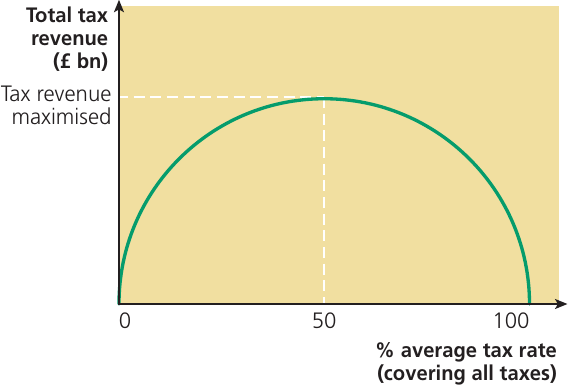
Supply-side economists argue that high income tax rates and the overall tax burden create disincentives. As taxation increases and reduces national income, it may also reduce the government's total tax revenue. This relationship is illustrated by the Laffer curve.
Example
Understanding the Laffer Curve
The Laffer curve shows how government tax revenue changes as the average tax rate increases from 0% to 100%:
- At 0% tax rate: Tax revenue must be zero (no tax is collected)
- At 100% tax rate: Tax revenue is also zero (no incentive to produce output)
- Between these extremes: Tax revenue first rises then falls
The curve shows tax revenue is maximised at the highest point, which occurs at an average tax rate of around 50% in the diagram. Beyond this point, further tax increases become counterproductive, causing total tax revenue to fall.
Policy implications
Important
Supply-side economists argued that during the Keynesian era, tax rates needed to finance government growth had pushed the average rate beyond the critical point on the Laffer curve. In this situation, any further tax increase would have the perverse effect of reducing government revenue.
According to supply-side theory, if the government wants to increase total tax revenue when positioned beyond the optimal point, it must cut tax rates rather than increase them.
Recent evidence suggests most developed economies are now positioned on the left-hand side of the Laffer curve. Any benefits from further tax cuts may not be significant as a supply-side boost, but would likely increase aggregate demand.
A reduction in tax rates creates incentives needed to stimulate economic growth. Faster growth means total tax revenue increases despite lower tax rates. The effect is reinforced by a decline in tax evasion and avoidance, as the incentive to engage in these activities reduces at lower tax rates.
The role of supply-side policies in achieving macroeconomic objectives
Supply-side economists believe government intervention should be minimised. Their aim is to set markets free and promote entrepreneurship, believing that competitive markets, low taxes, the profit motive and self-interest will create economic growth. This creates conditions where other objectives like full employment are 'naturally' achieved.
Reducing the natural rate of unemployment
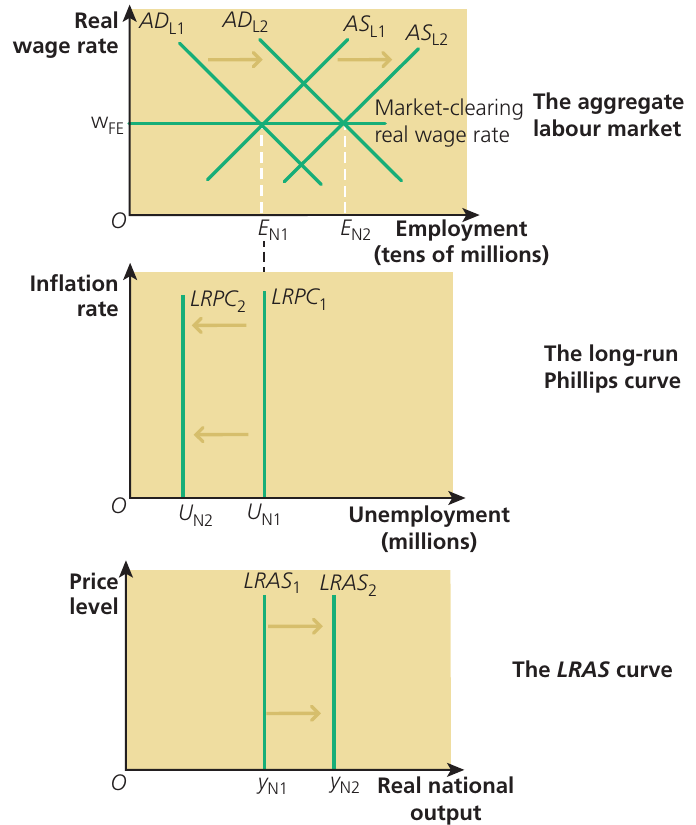
The following diagram brings together three main elements of supply-side macroeconomics:
Note
The three panels show:
Top panel - Aggregate labour market: Shows equilibrium in the economy's labour market. The natural or equilibrium level of employment () is determined at the market-clearing real wage rate (). When the labour market is in equilibrium, the number of workers willing to work equals the number of workers firms wish to hire.
Middle panel - Long-run Phillips curve: Shows the natural level of unemployment () immediately below in the upper panel. This represents the natural rate when stated as a percentage of the labour force.
Bottom panel - LRAS curve: Shows the natural level of real output (), which equals the 'normal capacity' level of real output. The long-run aggregate supply curve () is positioned immediately below (middle panel) and (top panel).
How tax cuts affect unemployment and output
Example
Worked Example: The Effect of Cutting Employers' National Insurance Contributions
Consider what happens when the government cuts employers' national insurance contributions:
Step 1: Labour demand increases Employment costs fall, making it more attractive for firms to employ labour. The aggregate demand for labour curve shifts rightwards from to .
Step 2: Labour supply increases If income tax is cut, this increases workers' disposable income and the incentive to work. The aggregate supply of labour curve shifts rightwards from to .
Step 3: Natural employment rises These changes increase the economy's natural level of employment, which rises from to .
Step 4: Natural unemployment falls The long-run Phillips curve shifts leftwards from to . The economy's natural level of unemployment falls from to .
Step 5: Potential output increases The increase in natural employment and the fall in natural unemployment lead to a rightward shift of the long-run aggregate supply (LRAS) curve. It shifts from to , meaning the economy can produce more output without causing inflation.
Monetary policy and supply-side policies
When supply-side policies were first implemented around 40 years ago, extreme supply-side economists argued that neither monetary nor fiscal policy should be used to manage aggregate demand. Instead, government activity should focus on creating supply-side conditions (and 'sound' money) in which markets function competitively and efficiently.
Most free-market economists now accept that monetary policy should be used to manage demand, but it should be supportive of supply-side reforms and future changes. The essential tasks of monetary policy are to:
- Ensure sufficient demand to absorb the extra output produced by the supply side
- Maintain public confidence in 'sound' money by achieving a low, stable inflation rate
Note
UK governments now recognise that monetary and fiscal policy are interdependent. The success of monetary policy depends on the fiscal policy implemented by the Treasury. When government runs a budget deficit, it must borrow to finance the difference between spending and revenue. This borrowing creates implications for monetary policy and can produce undesirable results, either increasing the money supply (potentially inflationary) or raising interest rates (potentially crowding out private investment).
Supply-side policies, inflation and the balance of payments
Supporters of pro-free-market supply-side policies argue that these measures can:
Reduce inflationary pressures
By reducing businesses' costs of production and reducing monopoly profits through more competitive markets, supply-side policies reduce cost-push inflationary pressures. As productive capacity grows in line with aggregate demand, supply-side policies also help reduce demand-pull inflation pressures.
Improve international competitiveness
By creating 'lean and fit' firms, successful supply-side policies improve the country's quality competitiveness. Highly competitive firms invest in product design and advanced technology, producing high-quality goods that customers demand.
Increased price and quality competitiveness give the country a competitive edge in both domestic and overseas markets. Domestic customers switch to high-quality home-produced goods, whilst overseas residents buy more of the country's exports. This improves the country's balance of payments on current account.
Expansionary fiscal contractionism
Some economists have proposed a controversial theory called 'expansionary fiscal contractionism' (EFC), also known as 'expansionary austerity'.
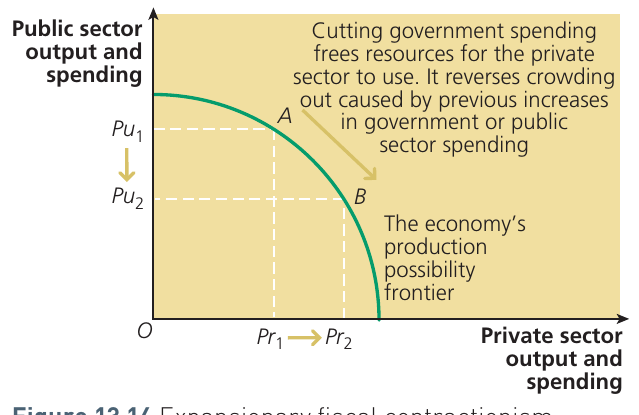
The theory suggests that severe cuts in government spending would free resources for the private sector to use more productively. If true, workers who lost their jobs in the public sector would soon be employed more productively in the private sector.
Important
The expansionary fiscal contractionism hypothesis predicts that, given certain assumptions about how people behave and major reductions in government spending that change future expectations about taxes and spending, private-sector spending can expand, resulting in overall economic expansion.
However, not all economists accept the EFC hypothesis. Critics argue there is little compelling evidence to support it. There is also increased likelihood that wealthy individuals will move their money to countries with lower taxes, making the effect less likely to occur.
The 'trickle-down' effect
Some free-market economists argue that although wealthy people benefit most from supply-side tax cuts, a 'trickle-down' effect means the working poor also benefit. This is because the wealthy respond to tax cuts by employing more staff, albeit generally on low wages.
Important
However, other economists question the strength and even existence of trickle-down effects. There is limited evidence to support it. Additionally, if a trickle-down effect does operate, the widening income inequalities that result from more poor people being employed by the rich are viewed by Keynesian economists as inequitable or unfair.
Microeconomic supply-side policies
Most supply-side policies are based on microeconomic fundamentals, targeting individual markets and economic agents. The supply-side theory of taxation effects on labour markets lies at the heart of free-market supply-side economics, depending on the shape of the supply curve of labour.
Labour supply curves
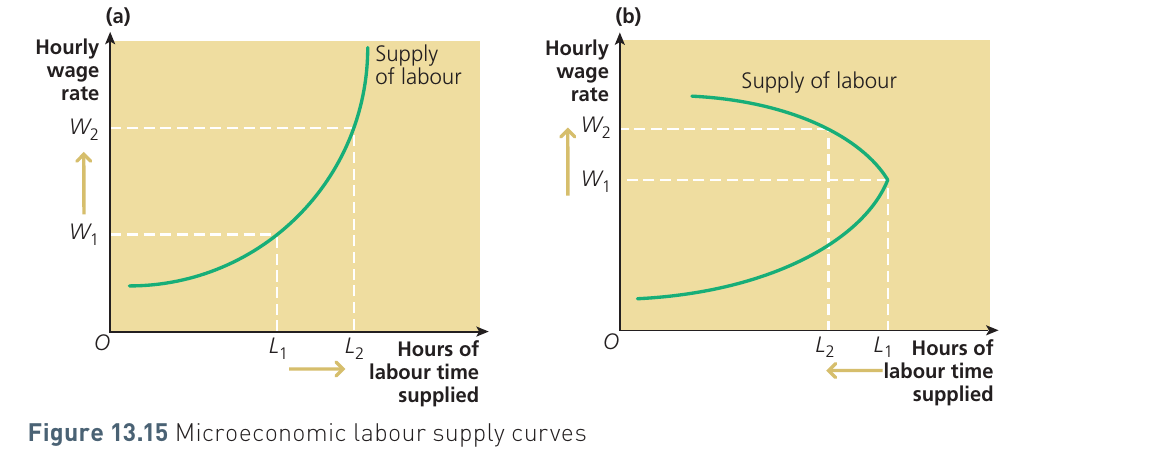
Supply-side economists usually assume a conventional upward-sloping supply curve of labour. Such a curve shows that workers respond to higher wage rates by supplying more labour.
However, the supply curve of labour need not necessarily slope upwards throughout its length. The backward-bending labour supply curve is another possibility.
Example
Understanding Labour Supply Curves
The diagram shows two possibilities:
(a) Standard upward-sloping supply curve: Workers respond to higher wages ( to ) by supplying more labour hours ( to ).
(b) Backward-bending supply curve: Initially, workers respond to wage increases by supplying more labour. However, above a certain wage rate (), further wage rate increases (to ) cause workers to supply fewer hours ( instead of ). This happens because workers prefer to enjoy extra leisure time rather than work.
Following an increase in hourly wage from to , the hours of labour time supplied fall from to . At higher wage levels, workers prefer leisure over work.
Important consideration
Important
If labour supply curves bend backwards, the supply-side argument that tax reductions increase national output and efficiency through labour market incentives becomes much weaker. A wage rise or income tax cut might have the opposite effect, causing people to work fewer hours and enjoy more leisure time.
Examples of microeconomic supply-side policies
Industrial policy measures
- Privatisation: The sale or transfer of state-owned assets (nationalised industries) to the private sector
- Marketisation (commercialisation): Shifting economic activity from non-market provision to commercial provision for which customers pay
- Deregulation: Removing previously imposed regulations to promote competition. This removes barriers to market entry, makes markets more contestable, and eliminates unnecessary bureaucracy that increases firms' production costs
- Internal markets: In areas like the National Health Service and education where the state remains a major provider, internal markets can provide commercial discipline and improve efficiency
- Subsidising spending on research and development: Often achieved through corporation tax rate cuts to increase business profits, providing greater financial resources for investment and R&D spending, leading to better products and higher sales
Labour market measures
- Lower rates of income tax: Marginal rates can be reduced to create labour market incentives. Tax thresholds or personal tax allowances can be raised to remove low-paid workers from the tax net
- Reducing state welfare benefits relative to average earnings: Lower benefit levels create incentives to choose low-paid employment over claiming unemployment-related benefits. Benefits can be made more difficult to claim and available only to those genuinely looking for work. This may also reduce the unemployment trap
- Changing employment law to reduce trade union power: Possible changes include removing legal protection, restricting rights, extending freedom for workers not to join unions, allowing employers not to recognise unions, replacing collective bargaining with individual negotiation, and restricting the right to strike
- Repealing legislation limiting employers' freedom to employ: Making it easier to 'hire and fire' workers
- More flexible pension arrangements: Encouraging workers to opt out of state pensions and arrange private plans to reduce burden on taxpayers. Allowing transfer of private pensions between employers when changing jobs
- Improving training of labour: Establishing training agencies and academies for vocational technical education. However, UK governments have rejected proposals for a 'training tax' on employers without training schemes
- Short-term employment contracts: Though not strictly a government policy, the introduction of short-term contracts in labour markets has had supply-side effects. Zero-hours contracts guarantee no minimum work hours but allow employers flexibility. In 2013, just under 600,000 UK workers were on such contracts, rising to around 1 million by 2020. Critics argue these policies increase poverty and inequality for ordinary workers
Note
The debate over zero-hours contracts highlights the tension between labour market flexibility (favoured by free-market economists) and worker protection (emphasised by interventionist approaches).
Financial and capital market measures
- Deregulating financial markets: Creating greater competition among banks and building societies. Opening UK financial markets to overseas institutions. These reforms have increased fund supply and reduced borrowing costs for firms. However, lightly regulated banks contributed significantly to the 2008-09 financial crisis
- Encouraging saving: Governments have created special tax privileges for saving. They've encouraged saving by giving individual shareholders first preference when former nationalised industries were privatised. However, very low interest rates from monetary policy have discouraged saving in recent years
- Promoting entrepreneurship: Governments have encouraged popular capitalism and an enterprise culture. Company taxation has been reduced and markets deregulated to encourage risk-taking
- Reducing public spending and public-sector borrowing: Intended to free resources for private-sector use and avoid crowding out
Market-based versus interventionist supply-side policies
Supply-side policies described so far have generally been market-based, used to 'free up' markets, 'roll back' the state's economic functions, and replace public-sector activity with private-sector activity. Free-market economists promote market conditions by designing policies that stimulate market forces through:
- Tax cuts to create incentives to seek profits and work harder
- Privatisation to unleash market forces by taking businesses out of the public sector
- Deregulation to encourage enterprise and increase competition
This view stems from the original use of 'supply-side economics' in the free-market revival 40 years ago.
However, interventionist policies can also target the supply side, provided they aim to improve efficiency and economic performance of individual firms, industries and markets. Interventionist supply-side policies include:
- Government spending on education and training
- Industrial and regional policy
- Spending on infrastructure such as motorways
- Subsidising spending on research and development (R&D)
Note
Interventionist supply-side policies are based on the view that government intervention is needed to correct market failure and short-termism, which may reduce investment and growth. More recent pro-free-market supply-side policies have generally aimed to correct and reduce government failure.
Remember!
Summary
Key Points to Remember:
-
Supply-side policies aim to improve the productive potential of the economy by shifting the LRAS curve to the right, increasing competitiveness and efficiency.
-
Two main types exist: Market-based policies (privatisation, deregulation, marketisation) reduce government intervention, while interventionist policies (education, training, infrastructure) involve government action to correct market failures.
-
The Laffer curve demonstrates that very high tax rates can be counterproductive, reducing government revenue by creating disincentives to work and produce. There exists an optimal tax rate that maximises revenue.
-
Supply-side policies can reduce the natural rate of unemployment by increasing labour market flexibility and shifting both the labour demand and supply curves, leading to a rightward shift in LRAS and leftward shift in the long-run Phillips curve.
-
Successful supply-side policies improve international competitiveness, reduce inflationary pressures (both cost-push and demand-pull), and can improve the balance of payments by making domestic goods more attractive to both home and overseas buyers.