Fundamentals of Fiscal Policy (AQA A-Level Economics): Revision Notes
📚Revision Notes
Fundamentals of Fiscal Policy
What is fiscal policy?
Fiscal policy refers to how the government uses its spending powers and taxation system to achieve its economic objectives. This makes it a central part of overall economic policy, working alongside monetary policy and supply-side policies.
Note
Fiscal policy operates at two distinct levels:
Macroeconomic level: Functions as a tool for managing aggregate demand in the economy. This role became particularly prominent during the Keynesian era from the 1950s to the late 1970s, when governments actively used fiscal policy to influence the total level of spending in the economy.
Microeconomic level: Helps make markets work more efficiently and dynamically. The government can use taxes and subsidies to influence consumer behaviour, shape work incentives through income tax rates, and affect labour market participation through the welfare system.
These microeconomic functions aim to improve how individual markets operate rather than managing the economy as a whole. Both levels are important for achieving different economic objectives.
Understanding budget positions
The government's budget position describes the relationship between government spending and government revenue , representing taxation and other income sources. There are three possible budget positions:
Balanced budget: This occurs when government spending exactly equals government revenue . Historically, governments aimed to balance their budgets annually, viewing this as financially responsible management.
Budget deficit: A deficit arises when government spending exceeds government revenue . The government must finance this shortfall by borrowing from the private sector. Budget deficits became a deliberate policy tool during the Keynesian era.
Budget surplus: A surplus exists when government spending is less than government revenue . The government collects more in taxes than it spends, potentially using the excess to pay down previous debts.
Important distinction
Important
Students often confuse a budget deficit with a balance of payments deficit. These are completely different concepts:
- Budget deficit: Concerns the government's finances - the gap between what government spends and what it receives in revenue
- Balance of payments deficit: Relates to the country's external trade position and capital flows with other nations
These measure entirely different aspects of the economy and should never be confused.
Demand-side fiscal policy
Demand-side fiscal policy focuses on managing the level of aggregate demand in the economy. It works by shifting the AD curve either right or left through deliberate changes in government spending, taxation rates, and the budget balance.
Note
The Aggregate Demand Equation
To understand how fiscal policy affects the economy, recall:
Where:
- = Consumption
- = Investment
- = Government spending
- = Exports
- = Imports
Government spending is directly one of the components of aggregate demand. When the government increases its spending, or when it cuts taxes (which increases consumption ), aggregate demand rises.
Conversely, cutting government spending or raising taxes reduces aggregate demand. This direct relationship makes fiscal policy a powerful tool for influencing economic activity.
The Keynesian foundation
The theoretical foundation for demand-side fiscal policy comes from Keynesian macroeconomic theory, developed by economist John Maynard Keynes in the 1930s. Keynes challenged the traditional view that governments should always balance their budgets. He argued that during economic downturns, deficit financing - deliberately running a budget deficit and borrowing to finance it - could help restore full employment.
The key Keynesian insights that shaped fiscal policy from the 1950s to late 1970s included:
-
Market failure in unregulated economies: Left alone, market economies tend to produce low growth, high unemployment, and volatile business cycles. They naturally settle into positions of underemployment rather than full employment.
-
The problem of insufficient demand: Private sector saving and investment decisions can create persistent deficits of aggregate demand. When households and firms save too much and invest too little, the economy operates below its potential, with unnecessary unemployment.
-
Active demand management: Through deficit financing, governments can inject additional demand and spending power into the economy. This helps eliminate deficient aggregate demand and move towards full employment.
-
Discretionary fine-tuning: Once full employment is achieved, governments can use discretionary fiscal policy to make ongoing adjustments to tax rates and spending levels, fine-tuning aggregate demand to maintain economic stability.
-
Demand-focused orientation: Economic policy should prioritise managing the demand side of the economy. While supply-side elements like industry support have a role, they were viewed as subordinate to the primary task of managing aggregate demand.
Deficit financing in practice
During the Keynesian era, governments would deliberately set public spending higher than tax revenues. For each year of deficit, the shortfall had to be financed through public-sector borrowing. The aim was to achieve full employment and stabilise economic fluctuations without creating excessive inflation.
Note
A Fundamental Shift in Thinking
This approach represented a revolutionary change. Before Keynes, running a budget deficit was seen as irresponsible - like a bankrupt household unable to manage its finances.
Keynes established that a government deficit could be a moral duty when the economy needed stimulus. If households and firms in the private sector were saving excessively, causing unemployment, the government should step in by borrowing those excess savings and spending them through public programmes.
Expansionary fiscal policy
Expansionary fiscal policy (also called reflationary fiscal policy) aims to increase aggregate demand and stimulate economic growth. The government implements this by either increasing government spending, cutting taxes, or both. Either action increases the budget deficit or reduces a budget surplus.
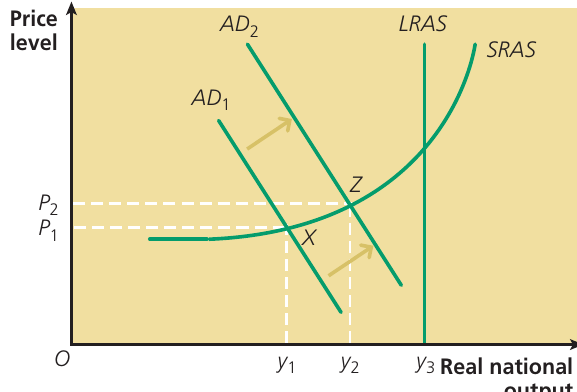
The diagram above illustrates how expansionary fiscal policy works. Initially, the economy is at equilibrium point , where the aggregate demand curve intersects with short-run aggregate supply . The economy produces output level at price level .
When the government increases spending or cuts taxes, the AD curve shifts rightward from to . This creates a new equilibrium at point , with higher output and a higher price level . The economy has expanded, potentially creating more jobs and reducing unemployment.
Important
The Effectiveness Depends on Economic Capacity
The closer the economy operates to its long-run aggregate supply - its 'normal capacity' - the more the policy creates inflation rather than real output growth.
Once the economy reaches full capacity (operating on its production possibility frontier), further government spending simply pushes up prices without increasing real output.
Contractionary fiscal policy
Contractionary fiscal policy works in the opposite direction. When the economy faces excess demand and rising inflation, the government can reduce spending, increase taxes, or both. This shifts the AD curve leftward, reducing both output and the price level, helping to control inflation.
The role of the multiplier
Central to Keynesian fiscal policy was the concept of the multiplier effect. Keynes argued that changes in government spending would be magnified through the economy, creating a proportionally larger change in national income. A relatively large multiplier means fiscal policy can be quite effective in managing aggregate demand.
However, real-world evidence suggests government spending multipliers are generally small and often not significantly different from (meaning no multiplication effect). This has been one reason why fiscal policy's effectiveness has been questioned.
Discretionary fiscal policy and its limitations
Discretionary fiscal policy involves making deliberate, separate changes to government spending , taxation , and the budget deficit to manage aggregate demand levels. Governments adjust these policy levers in response to economic conditions, aiming to stabilise the economic cycle.
During the Keynesian era, governments believed fiscal policy could achieve full employment and stabilise fluctuations while avoiding excessive inflation. However, this approach faced several challenges. Sometimes fiscal stimulus overheated economies, creating demand-pull inflation. Excess demand could also pull imports into the country, causing balance of payments crises. When these problems emerged, governments had to reverse course, cutting spending or raising taxes to reduce demand.
The crowding out effect
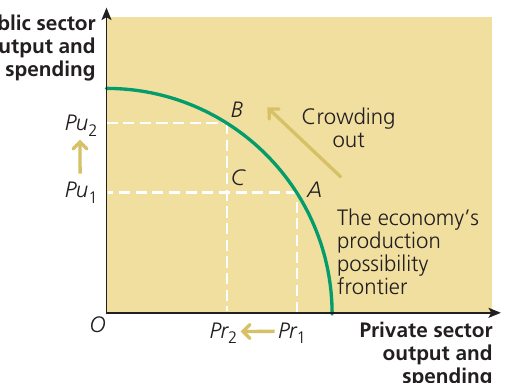
A major limitation of expansionary fiscal policy is the crowding out effect. This describes a situation where an increase in government or public-sector spending displaces or crowds out private-sector spending, resulting in little or no overall increase in aggregate demand.
Note
Understanding the PPF Diagram
The diagram above uses a production possibility frontier to illustrate crowding out. The economy cannot employ resources simultaneously in both the private and public sectors. The PPF curve shows the maximum combinations of public-sector output and private-sector output that can be produced with available resources.
Assuming the economy starts at full employment (point on the production possibility frontier), an increase in public-sector spending from to requires moving from point to point . This necessarily involves sacrificing private-sector output, which falls from to . The public sector crowds out the private sector because there are no spare resources available.
However, if the economy were initially inside the production possibility frontier at point (meaning spare capacity exists), then increasing public-sector spending could move the economy towards point without reducing private-sector output. In this situation, the multiplier effect would be larger because the extra government spending absorbs idle resources rather than displacing private activity.
Important
Context Matters: Spare Capacity vs Full Employment
Back in the 1930s, when Keynes developed his theory, economies had significant spare capacity during the Great Depression. Fiscal expansion made sense because it could put unemployed resources to work.
However, if an economy is already at or near full employment, fiscal expansion mainly crowds out private spending rather than genuinely expanding the economy. This is why the effectiveness of fiscal policy depends critically on the economic context.
Supply-side fiscal policy
After 1979, with limited exceptions during the 2008-10 financial crisis and the Covid-19 pandemic, governments increasingly shifted away from demand-side fiscal policy. They focused instead on supply-side fiscal policy, which aims to increase the economy's ability to produce and supply goods and services.
Supply-side fiscal policy works differently from demand-side policy. Rather than managing aggregate demand, it seeks to shift the long-run aggregate supply curve rightward, increasing the economy's productive potential. The main tools include:
- Creating incentives to work through lower income tax rates
- Encouraging saving and investment through tax incentives
- Supporting entrepreneurship through business-friendly tax policies
- Funding retraining schemes for unemployed workers
These policies aim to make the economy more productive and competitive. By improving incentives and reducing barriers to enterprise, supply-side fiscal policy seeks to shift the LRAS curve rightward.
Note
How Supply-Side Policy Shifts LRAS
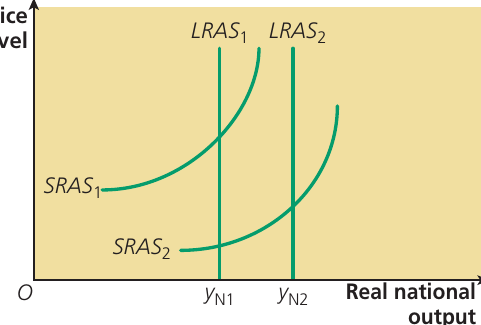
The diagram above shows how successful supply-side fiscal policy affects the economy:
- The LRAS curve shifts right from to
- This indicates an increase in the economy's normal capacity output from to
- The short-run aggregate supply curve also shifts right from to
- This reflects improved productivity and falling unit costs
In normal circumstances, these supply-side improvements are accompanied by rising aggregate demand. This means the policy tends to moderate inflation rather than cause deflation. The economy benefits from increased productive capacity without necessarily experiencing falling prices.
It's important to note that while supply-side fiscal policy became the dominant approach after 1979, governments may also use non-fiscal supply-side policies that don't involve the budget. The focus on supply-side reflects a fundamental shift in economic thinking away from Keynesian demand management towards improving the economy's productive capacity and competitiveness.
Historical context: the Keynesian era and its decline
Keynesian fiscal policy was implemented with varying success from the 1950s until 1979. During these decades, UK governments and many other industrialised mixed economies based their macroeconomic policy on using fiscal policy to manage aggregate demand.
By the late 1970s, however, signs of change were emerging. In 1976, UK Labour Prime Minister James Callaghan made a famous speech indicating that governments could no longer 'spend their way out of recession'. This marked the beginning of the end for Keynesian fiscal policy dominance.
Note
The Post-1979 Shift
After 1979, governments increasingly turned away from Keynesian demand management. They adopted free-market economic theories and embraced balanced budgets.
Keynes had argued that mass unemployment in the Great Depression was caused by deficient aggregate demand, but critics countered that real-world government spending multipliers were too small to make fiscal policy effective.
Since 1979, governments have relied more heavily on monetary policy for managing the macroeconomy. However, the economic shocks from the 2008 financial crisis and the Covid-19 pandemic led to a partial revival of Keynesian fiscal policy. During these crises, governments pumped large amounts of demand into the economy through both tax reductions and increased government spending, demonstrating that fiscal policy remains an important tool in exceptional circumstances.
Real-world application: budget day in the UK
In the United Kingdom, fiscal policy decisions are announced annually on Budget Day. The government's financial year runs for 12 months beginning on 5 or 6 April. In October or November of the previous year, the Chancellor of the Exchequer (the elected MP responsible for the economy) reads the Budget speech to the House of Commons.
The Chancellor's speech outlines how the government proposes to collect tax revenue in the forthcoming financial year. Part of the Budget speech is published in the 'Red Book' (formally called the Financial Statement and Budget Report), which contains the Chancellor's analysis of current UK economic performance. This Budget forms the core of fiscal policy and is of particular interest to economists.
Note
Budget Day Traditions
The Budget Day tradition includes some unique customs:
- The Chancellor holds up a red box outside Number 11 Downing Street before delivering the statement
- This box has been used to carry the Chancellor's speech for over 100 consecutive years
- During the Budget speech, the Chancellor is traditionally allowed to refresh themselves with alcoholic drinks - a privilege no other Member of Parliament enjoys during Commons proceedings
Although Budget Day has typically occurred in autumn in recent years, it has also been held in spring on several occasions over the past thirty years. The Budget speech is followed by four days of debate on Budget Resolutions, which cover different policy areas such as health, education, and defence.
Summary
Key Points to Remember
-
Fiscal policy uses government spending and taxation to achieve policy objectives, operating at both macroeconomic (demand management) and microeconomic (market efficiency) levels.
-
Budget positions matter: A balanced budget has , a deficit has (government must borrow), and a surplus has (government has excess funds).
-
Demand-side fiscal policy shifts the AD curve through changes in spending and taxation. Expansionary policy (higher spending or lower taxes) shifts AD right; contractionary policy shifts AD left.
-
Crowding out limits fiscal policy effectiveness when increased public spending displaces private spending, particularly when the economy is at or near full capacity.
-
Supply-side fiscal policy focuses on productive capacity rather than demand, aiming to shift the LRAS curve rightward through incentives to work, save, invest, and be entrepreneurial. This approach has dominated since 1979.
-
Historical evolution: Keynesian demand-side policy dominated from the 1950s to 1979, then shifted towards supply-side approaches. However, major crises (2008, Covid-19) saw temporary returns to Keynesian stimulus.