Circular Flow of Income (AQA A-Level Economics): Revision Notes
📚Revision Notes
Circular Flow of Income
Understanding national income
Before we explore the circular flow of income, it's important to understand what national income means and how it is measured.
What is national income?
National income represents the flow of new output produced by an economy during a specific time period, typically measured over a year. There are three ways to think about and measure this flow:
-
Income approach - This method adds together all the incomes received by the factors of production (such as wages for labour and profits for capital)
-
Output approach - This method calculates the value added at each stage of production across all industries in the economy (agriculture, manufacturing, services, etc.)
-
Expenditure approach - This method sums up all spending in the economy: consumption, investment, government expenditure, and net exports (exports minus imports)
Note
Since these three approaches measure the same thing (the flow of new output) from different perspectives, they always produce equal totals. This fundamental relationship is one of the most important concepts in macroeconomics.
This gives us the fundamental equation:
Nominal versus real national income
It's crucial to distinguish between two ways of expressing national income:
Nominal national income measures the flow of output at current price levels in the economy. This figure includes the effects of inflation.
Real national income measures the actual goods and services produced, adjusted to remove the effects of price changes. This provides a more accurate picture of the economy's true productive capacity.
Important
For comparing economic performance over time or between countries, real national income is the better indicator because it reflects genuine changes in output rather than simply changes in prices. Using nominal income can be misleading when inflation rates differ between periods or countries.
National income as an economic indicator
The level of real national income indicates current living standards within an economy. The rate of change of real national income shows whether the economy is experiencing growth or decline. These measures allow economists and policymakers to compare economic performance across different time periods and between different countries.
The circular flow of income model
The circular flow model provides a visual framework for understanding how income, spending, and resources move around the economy. It shows the relationships between different economic actors and how money and goods circulate between them.
The simple two-sector model
The most basic version of the circular flow model includes just two types of economic agents: households and firms. This is known as a closed economy - one with no government sector and no international trade.
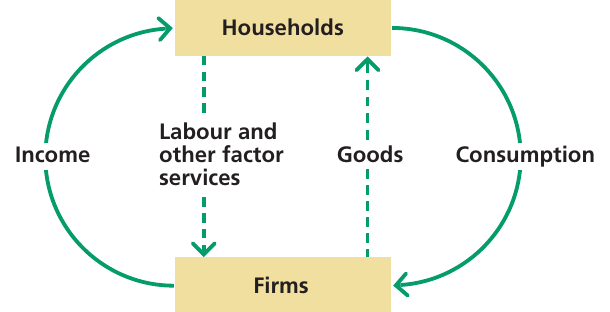
In this simple model:
- Households own the factors of production (labour, land, capital, and enterprise)
- Firms use these factors to produce goods and services
The model shows two types of flows:
Real flows (shown by dashed lines):
- Labour and factor services flow from households to firms
- Goods and services flow from firms to households
Money flows (shown by solid lines):
- Income flows from firms to households as payment for factor services
- Consumption expenditure flows from households to firms as payment for goods and services
Note
This creates a continuous circular movement. Households earn income by providing factor services to firms, then spend that income on goods and services produced by firms. The spending becomes revenue for firms, which they use to pay for factor services, creating income for households. The cycle continues indefinitely.
Introducing withdrawals and injections
A more realistic model recognizes that not all household income is spent immediately on consumption. Some income is saved, creating what economists call a withdrawal or leakage from the circular flow.
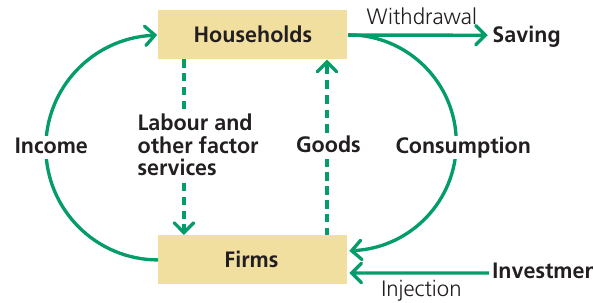
Saving is income that households choose not to spend. It represents a withdrawal from the circular flow because that money is not being used to purchase goods and services from firms.
However, the circular flow doesn't necessarily shrink when households save. If firms borrow these savings (through financial intermediaries like banks) to spend on capital goods, this creates an injection back into the flow.
Investment refers to total planned spending by firms on capital goods (machinery, equipment, buildings) produced within the economy. This represents an injection of spending into the circular flow.
Important
When households save, they are essentially setting aside purchasing power. If this saved money sits idle (perhaps hidden under a mattress), it creates deficient aggregate demand - there's insufficient spending to purchase all the output the economy can produce. Firms cannot sell all their goods and services, so they reduce output, and national income falls.
However, when savings are lent through the financial system to firms and other borrowers, planned saving may equal planned investment. In this case, the withdrawal from consumption is offset by the injection of investment spending, and the circular flow remains stable.
Equilibrium national income
A key concept in circular flow theory is equilibrium. Equilibrium national income is the level of income at which withdrawals from the circular flow equal injections into the flow. At this point, the level of output also equals aggregate demand, meaning aggregate demand equals aggregate supply.
Important
It's important to understand that equilibrium national income is not necessarily the same as full employment income. Full employment income occurs when the economy is producing at its production possibility frontier with no spare capacity. An economy can be in equilibrium at a lower level of output where there is unemployment and spare capacity.
How equilibrium is determined
In the simple two-sector model, the equilibrium condition is:
or simply:
If this condition holds, national income remains stable. However, if planned saving exceeds planned investment , there is a net withdrawal from the circular flow. Spending falls short of output, firms cannot sell all their production, so they cut back output and national income falls.
Conversely, if planned investment exceeds planned saving , there is a net injection into the circular flow. Spending exceeds current output, firms respond by increasing production, and national income rises.
Note
The problem is that households and firms make saving and investment decisions for different reasons, so there's no guarantee that planned saving will equal planned investment. Households save based on factors like income levels, interest rates, and confidence about the future. Firms invest based on expected profitability, interest rates, and business confidence. These decisions are made independently.
If people hoard much of their income rather than spending or lending it, harmful effects can occur. Without sufficient demand to purchase output, firms reduce production and national income falls, potentially leading to recession.
Expanding the model: government and overseas sectors
The simple two-sector model is helpful for understanding basic principles, but real economies include government activity and international trade. We need to expand the model to include these important elements.
An open economy is one that engages in international trade, buying goods from and selling goods to other countries.
Additional withdrawals and injections
When we add the government and overseas sectors, we introduce three new elements to each side of the equation:
Additional withdrawals:
- Taxation (T) - This takes spending power away from households and firms, reducing the amount available for consumption or investment
- Imports (M) - When UK residents spend money on goods produced overseas, this spending leaks out of the UK's circular flow and instead stimulates other countries' economies
Additional injections:
- Government spending (G) - Government expenditure on goods, services, and infrastructure injects spending into the economy
- Exports (X) - When people in other countries buy UK-produced goods, this brings spending into the UK's circular flow
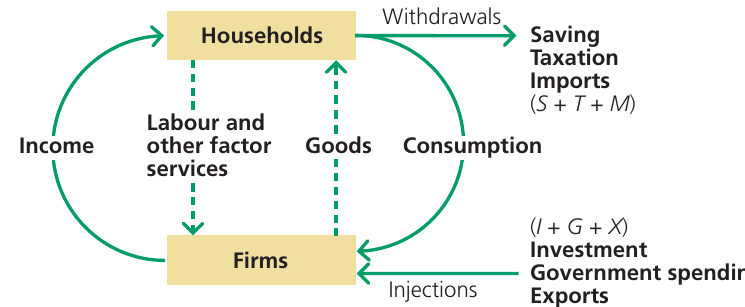
Equilibrium in the full model
In this expanded model, equilibrium national income occurs when:
When this condition holds, national income is stable - neither rising nor falling.
If total withdrawals exceed total injections , there is a net leakage of spending from the circular flow. The economy faces deficient aggregate demand, output falls, and national income declines.
If total injections exceed total withdrawals , there is a net injection of spending into the circular flow. Aggregate demand exceeds current output, firms increase production, and national income rises.
Important notation reminder
Note
Economists use shorthand letters for macroeconomic variables:
- = Income
- = Consumption
- = Saving
- = Investment
- = Government spending
- = Taxation
- = Exports
- = Imports
Be careful not to confuse (investment) with (income), and remember that refers to savings but can also be used as an abbreviation for supply in other contexts.
Keynesian perspective on deficient demand
The economist John Maynard Keynes developed important insights about what happens when planned saving exceeds planned investment. If households save more than firms wish to invest, and these savings are not lent to others for spending, there will be insufficient aggregate demand in the economy.
With too little demand to buy the output the economy is capable of producing, firms cannot sell all their goods and services. They respond by cutting back production, which means national income and output fall. This creates a recession. Keynes argued that deficient aggregate demand was the cause of recessions, including the Great Depression of the 1930s.
Important
Keynes believed that if households save without lending those savings to finance spending by others (particularly businesses for investment), the economy would experience falling income and output. Saving would decline until it equalled investment, restoring equilibrium but at a significantly lower level of national income.
However, Keynes recognized that interest rates could potentially bring saving and investment back into balance. When interest rates fall, saving becomes less attractive (lower returns) and investment becomes more attractive (lower borrowing costs). People save less and firms invest more in capital goods. But Keynes believed this adjustment process was slow, famously noting "in the long run we are all dead."
According to Keynesian analysis, when planned leakages of demand from the circular flow exceed planned injections of demand into the flow, income and output fall to restore equilibrium. Therefore, Keynes viewed deficient aggregate demand as the fundamental cause of recessions.
The purpose of economic models
The circular flow model we've studied is an example of an economic model - a simplified representation of reality that helps us understand complex economic relationships.
Economic models are essential analytical tools used by economists to:
- Understand and explain how the economy works
- Make predictions about what might happen in the future
- Derive policy recommendations based on predicted outcomes
How models work
A good economic model simplifies reality sufficiently to highlight important relationships while avoiding excessive over-simplification. The model concentrates attention on key economic relationships while abstracting away from irrelevant detail or "background noise."
Economic models describe particular aspects of economic behaviour for individuals, groups, or the whole economy. They often use mathematical equations and diagrams to show relationships in a clear, visual way.
Note
Models are deliberately small-scale replicas of real-world phenomena. They incorporate simplifying assumptions about human behaviour to make the model manageable. For example, a model might assume all consumers behave identically, when in reality there is considerable variation. The art of good modelling involves making strong assumptions to simplify the problem without losing the essential features of the relationship being explained.
Testing and refining models
Economists use models first to understand and explain current economic conditions, and second to predict future developments. They then use sophisticated statistical techniques to test whether the model's predictions align with actual observed behaviour.
Good models and theories survive this empirical testing process. Models or theories that consistently fail to align with observed reality must be revised or discarded. This scientific approach ensures that economic understanding improves over time as weak theories are rejected and stronger ones developed.
Note
It's worth noting that economists can sometimes reach different conclusions from the same model by making different assumptions. For example, a labour market model might predict that higher wages increase labour supply (encouraging people to work more) or decrease it (as people reach their income target sooner and prefer leisure). The outcome depends on the behavioral assumptions built into the model.
Remember!
Summary
Key Points to Remember:
-
National income equals national output equals national expenditure - three different ways of measuring the same flow of new output in the economy
-
Real national income is a better indicator of economic performance than nominal income because it removes the effects of price changes
-
The circular flow model shows how money, goods, and services move between households and firms in a continuous cycle
-
Withdrawals remove spending power from the circular flow, while injections add spending power to the flow
-
Equilibrium national income occurs when total withdrawals equal total injections , but this doesn't necessarily mean the economy is at full employment
-
Deficient aggregate demand occurs when withdrawals exceed injections, causing output and income to fall - this was Keynes' explanation for recessions