Globalisation (AQA A-Level Economics): Revision Notes
📚Revision Notes
Globalisation
The meaning of globalisation
Globalisation refers to the way economies across the world have become increasingly interconnected and interdependent. This process integrates national economies into a global economic system where countries rely heavily on each other for trade, investment, and economic activity.

While some economists suggest that globalisation has occurred over centuries, dating back to periods of relatively free worldwide trade in the nineteenth century and even to European colonial expansion, the term itself gained prominence in economic literature during the mid-1980s. Since then, its use has grown dramatically as the process has intensified.
Note
The shift from simple internationalisation (basic cross-border economic relationships) to globalisation reflects a deeper level of economic integration. Countries are no longer just trading partners; they are fundamentally linked through complex networks of production, finance, and commerce.
The causes of globalisation
Recent globalisation has been driven primarily by technological advances. The most significant developments have been in information and communication technology (ICT), alongside improvements in transport and other traditional forms of technology.
The 'death of distance' has been a crucial factor. Modern telecommunications and the internet mean that geographical separation matters far less than it once did. Service industries can now operate globally with ease. For example, UK companies handle customer service through call centres based in India, whilst fashion companies design products in Europe, manufacture them in southeast Asia, and sell them predominantly in North America.
Note
Advances in transport technology, particularly containerisation, have dramatically reduced shipping costs. This makes it economically viable to move goods across vast distances, enabling the complex global supply chains that characterise modern production.
The main characteristics of globalisation
Globalisation exhibits several key features that distinguish it from earlier forms of international economic activity:
Trade liberalisation has been central to the process. The World Trade Organization (WTO) has encouraged countries to reduce import tariffs and other trade barriers. This international body promotes free trade, though it has become closely associated with both the benefits and criticisms of globalisation.
International mobility of capital and labour has increased significantly. Capital moves relatively freely between countries as businesses seek the best investment opportunities. Labour mobility has also grown, though to a lesser extent, with skilled workers and migrants moving between countries for employment.
The growing power of multinational corporations (MNCs) has been fundamental to globalisation. These enterprises operate across several countries whilst maintaining headquarters in one nation. MNCs or transnational companies have become major drivers of global economic integration.
Deindustrialisation has affected older industrial regions in developed countries. Manufacturing has shifted away from traditional industrial heartlands towards newly industrialising countries (NICs), particularly in Asia. This reflects the global reorganisation of production.
Service industry mobility has emerged more recently. Call centres, accounting offices, and other service operations have moved to NICs, facilitated by modern telecommunications technology.
Important
Decreased governmental power has accompanied globalisation. National governments have lost some ability to control multinational firms operating within their borders and face constraints on their economic policy choices. Capital flows restrict monetary policy independence, even for countries with floating exchange rates.
'Coca-colonisation' refers to the cultural dimension of globalisation. This involves the spread and dominance of products from major economies (particularly the USA) which can erode local cultural identities and practices.
Note
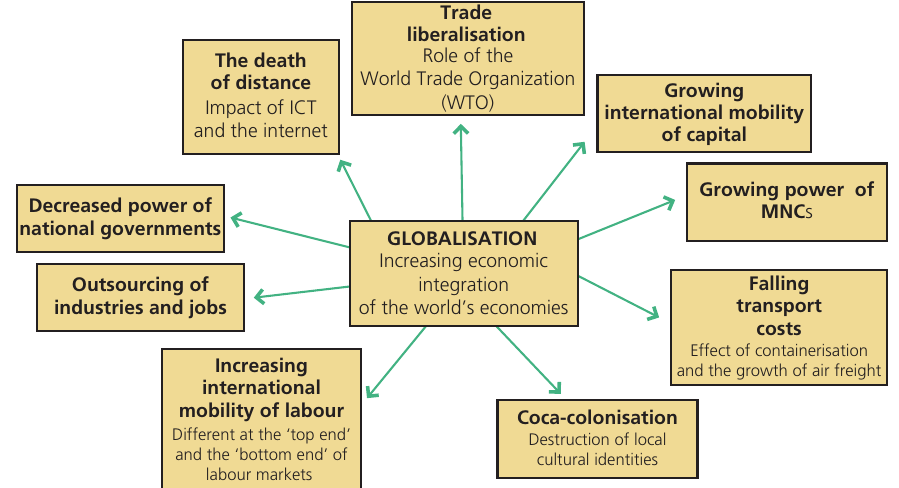
This diagram illustrates how these various elements interconnect to form the globalisation process, showing the relationships between trade liberalisation, technological change, capital mobility, MNC power, and their various effects.
The consequences of globalisation for less developed economies
Less developed economies (LEDCs) are characterised by low national income per capita, high population growth, low human capital, high unemployment, poor infrastructure, and over-dependence on exports of a few primary commodities. Many nations in Asia, Africa, and Latin America fit this profile.
Critics of globalisation highlight several problematic aspects affecting LEDCs:
Important
Exploitation of workers occurs in 'sweatshops' – production facilities where workers endure poor conditions, including long hours, minimal welfare checks, and very low wages. Factory workers producing goods for global markets often receive wages far below those in developed countries, whilst the products sell at high prices internationally.
Agricultural pressures include farmers in developing countries being forced to grow genetically modified (GM) crops. This creates dependency on seed suppliers and raises concerns about long-term agricultural sustainability.
Privatisation requirements have been imposed on LEDCs. To qualify for loans from institutions like the International Monetary Fund (IMF) and World Bank, countries have had to sell state-owned industries. This has sometimes resulted in the loss of national control over key economic assets.
Cultural dominance through what critics call 'McDonaldisation' or 'Coca-colonisation' threatens local identities. US corporate culture and multinational companies symbolise what opponents see as wrong with globalisation's effects on less developed economies. Significant parts of the world economy face potential destruction of local and national products, identities, and cultures by dominant global brands.
However, this cultural process has nuances. Glocalisation describes how global products and services become more successful when adapted to local practices and cultural expectations. For example, McDonald's restaurants offer menus tailored to local tastes in different countries, such as the 'Maharaja Mac' (a chicken burger) in beef-avoiding regions, positioned as equivalent to the 'Big Mac' in beef-eating countries.
Note
Labour treatment controversies persist regarding multinational corporations. Companies face accusations of selling products in developed economies at prices far exceeding production costs and the low wages paid to workers in developing countries who manufacture the goods. Multinationals argue, conversely, that their wages exceed local rates paid by indigenous firms, encouraging local wage rises and improving labour productivity, health, safety, and other conditions in poor countries where they operate.
The consequences of globalisation for more developed economies
More developed economies (MEDCs) have high levels of economic development, high average incomes, high living standards, and are typically dominated by service industries, with substantial investment in human capital and infrastructure built up over many years.
The anti-globalisation perspective argues that 'Coca-colonisation' has not only harmed less developed economies but also negatively affected more developed ones. Critics believe that whilst consumers in richer countries may demand global products, considering them superior to traditional local alternatives, this preference comes at a cost.
Important
Wage and employment pressures emerge as MNCs threaten to close factories and offices in developed countries and relocate production to poorer nations. This can reduce wages and living standards in developed economies. When jobs disappear through deindustrialisation and globalisation, the significance depends on what type of employment emerges to replace lost jobs. New positions may be in the highly skilled service sector, but could also be menial, low-skilled roles.
However, supporters of globalisation who believe the world economy benefits overall argue that these concerns miss the bigger picture. They contend that globalisation stems partly from the massive increase in world trade since the Second World War. This expansion has only been possible due to increased trade liberalisation and reduction of protectionist measures such as import controls.
Resource allocation benefits arise from free trade, according to pro-globalisation economists. They believe free trade leads to better allocation of resources, with additional benefits derived from international competition and technology spread, making most people better off overall.
Dependency theory of trade and development
Supporters of dependency theory challenge the view that globalisation benefits all countries equally. This theory argues that many developing economies lack capital because the world trade and payments system has been organised by developed industrial economies to serve their own interests.
Terms of trade movements have generally favoured industrialised countries over primary producers. The terms of trade – the ratio of a country's export prices to import prices – means that by exporting the same quantity of manufactured goods to developing economies, a developed economy can import increasingly larger quantities of raw materials or foodstuffs.
Conversely, developing economies must export more to purchase the same quantity of capital goods or energy vital for development. The movement of terms of trade in favour of developed economies has raised income and living standards in richer nations at the expense of poorer developing economies. Exceptions exist, such as oil-producing non-industrial countries benefiting from substantial oil price increases in recent decades.
Note
Wealth and resource transfers further promote the flow of resources to richer economies, according to dependency theorists. On an international scale, dividends and profits flow to multinational corporations headquartered in North America, western Europe, and Japan from their subsidiaries in the developing world. Similarly, interest payments flow to western banks from loans originally made to finance development in developing economies.
Global North and Global South patterns show that flows of dividends and interest payments from the Global South to the Global North exceed flows in the opposite direction. The Global North comprises high-income countries including the USA, UK, Germany, France, Japan, and other economically developed nations. The Global South refers to poorer developing economies in regions such as sub-Saharan Africa. The terms reflect the geographical distribution of most countries north and south relative to each other.
Is globalisation good or bad?
Free-market economists generally support globalisation, viewing its growth as inevitable. They argue that benefits of further global economic integration, including the extension of political freedom and democracy alongside economic benefits of increased production and higher living standards, significantly exceed disadvantages such as local cultural destruction.
Important
Opponents counter that globalisation represents exploitation of the poor, mostly in developing economies, by international capitalism and US economic and cultural imperialism. This debate remains unresolved, with valid points on both sides.
Globalisation in the service sector
Until relatively recently, manufacturing was considered much more internationally mobile than service-sector employment. This perception has changed. Call centres became one of the fastest-growing employment sources in the UK during the 1980s and 1990s. UK-based companies initially favoured locating call centres in high unemployment regions (with relatively low wages) within the UK. This pattern has subsequently changed significantly.
Many call centres and back-office activities of firms in industries such as financial services have relocated to less developed economies, notably the Indian subcontinent, and also to eastern member countries of the European Union (EU), such as the Czech Republic.
Note
The European Union is an economic and partially political union established in 1993, developing from the European Economic Community (EEC) originally formed in 1957. Following the UK's departure, the EU has expanded to include 27 countries. These movements result from the 'death of distance' – distance becoming less of a barrier for businesses and consumers – which forms an important part of globalisation. Rapid development of electronic communication methods means many service activities can now be located anywhere in the world with minimal effect on a company's ability to provide services efficiently to customers.
Four factors have encouraged overseas call centre location:
- Relatively low wages in developing economies and in eastern and central Europe
- Highly reliable and inexpensive telecommunications
- 24-hour shift employment to overcome time zone problems
- Workers fluent in English, now the world's business language
However, call centres often face a challenge: many overseas workers lack sufficient familiarity with UK culture and habits, leading to communication problems. This has recently caused some call centres to relocate back to the UK. This disadvantage proves much less significant for back-office employment, such as employing people in India to administer a UK company's accounts.
Global labour and capital mobility
Globalisation involves moving capital to lower-cost labour locations much more than allowing low-paid workers born in poor countries to enter rich countries in North America and Europe. Since the late nineteenth century, there has been far greater movement of poor people into rich countries than ever before.
Immigration controls introduced by countries such as the USA and Australia replaced earlier completely free labour movement, slowing this process. However, illegal immigration and rich countries informally encouraging migration to fill relatively low-paid jobs that their own citizens avoid doing have offset this. MNCs recruit skilled labour from other countries, and governments encourage highly trained and talented individuals to migrate to address skill shortages.
Note
A larger EU (especially after the 2004 expansion adding ten countries) has increased both labour and capital mobility on a regional basis. Western European firms have moved eastwards, balanced by workers from countries such as Poland and Hungary migrating westwards. Nevertheless, in a globalised world, it remains much easier for a brain surgeon or highly paid business executive to move between countries than for a low-skilled worker.
Globalisation and the power of national governments
In recent decades, globalisation has considerably reduced national government power, particularly in smaller countries, to control multinational firms operating within their borders. National governments have also lost much freedom to undertake economic policies of their choice regarding domestic economy management.
Important
Governments enjoy less freedom to introduce tariffs and other import controls. Simultaneously, capital flows into and out of currencies severely constrain a government's ability to implement independent monetary policy, even when the country's exchange rate floats freely.
The role of multinational corporations in globalisation
Multinational corporations (MNCs) are business enterprises operating across several countries to manage production or deliver goods and services, whilst maintaining headquarters in just one country. MNC growth since the 1970s has driven globalisation in four main ways.
Economic integration and increased trade
MNCs have built global production platforms enabling specialisation and exploiting the international division of labour. They have broken production processes down so specialist workers in different geographical locations contribute value to product development.
For example, Apple products bear inscriptions stating: 'Designed by Apple in California. Assembled in China.' High-skilled development occurs in Silicon Valley in California, whilst low-skilled assembly takes place where labour costs significantly less.
By organising global production platforms and supply chains stretching across international boundaries, MNCs have increased economic integration between different countries. Products are no longer made in one country then exported worldwide. Instead, components are manufactured in various locations and assembled in different regional factories.
Note
The technological revolution in communication and transportation has enabled MNCs to coordinate global business activities and access new markets. Consequently, trade flows – the buying and selling of imports and exports between countries – have increased as MNCs move products along their global supply chains.
Investment and technology transfers
MNCs think globally, seeking to locate operations in countries offering the best business opportunities. In the late 1990s, oil company British Petroleum changed its name to BP to reflect a new global identity. MNCs invest and create jobs in regions appearing attractive.
By creating business-friendly environments, since the 1990s the Chinese government has attracted foreign direct investment worth billions of dollars from MNCs. The Chinese currency has remained relatively weak against the US dollar, and abundant cheap labour supply has meant firms locating low- and medium-skilled manufacturing in China have significantly reduced production costs. Since 1990, hundreds of millions of Chinese workers have escaped poverty, moving from subsistence farming to better-paid factory employment.
Long-term investment flows undertaken by MNCs have facilitated technology transfer from developed economies such as the USA and UK to emerging market economies, most notably China and India. Capital equipment and advanced technology previously located in western economies has enabled countries in southeast Asia to industrialise.
Important
In the long term, economic power is shifting from West to East. However, this has caused tensions, particularly between the US and Chinese governments. American firms have been dissatisfied with lack of legal protection and, in some cases, theft of intellectual property and forced technology transfers to China. US businesses have been compelled to hand over proprietary technology in exchange for Chinese mainland market access. This has eroded US firms' technological advantages and allowed Chinese businesses to develop highly technical products without incurring research and development costs.
Forced technology transfers were important in the trade war that began in 2018 between the USA and China. A trade war occurs when countries take steps to restrict import flows from one country or region, often provoking retaliation from the other country. Former President Donald Trump argued that forced technology transfers constituted illegal state aid by the Chinese government. Even with Joe Biden's election as president in 2020, the USA–China trade war continues.
Changing employment patterns and global capitalism
Globalisation through MNCs has transformed employment patterns worldwide. The long-term trend has seen manufacturing and industrial production close down in advanced western economies and relocate to emerging market economies in southeast Asia. This has resulted in structural unemployment and large poverty pockets in industrial regions of North America and Europe, but created hundreds of millions of jobs, lifting workers from absolute poverty in China and India. MNCs have coordinated this process.
MNCs are profit-maximising enterprises using their leverage to demand favourable business environments when deciding factory and office locations. For decades, governments worldwide have faced pressure to cut corporate taxes, reduce social protection and workers' rights legislation, resist environmental protection, and create light-touch regulatory systems.
Note
Globalisation, driven by MNC demands, has affected inequality in two ways. First, many of the world's poorest workers have benefited from higher incomes as they have taken up factory jobs. Higher incomes have reduced inequality levels between the developed world and emerging markets. However, this has costs, including environmental degradation, pollution, long hours, and dangerous workplaces.
Second, significant numbers of workers in the developed world have experienced stagnating living standards and lower real incomes as well-paid employment has disappeared, relocating to cheaper labour zones. In these economies, inequality has increased.
The global marketplace and international brands
MNCs compete in markets worldwide. They seek to operate at global scale, enabling them to benefit from economies of scale and significantly reduce average production costs. MNCs develop brands recognised worldwide, though products are often tailored to suit particular market tastes. Standardised products have eroded national boundaries.
Consumer choice has widened, in the sense that greater variety of global products are now available. However, it has decreased as local firms have either disappeared or been assimilated into multinational conglomerates owned elsewhere. Globalisation means that MNCs sell consumers in different continents the same clothes, cars, computers, phones, food, and beverages.
Case study: Economic nationalism and global production platforms
Example
Case Study: The North American Car Industry and Economic Nationalism
The global car industry is dominated by a few large firms. Modern cars are highly sophisticated products containing thousands of component parts, from windscreens to satellite navigation systems, to airbags. Car makers have established complex supply chains across international borders, enabling them to source high-quality parts from specialist suppliers.
The NAFTA Trade Agreement: US car makers General Motors and Ford established production platforms across North America to build cars for the lucrative American markets. The now-defunct North American Free Trade Agreement (NAFTA) set out rules that firms selling in the USA, Mexico, and Canada had to comply with to qualify for tariff-free trade. Under NAFTA rules, 62.5% of a vehicle had to be made in the USA, Canada, or Mexico. Since the NAFTA trade bloc was established in 1994, US car makers have located factories in Mexico to exploit lower labour costs. In Europe, German firms have invested in central and eastern Europe, as have Japanese companies in China. This allows firms investing this way to reduce costs and remain price competitive.
The Trump Administration's Response: Global production platforms have enabled multinational companies to exploit specialisation and the division of labour. However, this has angered economic nationalists such as former US president Donald Trump, who argued that through MNCs moving factories to Mexico, American communities in the US car industry's traditional heartlands in Michigan have lost thousands of jobs. This has created structural unemployment and large poverty pockets.
Economic nationalists believe the US government needs to protect American jobs by forcing multinational firms to relocate factories back to the USA. The Trump administration argued that the NAFTA trade deal disadvantaged US workers, with advisors wanting to renegotiate trade rules and compel car makers to produce 85% of vehicles in North America and at least 50% in the USA.
Trump dislikes multilateral negotiations, favouring bilateral treaties because he believes the USA can secure more favourable terms by dealing with countries individually rather than in round-table talks. In discussions with the Mexican government, President Trump demanded introduction of $16 hourly wages in all car factories across North and Central America to prevent Mexican firms from undercutting American competitors.
Long-term Implications: The nationalist 'America First' agenda may be popular in the US 'rust belt' which has faced many years of decline, but it is questionable whether the strategy will succeed in the long run. Forcing multinational firms to relocate factories in the USA will raise unit costs in a fiercely competitive industry. Import tariffs can be increased to protect US firms from competition, but consumers will experience higher prices. Furthermore, managers at car makers will deploy considerable resources into reorganising supply chains to comply with new rules. This will divert funds from projects seeking to improve production methods and develop new technologies.
Finally, the 16 per hour, incentivise firms to replace low-skilled workers with automated machinery.
NAFTA was replaced in 2020 by the United States-Mexico-Canada Agreement (USMCA), which addressed some criticisms of the original NAFTA deal. Differences between NAFTA and USMCA included more environmental and working regulations. Greater incentives were also included to encourage car production in the USA, with more access given to the dairy market in Canada.
Case study: Has globalisation given way to de-globalisation?
Example
Case Study: The Trend Towards De-globalisation
Robert J. Samuelson recently questioned: 'What has happened to globalisation?' He argued that for decades, growing volumes of cross-border trade and money flows fuelled strong economic growth. However, something remarkable has occurred – the growth rate of trade and money flows is slowing and, in some cases, declining.
The Turning Tide: Samuelson pondered whether these changes herald prolonged economic stagnation and rising nationalism or, optimistically, whether they make the world economy more stable and politically acceptable. For workers employed or previously employed in US manufacturing industries, some aspects of de-globalisation are attractive. Globalisation has drawn factory jobs out of North America, but the tide may be turning.
Examples of Manufacturing Returning:
- Apple has announced a $100 million investment to return some Mac computer manufacturing to the USA. Though small, the decision may reflect a new trend.
- General Electric's sprawling Appliance Park in Kentucky once symbolised USA's manufacturing prowess, with employment peaking at 23,000 in 1973. Since then, jobs have shifted abroad or succumbed to automation. However, now General Electric (GE) is moving production of water heaters, refrigerators, and other appliances back to Appliance Park from China and Mexico.
- GE is not alone – Otis is moving some elevator output from Mexico to South Carolina.
Economic Factors Driving the Change: China's labour cost advantage has eroded. By 2020, China's manufacturing costs were projected to reach US$6.5 billion. Although wages of US production workers average much higher, other non-wage factors favour the USA:
- American workers are more productive
- Automation has cut labour costs
- Cheaper natural gas further lowers costs
- Higher fuel prices have boosted freight rates for imports
Study tips for understanding globalisation
You should understand how different groups in an economy are affected in different ways by events or policies. Consider how globalisation has affected different groups in both developed and emerging economies over the last 30 years. Create lists of costs and benefits of globalisation, using examples to support your reasoning.
Note
Use appropriate diagrams to explain how investment by an MNC affects less economically developed economies. For example, diagrams showing production possibility frontiers shifting outwards can explain how economies may experience economic growth, whereas negative production externality diagrams can illustrate how pollution may be imposed on third parties in society. Always integrate diagrams into written answers.
Remember!
Summary
Key Points to Remember:
-
Globalisation is the process of increasing economic integration of the world's economies, making countries increasingly dependent on each other.
-
Key drivers include trade liberalisation (encouraged by the WTO), technological advances in ICT and transport, and the growing power of multinational corporations.
-
Main characteristics include growth of international trade, increased capital and labour mobility, rising MNC influence, deindustrialisation of developed economies, outsourcing of industries and services, decreased government power, and cultural impacts.
-
For less developed economies, globalisation brings both opportunities (employment, income growth, technology access) and challenges (low wages, poor working conditions, cultural dominance, loss of economic sovereignty).
-
For more developed economies, globalisation creates tensions between benefits (lower consumer prices, economic growth) and costs (job losses, wage pressures, structural unemployment in traditional industries).
-
MNCs drive globalisation through building global production platforms, transferring investment and technology, transforming employment patterns, and creating international brands.
-
Recent trends suggest possible de-globalisation, with some manufacturing returning to developed economies due to rising costs in emerging markets and nationalist political pressures.