International Economic Integration (AQA A-Level Economics): Revision Notes
📚Revision Notes
International Economic Integration
What is international economic integration?
International economic integration refers to the process by which countries work together to reduce barriers to trade and create closer economic relationships. This integration can take various forms, ranging from simple agreements to reduce tariffs on specific goods, all the way to complete economic and political unions.
Understanding these different levels of integration is essential for analysing how countries cooperate in the global economy and the effects this has on trade patterns, economic growth, and national sovereignty.
Types of international economic integration
There are six main types of international economic integration, each representing a progressively deeper level of cooperation between countries:
Preference areas
A preference area is the most basic form of economic integration. In this arrangement, countries agree to charge reduced or preferential tariffs on certain traded goods. These tariffs are lower than those applied to imports from other countries.
Note
Example: EU Association Agreements
The European Union has established Association Agreements with certain developing economies. Under these agreements, the EU charges lower tariffs on imports from these countries, helping to support their economic development whilst maintaining normal tariff rates on goods from other nations.
Free trade areas
A free trade area represents a deeper level of integration. Member countries agree to abolish tariffs completely on trade between themselves, creating a zone of tariff-free internal trade. However, each member country retains the right to set its own tariffs on imports from non-member countries.
Important
The Tariff Shopping Problem
This arrangement creates a potential problem. Traders might try to exploit the system by importing goods into the member country with the lowest external tariff, then re-exporting these goods tariff-free to other members.
To prevent this practice, free trade areas typically establish complex rules of origin and border controls. These rules ensure that only goods actually produced within the area qualify for tariff-free treatment, rather than goods simply imported and passed through.
Customs unions
A customs union takes integration one step further. It combines two key features:
- A free trade area where member countries trade with each other without tariffs
- A common external tariff that all members apply to imports from non-member countries
This external tariff is coordinated centrally, meaning all member countries must apply the same tariff rates to goods coming from outside the union. This eliminates the problem of tariff shopping that affects simple free trade areas, as there is no advantage to importing through one member rather than another.
Note
Understanding the Diagram
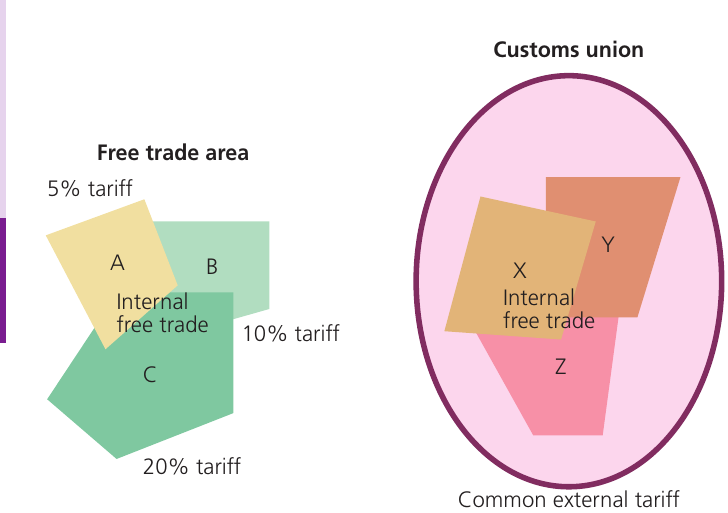
The diagram above illustrates the fundamental difference between these two arrangements. In a free trade area (left), countries A, B, and C enjoy internal free trade but apply different tariffs to external imports (5%, 10%, and 20% respectively). In a customs union (right), countries X, Y, and Z also have internal free trade, but they all apply the same common external tariff to imports from outside the union.
Common markets
A common market builds upon a customs union by adding provisions to encourage deeper economic integration. In addition to free trade in goods and the common external tariff, a common market includes:
- Free mobility of factors of production (labour and capital can move freely between member countries)
- Harmonisation of trading standards and practices across the union
- Common regulations and quality standards
This means workers can move freely to take up employment in any member country, and businesses can invest and operate across borders without facing different regulatory requirements in each nation.
Economic unions
An economic union represents an even higher level of integration. It takes the common market concept further by introducing:
- Harmonisation of economic, legal and social policies across member states
- Development of union-wide policies that affect all members
- Often, a monetary union where members adopt a common currency and coordinate monetary policy through a central bank
The economic union aims to create a single economic space where policies are coordinated to achieve common goals, rather than each country pursuing independent economic strategies.
Political unions
A political union is the ultimate form of economic integration. It involves the partial or complete submission of separate national institutions to a central authority. Even within this category, there are varying degrees of integration.
For example, in the United States, individual states have substantial powers over taxation, whereas in the United Kingdom, local government has relatively few such powers (though Scotland has some ability to vary income tax rates from those in other parts of the UK). The key characteristic is that member states give up some national sovereignty to shared political institutions.
Note
Exam tip: When analysing trade agreements, always identify which type of integration is involved. This will help you evaluate the likely economic effects and the constraints on national policy-making.
The European Union as a case study
Origins and development
The organisation that became the European Union in 1993 was originally called the European Economic Community (EEC). It was formed almost 60 years ago for both economic and political reasons.
Example
Founding Motivations of the EEC
Political motivations: West Germany (as it was then called) was one of the six founding members. The German government hoped that EEC membership would protect Germans from the threat of invasion by the Soviet Union. By contrast, France hoped that a stable and economically successful Germany would reduce the risk of another major European war.
Economic motivations: France wanted to develop trade in manufactured goods, which would primarily benefit German industry, but only if French farmers could be protected from more efficient New World producers through a common external tariff. Germany readily agreed to the creation of a protectionist Common Agricultural Policy (CAP) as the quid pro quo (the exchange or favour in return) for free trade in manufactured goods within the EEC.
The EU as an economic union
When the United Kingdom joined the EEC in the early 1970s, it was leaving a free trade area and joining a customs union that already had several common economic policies. The word 'economic' in the European Union's original name clearly indicates that the founders intended to develop the organisation well beyond a simple trading bloc.
Since its creation, the EU has introduced numerous common economic policies, including:
- Common Agricultural Policy (CAP): By far the most important and expensive, established in 1962
- Common Fisheries Policy: Regulating fishing rights and quotas
- EU Competition Policy: Preventing anti-competitive practices and monopoly abuse
- EU Regional Policy: Providing funding to less developed regions
There was also an early attempt to introduce a common tax policy, focusing on Value Added Tax (VAT) as the EEC's main revenue source. However, member countries continue to set their own national VAT rates, and tax harmonisation has not progressed much further.
Note
The Eurozone
The creation of the eurozone in the late 1990s represented a significant step towards deeper economic integration. The eurozone (also called the euro area) is the group of EU countries that have replaced their national currencies with the euro. As of 2022, 19 of the 27 EU members had adopted the euro.
The Stability and Growth Pact was established to constrain government spending and borrowing in eurozone countries, attempting to impose common fiscal policy rules. In recent years, the European Commission and the European Central Bank (ECB) have imposed strict conditions on eurozone countries, particularly Greece, when providing financial assistance to deal with large national debts incurred during the eurozone crisis.
Important
Case study note: The move towards closer economic integration and the freedom of movement for workers across the EU were among the main reasons cited by those who voted for the UK to leave the EU in 2016 (Brexit).
The World Trade Organization
Historical background
To understand how the World Trade Organization (WTO) came into existence and its role today, we need to look back to events in the 1930s and 1940s.
During the 1940s and the Second World War, it was widely believed (especially in the UK and USA) that the worldwide Depression and mass unemployment of the 1930s had been worsened, and possibly even caused, by a collapse of international trade. Countries had desperately tried to save local jobs by introducing protectionist policies, but these measures were blamed for making the situation worse.
From GATT to the WTO
By 1945, the USA and UK had decided to try to create a post-war world of free trade. The General Agreement on Tariffs and Trade (GATT) was established as a multilateral agreement to liberalise world trade.
Note
Initially, GATT was supposed to be a temporary organisation, to be replaced with a 'world trade organization' as soon as member countries could agree on its structure. However, members were unable to reach agreement, so the 'temporary' organisation lasted much longer than intended. Indeed, GATT still exists today, though its functions have largely been taken over by the WTO.
Trade negotiation rounds
Throughout their history, GATT and later the WTO have organised rounds of talks among member countries to reduce import controls. These rounds, which occur at roughly five-year intervals, are often named after the city or country where the talks begin. Examples include:
- The Tokyo Round
- The Uruguay Round
- The Kennedy Round (named after the then-recently assassinated American president in the mid-1960s)
- The Doha Round (more recently)
Each round of talks aims to end with an agreement to reduce import controls. GATT and the WTO then work to ensure that member countries implement the tariff cuts they have agreed to.
Successes and challenges
GATT and WTO agreements have been successful in reducing import controls on manufactured goods. Tariffs on manufactured products have fallen significantly over the decades, contributing to the growth of global trade.
However, there has been much less success in securing agreements to reduce tariffs and quotas on trade in services and agricultural goods. These sectors remain heavily protected in many countries.
Recently, the WTO has tried to persuade developed economies like the EU and USA to open their markets to cheap food imports from the developing world. However, the most recent rounds of talks organised by the WTO at Cancún (in Mexico) and Doha (in Qatar) were not successful.
Important
Important perspective: Economists and politicians in many developing economies argue that this lack of success provides further evidence of globalisation and international organisations serving the interests of rich countries at the expense of the poor. They claim that whilst developed nations push for free trade in areas where they are competitive (manufactured goods and services), they protect their own inefficient agricultural sectors from competition.
Note
Exam tip: When discussing the WTO, consider both its successes (reducing tariffs on manufactured goods) and its limitations (failure to liberalise agricultural trade). This balanced approach will demonstrate critical thinking in your answers.
Remember!
Summary
Key Points to Remember:
-
International economic integration exists on a spectrum from simple preference areas through to full political unions, with each level involving progressively deeper cooperation and loss of national sovereignty.
-
Free trade areas allow tariff-free trade between members but let each country set its own external tariffs, whilst customs unions add a common external tariff that all members must apply.
-
The European Union evolved from the European Economic Community and now represents an economic union (with the eurozone countries having gone further by adopting a common currency).
-
The World Trade Organization and its predecessor GATT have successfully reduced tariffs on manufactured goods through multilateral trade rounds but have struggled to liberalise trade in agricultural products and services.
-
Rules of origin are necessary in free trade areas to prevent traders from exploiting differences in external tariffs by importing through the member with the lowest rates, though customs unions eliminate this problem entirely.