Objectives of Firms (AQA A-Level Economics): Revision Notes
📚Revision Notes
Objectives of Firms
Introduction
When studying how firms operate in different market structures, it's essential to understand what goals or objectives businesses aim to achieve. Traditional economic theory assumes that all firms have one main objective: to maximise profit. However, in reality, firms may pursue various objectives depending on their ownership structure, market position, and the interests of different stakeholder groups.
Note
While profit maximisation is the traditional assumption in economic theory, modern businesses face complex pressures from multiple stakeholder groups, each with their own interests and priorities. This creates a more nuanced picture of firm behaviour than simple profit maximisation suggests.
Profit maximisation
Profit maximisation is the primary objective assumed in traditional economic theory. It means that business owners and entrepreneurs seek to produce at the output level where profit is greatest.
Understanding profit
For any firm, profit can be calculated using a simple formula:
Important
Total profit = Total revenue - Total cost
Where:
- Total revenue (TR) is the money received from selling goods or services
- Total cost (TC) includes all costs of production
- Profit is what remains after subtracting costs from revenue
The profit-maximising rule (MR = MC)
Rather than calculating total profit at every output level, economists use a more practical approach. Firms maximise profit when:
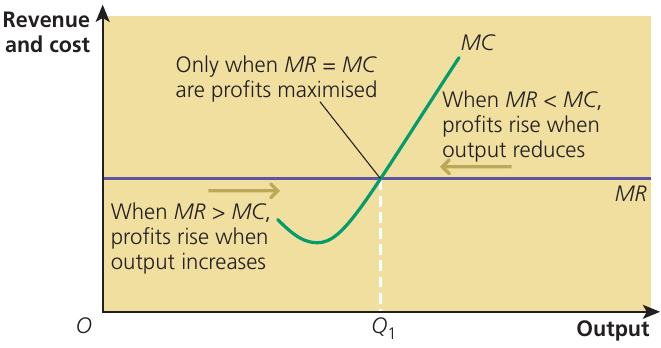
Marginal revenue = Marginal cost (or MR = MC)
This rule states that a firm's profits are greatest when the additional revenue from selling one more unit (marginal revenue) exactly equals the additional cost of producing that unit (marginal cost).
How the rule works
Understanding when to increase or decrease output is crucial:
- When MR > MC: Profits increase if the firm produces more output. The revenue gained from the next unit exceeds its production cost.
- When MR < MC: Profits increase if the firm reduces output. The cost of producing the next unit exceeds the revenue it generates.
- When MR = MC: Profits are maximised. The firm has no incentive to change its output level.
Example
Worked Example: Market Gardener's Profit Maximisation
Consider a market gardener growing tomatoes for a local market. The market price is 50p per kilo, which also equals the marginal revenue (the price received for each additional kilo sold).
Scenario: The gardener is selling 300 kilos and finds that producing the 300th kilo costs 48p.
Analysis:
- At this output level, MR (50p) > MC (48p)
- This means profit increases with more production
What happens with additional production:
- The 301st kilo costs 50p to produce → MR = MC at 50p, so profits remain unchanged
- The 302nd kilo costs 52p to produce → MR (50p) < MC (52p), so profits fall by 2p
Conclusion: The 301st kilo represents the profit-maximising output where MR = MC.
Universal application
The MR = MC condition applies to firms in all market structures, including:
- Perfect competition
- Monopoly
- Monopolistic competition
- Oligopoly
This makes it a universal principle for profit maximisation, regardless of how competitive or concentrated the market is.
Important
Common Misconception
Students often think that profit maximisation only applies to perfectly competitive markets. Remember that MR = MC is the profit-maximising condition for firms in any market structure, not just perfect competition.
The divorce of ownership from control
In small businesses, the entrepreneur typically owns and controls the firm, making all key business decisions. However, in larger companies, a separation exists between those who own the business and those who run it day-to-day.
What is divorce of ownership from control?
Important
Divorce of ownership from control occurs when the owners and those who control the firm (managers) are different groups with different objectives.
In large businesses:
- Owners (shareholders) own thousands or millions of shares but may have limited say in daily operations
- Managers (directors and executives) make strategic decisions and control operations but are employed by the company
- Most shares are held by institutional investors like pension funds and insurance companies
The principal-agent problem
The separation of ownership and control creates what economists call the principal-agent problem (or agency problem):
- Principals are the shareholders who own the business
- Agents are the managers employed to run the business
- The problem arises because agents may pursue their own interests rather than the principals' interests
Why the problem occurs
Several factors explain why managers may not act in shareholders' best interests:
Different objectives:
- Shareholders want profit maximisation
- Managers may want to maximise their own salaries, power, status, or job security
Note
This misalignment of objectives is at the heart of the principal-agent problem. While shareholders focus on returns on their investment, managers may prioritise personal benefits that don't necessarily increase shareholder value.
Information asymmetry: Managers have superior knowledge about the business compared to shareholders. It's difficult for owners to know whether poor performance results from managerial incompetence or external economic factors beyond management control.
Incentive misalignment: The agent (manager) bears the cost of effort but doesn't receive the full benefit of their actions. This reduces their incentive to work as hard as if they owned the business themselves.
Moral hazard: This occurs when managers take excessive risks because they enjoy the benefits of success (bonuses) but don't bear the full costs of failure (shareholders lose money).
Consequences for firms
The divorce of ownership from control can affect:
- Objectives: Firms may pursue managerial goals rather than profit maximisation
- Conduct: Decision-making may prioritise management interests
- Performance: Firms may be less efficient than if owners directly controlled operations
Realigning incentives
Various methods help align managers' interests with shareholders' interests:
- Profit-related pay: Link management compensation to company profits
- Executive stock options: Give managers shares so they benefit from company success like owners
- Threat of dismissal: Directors can be voted out by shareholders for poor performance (though this rarely happens in practice)
- Large financial pay-offs: Ironically, unsuccessful managers often receive substantial payments when leaving, weakening the threat of dismissal
Note
While these mechanisms can help reduce the principal-agent problem, they are not always fully effective. The challenge of perfectly aligning the interests of managers and shareholders remains one of the central issues in corporate governance.
Possible business objectives other than profit maximisation
Given the principal-agent problem and other factors, firms may pursue objectives beyond profit maximisation.
Growth maximisation and survival
Growth maximisation means pursuing expansion as a primary goal. While continued growth often helps achieve economies of scale and cost reductions, making it consistent with profit maximisation, it can also serve other purposes:
- Managerial prestige: Running a larger organisation enhances status and power
- Competitive advantage: Growth can eliminate smaller competitors, building monopoly power
- Political influence: Larger firms (like newspaper and television companies) can exert greater political influence
Note
Survival as an objective
Survival becomes the primary objective for struggling businesses, particularly during economic recessions. Loss-making firms or those with declining profits hope to survive difficult periods, expecting to grow and increase profits once economic conditions improve.
Sales revenue maximisation
Some firms aim to maximise sales revenue rather than profit, particularly when managerial pay links to revenue rather than profit.
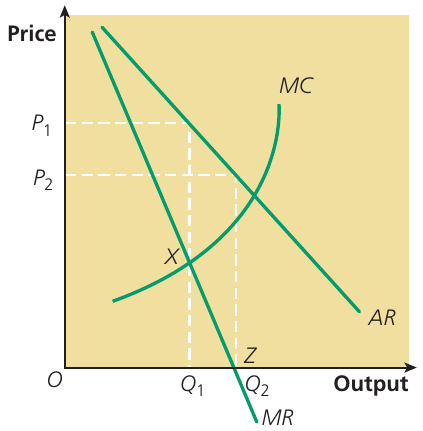
Sales revenue maximisation occurs at the output level where marginal revenue equals zero (MR = 0). This differs from profit maximisation, which occurs where marginal revenue equals marginal cost (MR = MC).
Important
Key distinction between profit and revenue maximisation:
- Profit maximisation: Occurs at output where MR = MC (point X on the diagram)
- Revenue maximisation: Occurs at output where MR = 0 (point Z on the diagram)
Since the average revenue (AR) curve slopes downward, the revenue-maximising output level always exceeds the profit-maximising level . The firm produces more and charges a lower price when maximising revenue compared to maximising profit.
Good customer service and quality
Firms may prioritise providing excellent customer service and high-quality products. These objectives serve socially minded owners and managers but also function as means toward achieving profit maximisation in the long run. Satisfied customers return and recommend the business to others.
The satisficing principle
Behavioural economists challenge the traditional view that firms simply maximise profits or other single objectives. They argue that firms are complex organisations with multiple stakeholder groups, each having different interests.
What is satisficing?
Important
Satisficing means achieving a satisfactory outcome rather than the best possible outcome.
Stakeholder theory
Different groups within and connected to a business have different objectives:
- Shareholders: Want higher profits
- Managers: Seek prestige, power, and high salaries
- Workers: Desire improved wages, job security, and better working conditions
- Customers: Want high quality and good service
- Suppliers: Prefer stable, long-term relationships
These conflicting interests create tensions within the organisation.
Why firms satisfice
Management may replace the profit-maximising objective with satisficing to resolve conflicts between stakeholder groups. Rather than maximising any single objective (which benefits one group at the expense of others), firms aim for satisfactory outcomes across multiple objectives.
Note
Satisficing in different market structures
In protected markets (monopolies and imperfectly competitive markets with high entry barriers):
- Firms can survive with satisfactory rather than maximum profits
- They may accept some inefficiency and unnecessary costs
- Entry barriers prevent more efficient competitors from forcing them to change
In competitive markets:
- Firms initially content with satisfactory profits face pressure from new entrants
- To survive, they must eliminate unnecessary costs
- Competition forces even satisficing firms to behave more like profit maximisers
Practical application
Attempting to satisfy multiple stakeholder groups simultaneously means accepting compromise. This may lead to:
- Minimum targets rather than maximum achievement
- A degree of inefficiency that profit-maximising firms would eliminate
- Greater stability and reduced conflict within the organisation
Remember!
Summary
Key Points to Remember:
-
Profit maximisation occurs at the output level where marginal revenue equals marginal cost (MR = MC), and this applies to firms in all market structures.
-
In large firms, there is a divorce of ownership from control, where shareholders own the business but managers control it, potentially leading to different objectives being pursued.
-
The principal-agent problem arises when managers (agents) pursue their own interests rather than maximising profits for shareholders (principals).
-
Firms may pursue alternative objectives such as growth maximisation, survival, or sales revenue maximisation instead of profit maximisation.
-
Satisficing means firms aim for satisfactory outcomes across multiple stakeholder objectives rather than maximising a single objective, particularly in markets with high entry barriers.