Price Discrimination (AQA A-Level Economics): Revision Notes
📚Revision Notes
Price Discrimination
The meaning of price discrimination
Price discrimination is a pricing strategy where firms charge different prices to different customers for the same product or service. The key feature is that these price differences are based on customers' ability and willingness to pay, rather than on differences in the cost of providing the product.
Customers who are prepared to pay more are charged a higher price than those who are only willing to pay a lower price. This allows firms to capture more consumer surplus and increase their total profits.
How price discrimination works
In the most common form of price discrimination, the different prices charged are not based on any differences in production or supply costs. For instance, a cinema might charge students less than adults for the same film showing, even though the cost of providing the seat is identical.
Note
While price discrimination typically involves charging different prices without cost differences, there are cases where varying costs may be involved. It's important to distinguish between price differences that reflect genuine cost variations and those that are purely based on customers' willingness to pay.
However, in some cases, different costs may be involved. For example, with bulk buying, consumers purchasing larger quantities are often charged lower prices per unit than consumers purchasing smaller quantities. This can occur because bulk purchases may have lower average costs of production than smaller purchases.
Price discrimination in practice: rail services
Example
Worked Example: Rail Service Price Discrimination
A rail operating company provides a useful example of price discrimination. The firm divides its market into two distinct groups:
- Peak time customers (busy periods) - typically commuters who need to travel at specific times
- Off-peak customers (less busy periods) - typically leisure travellers with more flexibility
Each group has a different elasticity of demand for travel. Peak customers tend to be less price-sensitive because they must travel at specific times for work. Off-peak customers are more price-sensitive because they have flexibility in when they travel.
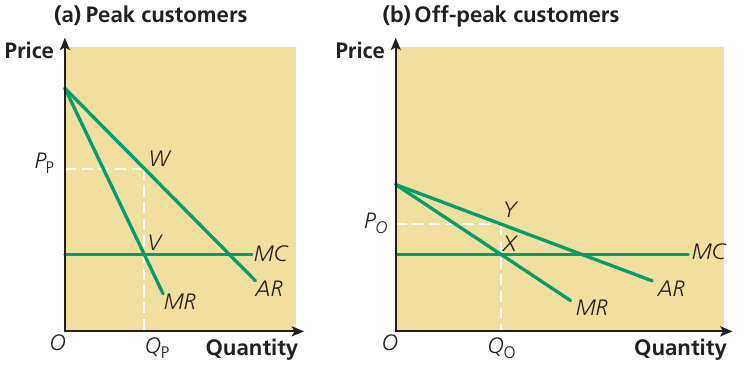
The diagram above illustrates how the firm maximises profit through price discrimination. Both peak and off-peak customers have downward-sloping demand curves, which also serve as average revenue (AR) curves. In each case, the marginal revenue (MR) curve is twice as steep as the AR curve.
To maximise profit, the firm sets output where marginal revenue equals marginal cost () in both sub-markets. The diagrams show that the marginal cost of providing rail services is the same for both groups (represented by the horizontal line).
Because peak customers have less elastic demand, they pay a higher ticket price () compared to off-peak customers who pay the lower price (). The quantity demanded by peak customers is , whilst off-peak customers use the rail service at quantity .
The crucial point is that the different prices charged result from the different price elasticities of demand. Profit is maximised when the more price-sensitive off-peak customers pay less to travel than the less price-sensitive peak customers.
Important
Critical Profit-Maximising Condition
When profit maximising, the marginal revenue received from the last peak customer and the last off-peak customer admitted must be the same. If this were not the case, the rail operator could increase profit by changing the numbers of peak and off-peak tickets available.
The conditions necessary for price discrimination
For price discrimination to be successful, three key conditions must be met:
Condition 1: Identifying different customer groups
It must be possible to identify different groups of customers or sub-markets for the product. This is possible when customers differ in their knowledge of the market or in their ability to shop around.
Several factors can create distinct customer groups:
- Some customers may have special needs for a product
- Competition among suppliers may vary in different parts of the market
- In some geographical areas, a firm may face many competitors
- In other geographical areas, the firm may be the sole supplier
- Different parts of the market may have different competitive conditions
Condition 2: Different price elasticities of demand
At any particular price, different groups of customers must have different price elasticities of demand. In these circumstances, total profits are maximised by charging a higher price in markets where demand is less elastic.
Note
This condition is essential because it allows the firm to extract more revenue from customers who are less sensitive to price changes, whilst still serving customers who are more price-sensitive at a lower price point.
Condition 3: Preventing market seepage
The markets must be separated to prevent seepage. Seepage occurs when customers buying at the lower price in one sub-market resell the product in another sub-market at a price which undercuts the firm's own selling price in that market.
Example
Real-World Example: European Car Market Seepage
In the European car market, car manufacturers have often charged higher prices for vehicles in the UK market than in mainland Europe. One reason for this has been that UK motorists drive right-hand drive cars, in contrast to cars in mainland Europe which are left-hand drive.
However, seepage occurred when specialist car importers bought cars on the Continent to resell in the UK market. This undercut the prices that car manufacturers recommended for the UK market. The geographical separation was not sufficient to prevent customers from accessing the lower-priced market.
Remember!
Summary
Key Points to Remember:
- Price discrimination means charging different prices to different customers for the same product, based on their willingness to pay rather than cost differences.
- Firms use price discrimination to capture more consumer surplus and increase profits by charging higher prices to less price-sensitive customers.
- Three essential conditions must be met: ability to identify different customer groups, different price elasticities of demand between groups, and separated markets to prevent seepage.
- The profit-maximising rule is to set MR = MC in each sub-market, which results in higher prices for customers with less elastic demand.
- Real-world examples include peak/off-peak rail fares, student discounts, and geographical pricing differences in markets like the European car industry.