Trade Union Influence on Wages and Employment (AQA A-Level Economics): Revision Notes
📚Revision Notes
Trade Union Influence on Wages and Employment
What are trade unions?
A trade union is an organisation where workers join together to protect and improve their working conditions, including their pay. Trade unions exist to represent the interests of their members and to give workers a stronger voice when dealing with employers.
The main purpose of a trade union is to negotiate with employers on behalf of its members. This process is called collective bargaining, which means that wage rates and other employment conditions are discussed and agreed through negotiations between unions and employers. Rather than individual workers negotiating alone, the union bargains collectively for all its members.
Note
When analysing trade unions in economic theory, we can think of them as monopoly suppliers of labour. This means they aim to control the supply of workers in a labour market by keeping non-members out and preventing members from accepting wages below the rate set by the union. In reality, unions may not always achieve these objectives perfectly, but this model helps us understand their economic impact.
Trade union power in the UK
In the UK today, many employers are reluctant to recognise and negotiate with trade unions. Several factors have shifted the balance of power away from unions and towards employers.
One major factor has been a series of Employment Acts that have restricted the legal rights of trade unions. These laws have made it harder for unions to take industrial action and reduced their bargaining power.
International competition has also weakened union influence in British labour markets. When companies face competition from abroad, they have less room to agree to wage increases demanded by unions. This is particularly true in manufacturing industries where cheaper imports are available.
Note
British trade unions now tend to be most powerful in industries that are protected from international competition. Examples include London Transport, the rail industry, and other areas of public sector employment. In these protected sectors, unions can still exert significant influence over wages and employment conditions.
Another trend affecting union power is the decline of collective bargaining itself. More wage rates, including those for teachers, are now set by employers on a 'take-it-or-leave-it' basis, without meaningful negotiation with unions.
Effects of introducing a trade union into a perfectly competitive labour market
When workers form a trade union in a market that was previously perfectly competitive, the market structure changes significantly. The market becomes imperfectly competitive because the union creates barriers and restricts the free operation of market forces.
Let's examine what happens using economic analysis. Before unionisation, the competitive wage rate is and employment is at . Once workers establish a union, collective bargaining leads to a higher minimum acceptable wage of . The union prevents its members from working for less than this rate.
This creates a kinked supply curve for labour. For all employment levels to the left of , the supply curve becomes a horizontal line at wage . This is because at this higher wage rate, the supply curve is perfectly elastic (horizontal) - employers can hire workers at but cannot hire anyone at a lower wage. Beyond , the supply curve slopes upward normally because higher wages are needed to attract additional workers.
At the union wage rate , employers only want to hire workers. However, workers are willing to work at this wage rate. This creates excess supply of labour, which means unemployment in the labour market. The resulting unemployment is shown by the distance .
Important
The fall in employment compared to the competitive equilibrium is . This type of unemployment is called classical unemployment or real-wage unemployment. It occurs because the wage has been pushed above the market-clearing level.
Key insight: In perfectly competitive labour markets, unions raise wages but inevitably reduce employment, creating a trade-off between higher pay for those employed and job losses.
Note
Exam tip: This same diagram can be used to analyse the effects of a national minimum wage set above the market equilibrium in a perfectly competitive labour market.
Alternative union strategies for raising wages
Rather than simply negotiating a higher minimum wage, trade unions can use other strategies to improve pay for their members. One approach is to establish a closed shop, which is a workplace where only union members can be employed. This keeps non-union workers out of the labour market entirely.
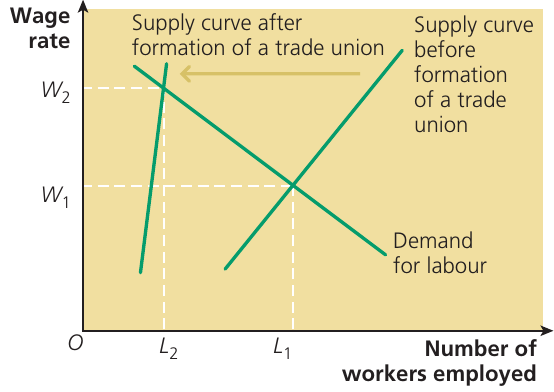
A closed shop has the effect of shifting the entire supply curve of labour to the left, making it more inelastic (steeper). This is shown in the diagram below, where the supply curve moves leftward and becomes less responsive to wage changes.
A similar effect can be achieved by unions and professional associations that insist on long training periods before workers are formally qualified. During training, workers typically receive very low wages. Employment falls from to , and the wage rate rises to .
Note
The key advantage to the union and its employed members is that there is no pool of unemployed workers willing to work for lower wages. There is no excess supply of labour in this scenario, unlike the simple wage-setting approach shown earlier.
Effects of introducing a trade union into a monopsony labour market
The analysis changes significantly when we consider monopsonistic labour markets rather than perfectly competitive ones. It's important to remember that no real-world labour market truly satisfies all the conditions of perfect competition.
In a monopsony (where there is only one buyer of labour), introducing a trade union can potentially raise both the wage rate and the level of employment. This is a striking contrast to the perfectly competitive case, where unions raise wages at the expense of jobs.
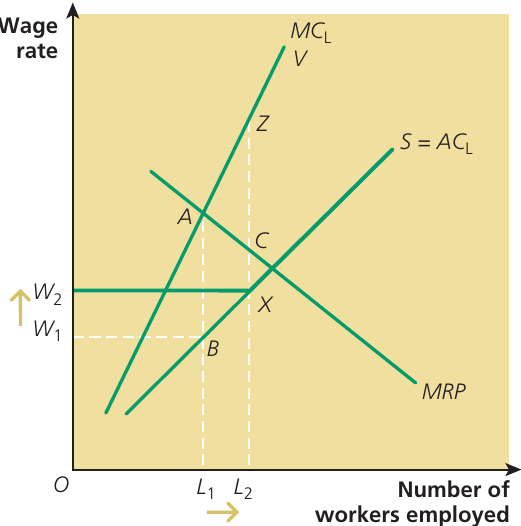
The diagram shows how this works. Without a trade union, the monopsony employer would set the wage rate at and employ workers. This is determined at point A, where point B establishes the wage rate below the competitive level.
When the union sets the wage rate at , the kinked line becomes the new labour supply curve (and also represents the Average Cost of Labour, or ACL). However, is not the Marginal Cost of Labour (MCL) curve. The MCL curve is the double-kinked line .
Important
Understanding the MCL Discontinuity:
Here's why this double kink occurs: Provided the monopsony employs a labour force smaller than or equal to , the MCL of hiring an extra worker equals both the ACL and the union-determined wage of . But beyond and point X, the monopsony must offer a higher wage to persuade members of an enlarged labour force to supply their labour.
With all workers being paid the higher wage rate, the marginal cost of labour increases significantly. There is a discontinuity (a gap) from point X to point Z in the MCL curve. To the right of , the MCL curve lies above the ACL curve. The upward-sloping line ZV shows the MCL of increasing employment above the level .
This discontinuity creates an opportunity for the union. Without a union, employment would be (at point A, with wages determined at point B). When the union sets wages at , employment rises to . This is the level where the MRP curve intersects the gap or discontinuity in the MCL curve at point C (between X and Z). The union has managed to increase both the wage rate and the level of employment.
Evaluating arguments about trade unions and employment
Free-market economists often argue that union attempts to raise wages must inevitably cost jobs. They claim that unions harm workers by creating unemployment. However, many economists, particularly those with Keynesian or left-leaning perspectives, dispute this conclusion.
Note
The Productivity Argument:
First, these economists argue that it's unrealistic to assume conditions of demand for labour remain unchanged when unions negotiate higher wages. By agreeing to accept technical progress, working with new capital equipment, and adopting new methods of organising work, unions can help improve the skills and productivity of their members. With management cooperation, this can shift the MRP curve of labour to the right.
In these circumstances, increased productivity creates room for both higher wages and increased employment. Higher wages may even encourage firms to adopt productivity improvements to pay for the increased labour costs. However, some unions resist changes in working practices that would boost productivity.
Second, both wages and employment can rise when a union negotiates higher wages in firms operating in an expanding goods market. In such conditions, increased demand for output creates increased demand for labour to produce the output. Rising real wages throughout the economy are likely to increase the aggregate demand for the output of all firms producing consumer goods, since wages are the most important source of consumption expenditure in the economy.
Real-world application: UK rail strikes in 2022
The year 2022 witnessed the largest instance of industrial action in the UK for many years, with trade unions across various industries voting for strike action. Universities, the legal profession, airlines, and rail transport all saw union activity.
Trade union action in the rail industry began in June 2022 when members of the National Union of Rail, Maritime and Transport Workers (RMT) went on strike over a dispute about pay and potential changes to working methods that would lead to some workers being made redundant. The RMT stated that Network Rail, a major employer of rail workers, was threatening to cut important safety-related jobs and reduce workers' working hours as part of a modernisation programme.
The initial strike followed the breakdown of negotiations between the RMT and 13 rail companies. Forty thousand rail workers went on strike, as well as staff working on the London Underground, leading to significant disruption of the rail network. People in the UK were urged to make only essential journeys on strike days, and many workers chose to work from home.
Note
Cost-of-Living Crisis Context:
The dispute occurred against the backdrop of the 'cost-of-living crisis' in the UK. RMT union members voted to strike after their request for a 7% pay rise was rejected and a 3% offer made to union members in response. This was at a time when inflation was significantly eroding workers' real wages. Three days of strike action were agreed, including days when 90,000 students were due to sit an A-Level Maths exam, with further strikes scheduled later in the summer.
Network Rail refused at the time to make any further improvements to its pay offer and also threatened to make redundancies if the RMT did not halt its intentions to strike.
Critics of the rail strikes, including Network Rail, argued that the rail system needed to operate much more efficiently. They pointed to significant changes in commuter habits following the Covid-19 pandemic, such as reduced use of ticket offices and increased working from home. Network Rail referred to jobs that could be completed by one person being carried out by teams of up to nine people, and excessive walking times to staff canteens before and after breaks.
Remember!
Summary
Key Points to Remember:
-
Trade unions are worker organisations that use collective bargaining to negotiate with employers for better wages and working conditions on behalf of their members.
-
In perfectly competitive labour markets, trade unions raise wages but reduce employment, creating classical unemployment (the gap between workers willing to work at the union wage and jobs available).
-
In monopsony labour markets, trade unions can potentially increase both wages and employment by countering the employer's market power, as shown by the discontinuity in the Marginal Cost of Labour curve.
-
Union power in the UK has declined due to Employment Acts and international competition, but unions remain strong in protected sectors like rail transport and the public sector.
-
Alternative union strategies include closed shops and professional training requirements that shift the labour supply curve left, raising wages without creating a pool of unemployed workers.