Centre of Mass for Point Masses and Laminas (AQA A-Level Further Maths): Revision Notes
📚Revision Notes
Centre of Mass for Point Masses and Laminas
What is the centre of mass?
When you have a system of multiple point masses, you can treat them as a single combined mass acting at a special point called the centre of mass. This point represents the location where the total weight of the system effectively acts.
Note
The centre of mass is essentially the weighted average position of all the masses in the system, where each position is weighted by the mass at that location. This means that heavier masses have more influence on the location of the centre of mass than lighter ones.

Centre of mass for point masses in one dimension
Definition and concept
Suppose you have masses placed along the x-axis at distances from the origin .
The total mass of the system is:
This system behaves as if its total weight acts at a single point called the centre of mass, which is at a distance from the origin.
Finding the centre of mass using moments
To find the position of the centre of mass, you take moments about the origin .
The moment of the total weight must equal the sum of the moments of the individual weights:
The factor cancels from both sides, giving:
Therefore, the centre of mass is located at:
So the centre of mass is at the point on the x-axis.
Important
The Weighted Mean Interpretation
You can think of as the weighted mean of the various x-values, where the weight of each x-value is the mass at that point. This is why heavier masses pull the centre of mass more strongly toward their position.
Centre of mass for point masses in two dimensions
Extension to 2D
The method extends naturally to two dimensions. If mass is at point , mass is at , mass is at , and so on, then the total mass is at the point .
Calculating the coordinates
The key insight is that you calculate each coordinate separately by taking moments about the appropriate axis.
For the x-coordinate: Take moments about the y-axis (perpendicular to the x-axis).
which can be written as:
For the y-coordinate: Take moments about the x-axis (perpendicular to the y-axis).
which can be written as:
Note
Understanding the Process
Notice that the formulas for and have identical structure - you're applying the same weighted average principle to each dimension independently. This makes the calculation systematic and reduces the chance of errors.
Key formulas
The centre of mass of a system of particles is at the point where:
Remember: The total mass is
Worked example 1: Four point masses
Example
Worked Example: Finding the Centre of Mass of Four Point Masses
Problem: Four masses of 3 kg, 2 kg, 4 kg and 1 kg lie at the points (2, 3), (5, 1), (8, 4) and (9, 6), respectively. Calculate the position of their centre of mass.
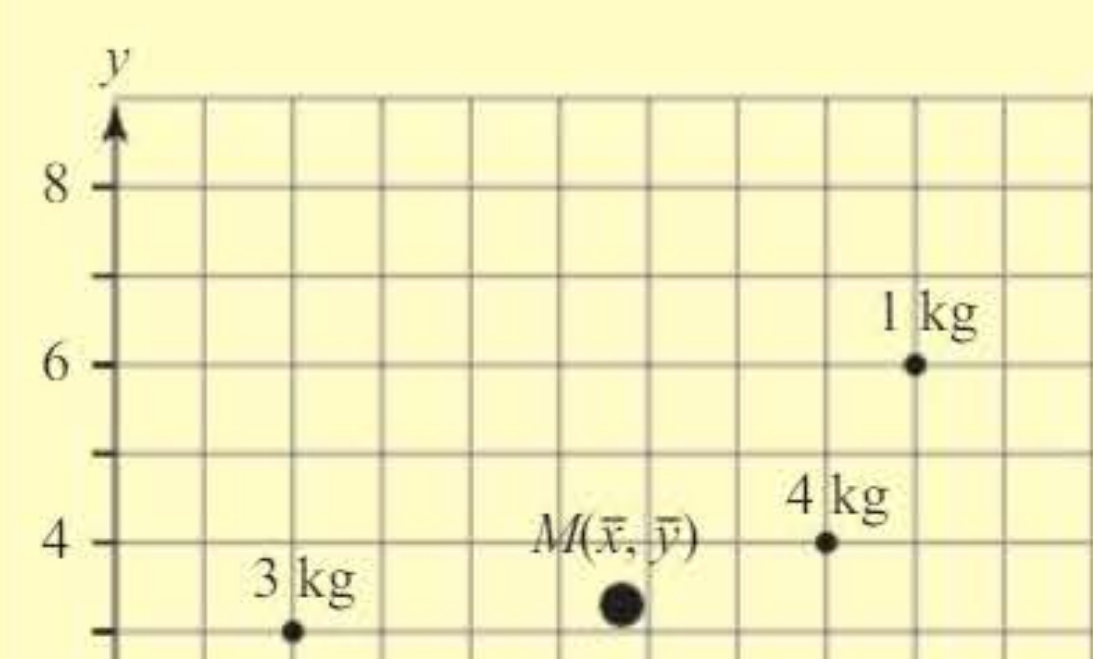
Solution:
Step 1: Calculate the total mass.
Step 2: Calculate the total moment about the y-axis (to find ).
Therefore:
Step 3: Calculate the total moment about the x-axis (to find ).
Therefore:
Answer: The centre of mass is at the point (5.7, 3.3).
Problem-solving strategy
When solving problems involving centre of mass, a systematic approach will help you avoid errors and work efficiently.
Note
Systematic Problem-Solving Steps
1. Draw a diagram showing all the information clearly, including masses and their positions.
2. Take moments to calculate unknown values. Always make sure you take distances from the correct axes when finding moments.
3. Consider symmetry when working with any simple or composite system of point masses or laminas. Symmetry in both the shape and distribution of masses may simplify your solution significantly.
Worked example 2: Framework problem
Example
Worked Example: Framework with Suspended Masses
Problem: A light, rectangular, rigid framework has side lengths m and m. Points and are the midpoints of and . Masses of 4 kg, 3 kg, 1 kg and 5 kg are fixed to , , and , respectively, and the framework is suspended by a string from .
a) Find the position of the centre of mass, .
b) Find the angle which makes with the vertical.
Solution:
Part a: Finding the centre of mass
Step 1: Calculate the total mass.
Step 2: Set up a coordinate system. Consider as the x-axis and as the y-axis, with the centre of mass, , at .
Step 3: Determine the coordinates of each mass. Create a table to organise the data:
| Mass | A | C | D | E | Whole system |
|---|---|---|---|---|---|
| Mass, kg | 4 | 3 | 1 | 5 | 13 |
| x-coordinate | 3 | 0 | 3 | 1.5 | |
| y-coordinate | 0 | 2 | 1 | 2 |
Step 4: Take moments about the y-axis to find .
Step 5: Take moments about the x-axis to find .
Answer for part a: The centre of mass is at the point G(1.73, 1.31).
Part b: Finding the angle with the vertical
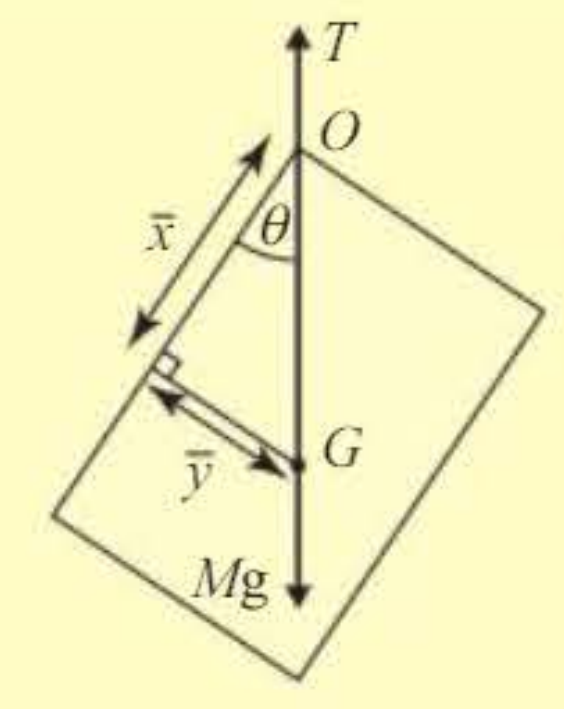
Step 1: Understand the equilibrium condition. When the framework is suspended from point , it will hang in equilibrium. For this to occur, the line must be vertical. This is because the tension in the string acts upwards through , and the weight acts downwards through . If these forces are not in line (both vertical), they create a couple that would rotate the system.
Step 2: Use trigonometry. In the right-angled triangle formed:
Answer for part b: The angle that makes with the vertical is 37.1°.
Important
Understanding Equilibrium in Suspended Bodies
Always check that your understanding of equilibrium is correct. For a suspended body to be in equilibrium, the line joining the suspension point to the centre of mass must be vertical.
If the tension and weight are not aligned vertically, they form a couple that causes rotation until equilibrium is reached with both forces vertical. This is why suspended objects naturally rotate to hang with their centre of mass directly below the point of suspension.
Equilibrium and suspension
When a body is suspended from a point and hangs in equilibrium, there are specific conditions that must be satisfied. Understanding these conditions is crucial for solving suspension problems.
Note
The Equilibrium Condition
For a body suspended from a point to be in equilibrium:
- The tension in the string acts upward through the suspension point
- The weight of the body acts downward through the centre of mass
- These two forces must be in the same vertical line
If the centre of mass is not directly below the suspension point, the tension and weight will not be aligned. This creates a couple (a pair of forces that causes rotation) which will turn the body until the centre of mass is vertically below the suspension point.
Summary
Key Points to Remember:
-
The centre of mass is the point where the total weight of a system effectively acts, located at where and .
-
To find the centre of mass, take moments about the axes: moments about the y-axis give you , and moments about the x-axis give you .
-
The centre of mass coordinates are weighted averages of the positions, where each position is weighted by the mass at that point.
-
When solving problems, always draw a diagram and construct a table to organise your data systematically.
-
For a suspended body in equilibrium, the line from the suspension point through the centre of mass must be vertical. If not, the tension and weight create a couple causing rotation.