Hooke’s Law (AQA A-Level Further Maths): Revision Notes
📚Revision Notes
Hooke's Law
Introduction to elastic strings and springs
In mechanics, we model strings and springs as having special properties. An elastic string or spring is one that returns to its original length after being stretched or compressed. We also assume these objects are light, meaning they have negligible mass.
Note
When an elastic string is stretched beyond its elastic limit, it becomes permanently deformed and Hooke's law no longer applies. Within the elastic limit, the string behaves predictably and returns to its natural length when the stretching force is removed.
Natural length, extension and compression
Every elastic string or spring has a natural length (denoted by ), which is its length when no forces are acting on it.
When a string is stretched, the difference between the stretched length and the natural length is called the extension :
For a stretched spring, this same formula applies. However, springs can also be compressed, in which case the decrease in length is called a compression .
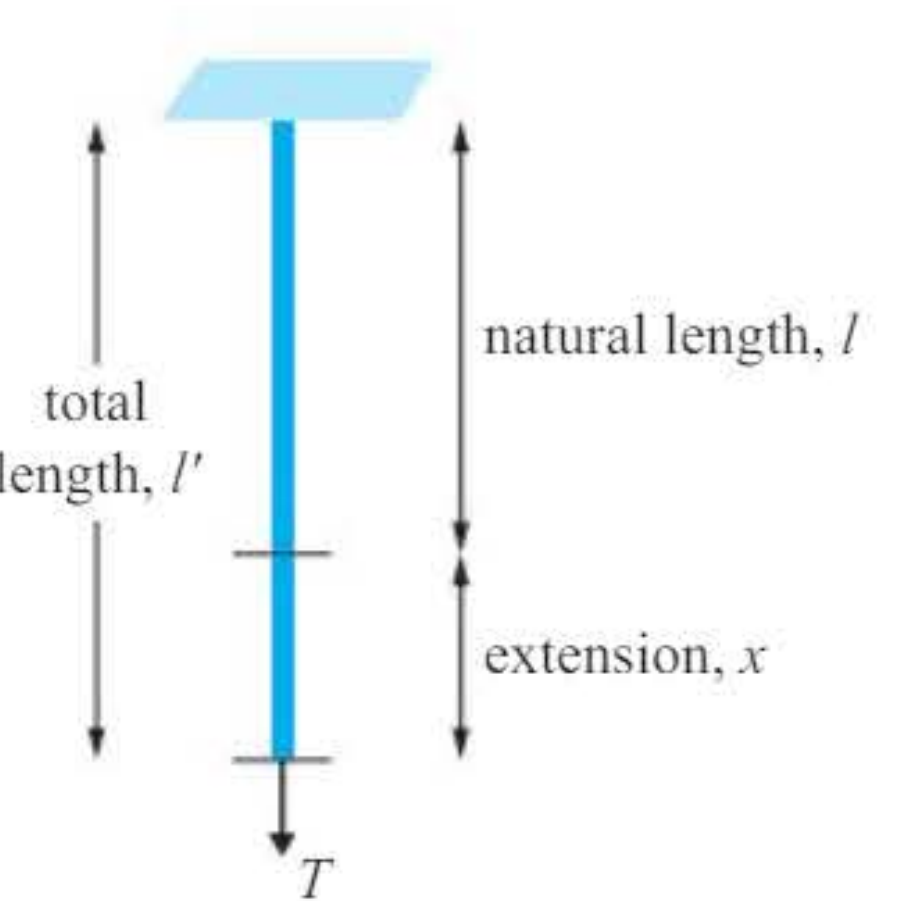
The diagram shows a string fixed at the top and pulled downwards by tension force . The natural length is , the total stretched length is , and the extension is .
Hooke's law
Hooke's law states that the tension in an elastic string or spring is proportional to its extension :
This can be written as:
where is the stiffness of the string or spring. The stiffness depends on:
- The material the string is made from
- The natural length of the string
Stiffness and modulus of elasticity
The stiffness is related to another constant called the modulus of elasticity (lambda):
where is the natural length.
Important
The modulus of elasticity is a property of the material itself. The units of are newtons (N).
Combining these relationships, we can write Hooke's law as:
where
This formula shows that the tension is directly proportional to the extension, with the constant of proportionality being .
Work done in stretching an elastic string
To calculate the work required to extend a string from its natural length by a distance , we need to account for the fact that the tension increases as the string stretches.
Consider a small extension when the tension is . The small amount of work done is:
To find the total work, we integrate over the entire extension from 0 to .
Method 1: Using calculus
The work required is:
Substituting :
Therefore:
Method 2: Using a graph
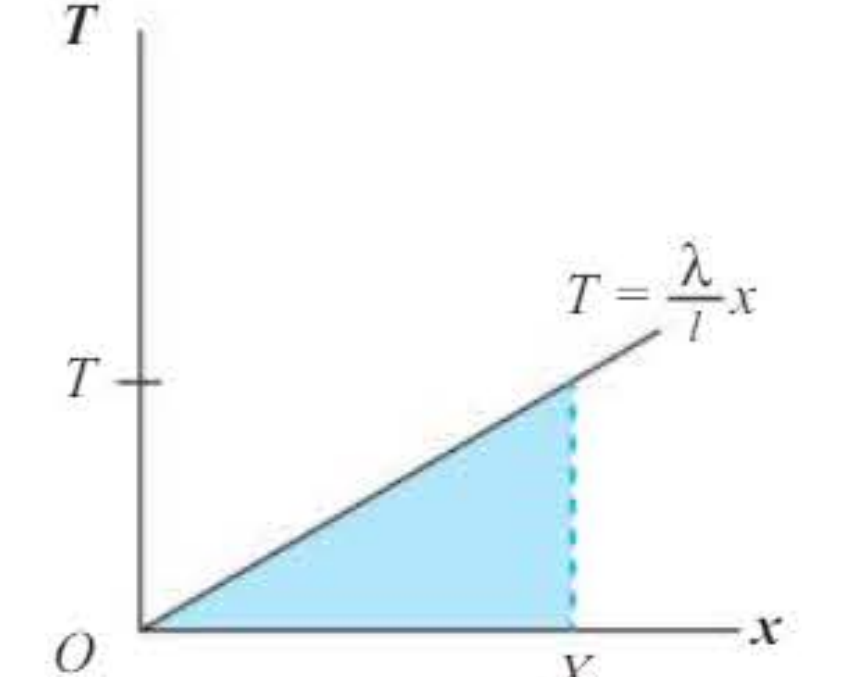
On a graph of tension against extension , the relationship is linear: .
The work done equals the area under this line, which is a triangle:
Note
Both methods give the same result. The graphical method provides a visual understanding, while the calculus method is more general and can be applied to more complex situations.
Elastic potential energy
The work done to stretch a string or spring is stored as elastic potential energy (EPE) in the string or spring.
Important
Key Formula: The elastic potential energy stored in a string or spring with natural length and modulus of elasticity when extended by distance is:
This formula has the same mathematical form as the kinetic energy formula , but with different variables.
Energy required to increase extension
If a string is already extended by and we extend it further to , the additional energy required is:
This can be factorised as:
Problem-solving strategies
When solving problems involving elastic strings and springs, follow this systematic approach:
Important
Problem-Solving Steps:
- Sketch a clear diagram showing all lengths, forces, and positions
- Use Hooke's law to relate tension, extension, and the material properties
- Write an energy equation that balances changes in kinetic energy (KE), gravitational potential energy (GPE), and elastic potential energy (EPE)
Conservation of energy
The principle of conservation of mechanical energy states that the total mechanical energy of a system remains constant when there are no external resistive forces (such as friction).
This means any increase in one form of energy must be balanced by a decrease in another form. In problems involving elastic strings:
or in other arrangements:
Note
When writing energy equations, it is often easier to think about increases and decreases in KE, GPE, and EPE rather than total energy values. This approach helps you track where energy is coming from and where it's going.
Worked example 1: Single string calculations
Example
Worked Example: Single String Calculations
Problem: A string with natural length 5 m and modulus of elasticity 10 N is extended 0.4 m.
a) What is the stiffness of the string?
The stiffness is:
b) Calculate the tension in the string and the EPE stored in it.
Using Hooke's law:
The elastic potential energy stored is:
c) If the string is extended a further 0.3 m, how much extra EPE is stored in it?
The increase in EPE is:
Worked example 2: Multiple strings in equilibrium
Example
Worked Example: Multiple Strings in Equilibrium
Problem: Two strings and are tied to an object which is held on a smooth table between two fixed points and which are 1.0 m apart.
- String has natural length 0.4 m and modulus of elasticity 12 N
- String has natural length 0.3 m and modulus of elasticity 18 N
Find the extensions of the strings and their total EPE.
Solution:
The object is in equilibrium, so the horizontal forces balance. This means the tensions in both strings are equal:
Using Hooke's law for each string:
For :
For :
Since :
Therefore:
The total distance between and is:
Simplifying:
Solving the simultaneous equations by substituting equation 1 into equation 2:
The total EPE is:
Worked example 3: Energy conservation with vertical string
Example
Worked Example: Energy Conservation with Vertical String
Problem: A vertical elastic string of natural length m with N has end fixed to a ceiling and end fixed to a mass of 2 kg. Take m s.
a) The mass is lowered gently until in equilibrium at point . Calculate the extension when at .
b) It is then pulled down a further 20 cm to point and released. Calculate its velocity when passing and the greatest height that it reaches. Describe its subsequent motion.
Solution:
Part a: When in equilibrium at with extension :
The tension in the string equals the weight of the 2 kg mass:
Using Hooke's law:
Part b: Energy equation from to :
At point , the mass is at rest (KE = 0) and the extension is 0.6 m. At point , the extension is 0.4 m and the mass has velocity .
Using energy conservation (taking as the reference level for GPE):
Greatest height: At the greatest height, the velocity is zero, so KE = 0.
Let the extension at the highest point be . Using energy conservation from to the highest point (taking as reference):
Dividing both sides by :
Alternatively, if , then m (this is point itself).
When , the mass is at . When , the mass is at the highest point.
The greatest height is metres below .
Subsequent motion: The midpoint of the oscillation is at point (the equilibrium position), so the mass oscillates between and the highest point, moving up and down through .
Remember!
Summary
Key Points to Remember:
-
Hooke's law: The tension in an elastic string is where is the modulus of elasticity, is the natural length, and is the extension.
-
Elastic potential energy: The energy stored when stretching a string is , which has the same form as the kinetic energy formula.
-
Problem-solving approach: Always sketch a clear diagram, apply Hooke's law to find tensions, and use energy conservation to relate changes in KE, GPE, and EPE.
-
Equilibrium conditions: When multiple strings are attached to an object in equilibrium, the tensions must balance, giving you equations to solve simultaneously.
-
Energy conservation: In the absence of resistive forces, the total mechanical energy remains constant. Any gain in one form of energy must equal the loss in other forms.